Instituto de Medicina Tropical Alexander von Humboldt, Universidad Peruana Cayetano Heredia, Lima, Peru.
PLoS One. 2011;6(10):e26276. doi: 10.1371/journal.pone.0026276. Epub 2011 Oct 27.
In high multidrug resistant (MDR) tuberculosis (TB) prevalence areas, drug susceptibility testing (DST) at diagnosis is recommended for patients with risk factors for MDR. However, this approach might miss a substantial proportion of MDR-TB in the general population. We studied primary MDR in patients considered to be at low risk of MDR-TB in Lima, Peru.
We enrolled new sputum smear-positive TB patients who did not report any MDR-TB risk factor: known exposure to a TB patient whose treatment failed or who died or who was known to have MDR-TB; immunosuppressive co-morbidities, ex prison inmates; prison and health care workers; and alcohol or drug abuse. A structured questionnaire was applied to all enrolled participants to confirm the absence of these factors and thus minimize underreporting. Sputum from all participants was cultured on Löwenstein-Jensen media and DST for first line drugs was performed using the 7H10 agar method.
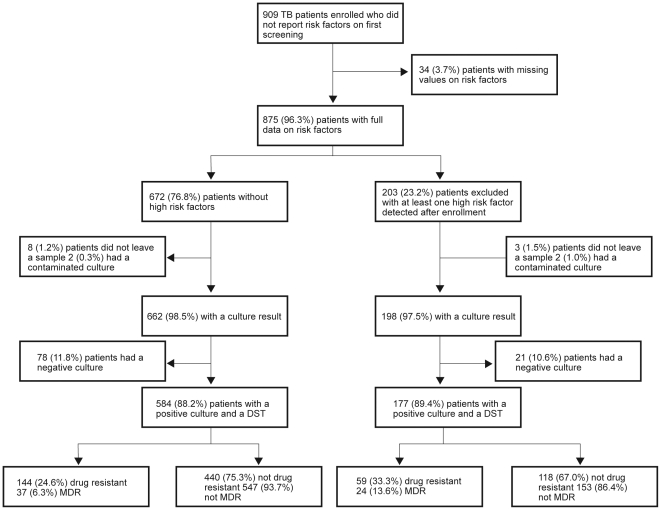
Of 875 participants with complete data, 23.2% (203) had risk factors for MDR-TB elicited after enrolment. Among the group with no reported risk factors who had a positive culture, we found a 6.3% (95%CI 4.4-8.3) (37/584) rate of MDR-TB. In this group no epidemiological characteristics were associated with MDR-TB. Thus, in this group, multidrug resistance occurred in patients with no identifiable risk factors.
We found a high rate of primary MDR-TB in a general population with no identifiable risk factors for MDR-TB. This suggests that in a high endemic area targeting patients for MDR-TB based on the presence of risk factors is an insufficient intervention.
在高耐多药结核病(TB)流行地区,建议对有耐多药风险因素的患者进行诊断时的药敏试验(DST)。然而,这种方法可能会错过一般人群中相当一部分的耐多药-TB。我们在秘鲁利马研究了被认为耐多药风险低的患者的原发性耐多药情况。
我们招募了新的痰涂片阳性 TB 患者,他们没有报告任何耐多药-TB 风险因素:已知接触治疗失败或患有耐多药-TB 的 TB 患者、免疫抑制合并症、前囚犯;监狱和医疗保健工作者;以及酗酒或药物滥用。对所有纳入的参与者应用结构化问卷以确认这些因素的不存在,从而最大限度地减少漏报。所有参与者的痰液均在 Löwenstein-Jensen 培养基上培养,并使用 7H10 琼脂法进行一线药物的 DST。
在 875 名有完整数据的参与者中,23.2%(203 名)在入组后出现了耐多药-TB 的风险因素。在没有报告风险因素且培养阳性的组中,我们发现 6.3%(95%CI 4.4-8.3)(37/584)的耐多药-TB 率。在该组中,没有流行病学特征与耐多药-TB 相关。因此,在该组中,无法识别风险因素的患者发生了耐多药。
我们在没有可识别的耐多药-TB 风险因素的一般人群中发现了高原发性耐多药-TB 率。这表明,在高流行地区,基于风险因素针对耐多药-TB 患者进行靶向治疗是不够的干预措施。