El-Salhy Magdy, Gilja Odd Helge
Section for Gastroenterology, Department of Medicine, Stord Helse-Fonna Hospital, Box 4000, 54 09 Stord, Stord, Norway.
Section for Gastroenterology, Department of Clinical Medicine, University of Bergen, Bergen, Norway.
BMC Gastroenterol. 2017 Aug 1;17(1):90. doi: 10.1186/s12876-017-0643-4.
This study examined whether the densities of stem- and enteroendocrine cell progenitors are abnormal in the ileum of patients with irritable bowel syndrome (IBS), and whether any abnormalities in ileal enteroendocrine cells are correlated with abnormalities in stem cells and enteroendocrine cell progenitors.
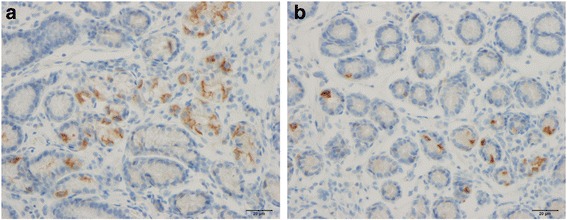
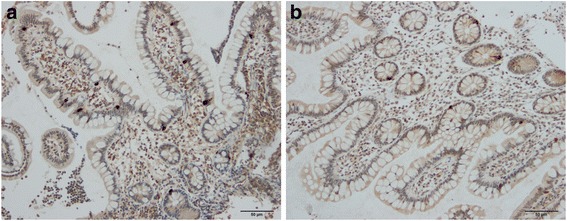
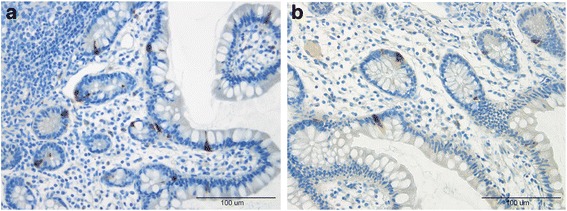
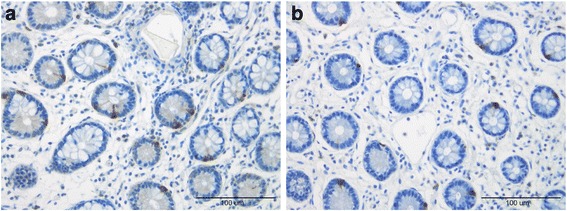
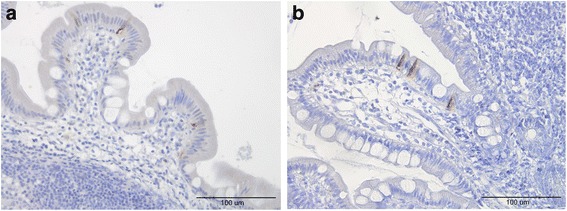
One hundred and one IBS patients covering all IBS subtypes were recruited, and 39 non-IBS subjects were included as a control group. The patients and controls underwent standard colonoscopies, during which biopsy specimens were obtained from the ileum. The biopsy specimens were stained with hematoxylin-eosin and immunostained for Musashi-1 (Msi-1), neurogenin 3 (NEUROG3), chromogranin A (CgA), serotonin, peptide YY (PYY), oxyntomodulin (enteroglucagon), pancreatic polypeptide, and somatostatin. The immunoreactive cells were quantified by computerized image analysis.
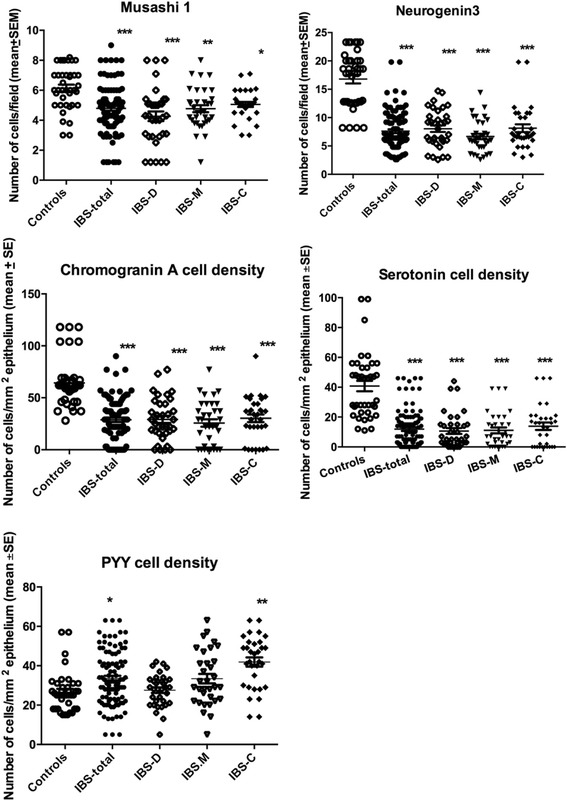
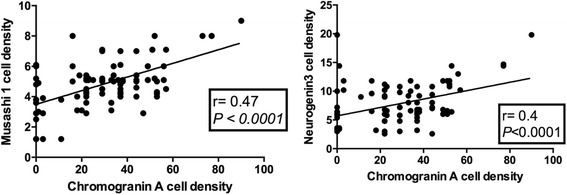
The densities of Msi-1, NEUROG3, CgA, and serotonin cells were reduced in all IBS patients and in patients with diarrhea-predominant IBS (IBS-D), mixed-diarrhea-and-constipation IBS (IBS-M), and constipation-predominant (IBS-C) relative to the control subjects. While the PYY cell density was increased in IBS-C relative to controls, it did not differ between control subjects and IBS-D and IBS-M patients. The densities of Msi-1 and NEUROG3 cells were strongly correlated with that of CgA cells.
The abnormalities in the ileal enteroendocrine cells appear to be caused by two mechanisms: (1) decreases in the clonogenic activity of the stem cells and in the endocrine-cell progenitors differentiating into enteroendocrine cells, and (2) switching on the expression of PYY and switching off the expression of certain other hormones in other types of the enteroendocrine cells.
本研究旨在探讨肠易激综合征(IBS)患者回肠中干细胞和肠内分泌细胞祖细胞的密度是否异常,以及回肠肠内分泌细胞的任何异常是否与干细胞和肠内分泌细胞祖细胞的异常相关。
招募了涵盖所有IBS亚型的101例IBS患者,并纳入39例非IBS受试者作为对照组。患者和对照者接受标准结肠镜检查,在此期间从回肠获取活检标本。活检标本用苏木精-伊红染色,并对Musashi-1(Msi-1)、神经生成素3(NEUROG3)、嗜铬粒蛋白A(CgA)、血清素、肽YY(PYY)、胃抑肽(肠高血糖素)、胰多肽和生长抑素进行免疫染色。通过计算机图像分析对免疫反应性细胞进行定量。
相对于对照受试者,所有IBS患者以及腹泻型IBS(IBS-D)、腹泻便秘混合型IBS(IBS-M)和便秘型IBS(IBS-C)患者中,Msi-1、NEUROG3、CgA和血清素细胞的密度均降低。虽然IBS-C患者的PYY细胞密度相对于对照组增加,但在对照受试者与IBS-D和IBS-M患者之间没有差异。Msi-1和NEUROG3细胞的密度与CgA细胞的密度密切相关。
回肠肠内分泌细胞的异常似乎由两种机制引起:(1)干细胞的克隆活性以及分化为肠内分泌细胞的内分泌细胞祖细胞减少;(2)其他类型的肠内分泌细胞中PYY表达开启,某些其他激素的表达关闭。