National Institute of Standards and Technology, Biochemical Science Division, Bioassay Methods Group, 100 Bureau Drive MS8312, Gaithersburg, MD 20899, USA.
BMC Biotechnol. 2011 Nov 7;11:102. doi: 10.1186/1472-6750-11-102.
Tools for authenticating cell lines are critical for quality control in cell-based biological experiments. Currently there are methods to authenticate human cell lines using short tandem repeat (STR) markers based on the technology and procedures successfully used in the forensic community for human identification, but there are no STR based methods for authenticating nonhuman cell lines to date. There is significant homology between the human and vervet monkey genome and we utilized these similarities to design the first multiplex assay based on human STR markers for vervet cell line identification.
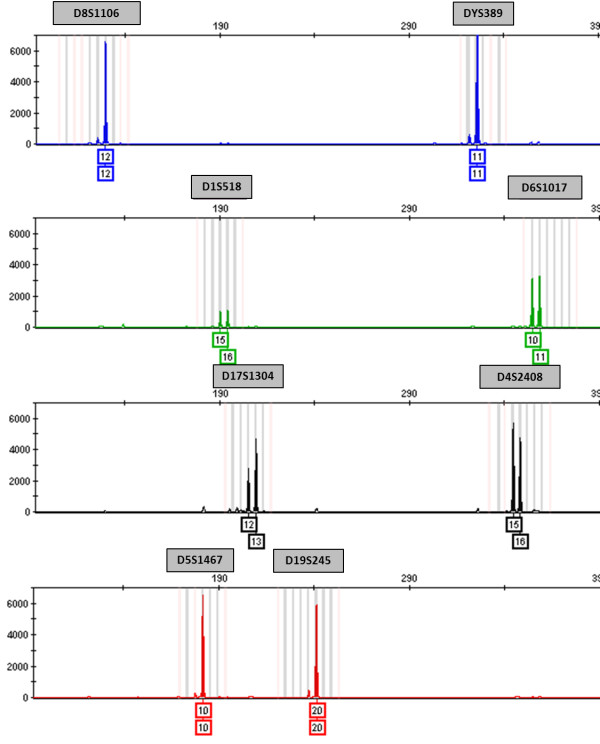
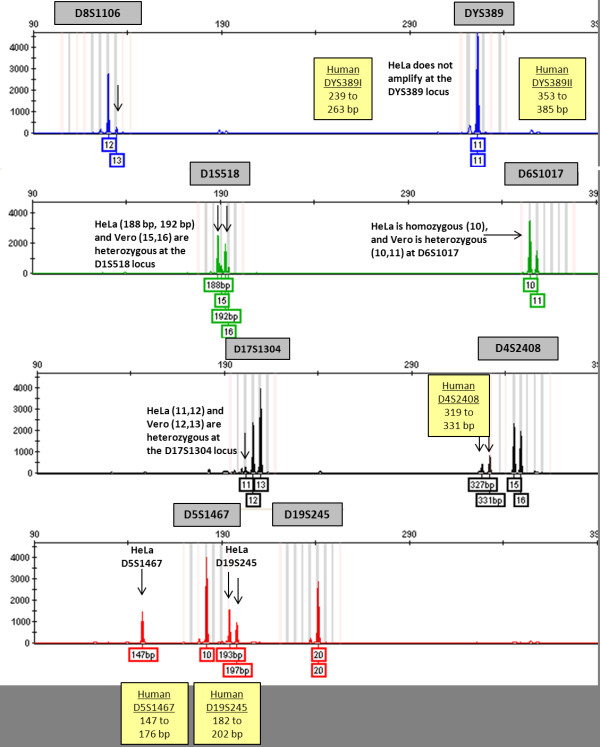
The following STR markers were incorporated into the vervet multiplex PCR assay: D17S1304, D5S1467, D19S245, D1S518, D8S1106, D4S2408, D6S1017, and DYS389. The eight markers were successful in uniquely identifying sixty-two vervet monkey DNA samples and confirmed that Vero76 cells and COS-7 cells were derived from Vero and CV-1 cells, respectively. The multiplex assay shows specificity for vervet DNA within the determined allele range for vervet monkeys; however, the primers will also amplify human DNA for each marker resulting in amplicons outside the vervet allele range in several of the loci. The STR markers showed genetic stability in over sixty-nine passages of Vero cells, suggesting low mutation rates in the targeted STR sequences in the Vero cell line.
A functional vervet multiplex assay consisting of eight human STR markers with heterozygosity values ranging from 0.53-0.79 was successful in uniquely identifying sixty-two vervet monkey samples. The probability of a random match using these eight markers between any two vervet samples is approximately 1 in 1.9 million. While authenticating a vervet cell line, the multiplex assay may also be a useful indicator for human cell line contamination since the assay is based on human STR markers.
用于鉴定细胞系的工具对于基于细胞的生物实验的质量控制至关重要。目前,有使用短串联重复(STR)标记物鉴定人细胞系的方法,这些方法基于成功用于人类识别的法医界的技术和程序,但迄今为止尚无用于鉴定非人类细胞系的基于 STR 的方法。人类和绿猴基因组之间存在显着同源性,我们利用这些相似性为绿猴细胞系鉴定设计了第一个基于人类 STR 标记物的多重分析。
将以下 STR 标记物纳入绿猴多重 PCR 分析:D17S1304、D5S1467、D19S245、D1S518、D8S1106、D4S2408、D6S1017 和 DYS389。这八个标记物成功地唯一鉴定了六十二只绿猴 DNA 样本,并证实 Vero76 细胞和 COS-7 细胞分别源自 Vero 和 CV-1 细胞。多重分析显示在确定的绿猴等位基因范围内对绿猴 DNA 具有特异性;然而,在几个基因座中,引物也会扩增每个标记物的人类 DNA,导致扩增子超出绿猴等位基因范围。STR 标记物在超过六十九次 Vero 细胞传代中表现出遗传稳定性,表明 Vero 细胞系中目标 STR 序列的突变率较低。
由八个具有 0.53-0.79 杂合度值的人类 STR 标记物组成的功能绿猴多重分析成功地唯一鉴定了六十二只绿猴样本。使用这八个标记物在任意两只绿猴样本之间随机匹配的概率约为 1 比 190 万。在鉴定绿猴细胞系时,由于该分析基于人类 STR 标记物,因此多重分析也可能是人类细胞系污染的有用指标。