Department of Hygiene and Epidemiology, University of Ioannina School of Medicine, Ioannina, Greece.
BMJ. 2011 Nov 7;343:d6829. doi: 10.1136/bmj.d6829.
To compare the reported effect sizes of cardiovascular biomarkers in datasets from observational studies with those in datasets from randomised controlled trials.
Review of meta-analyses.
Meta-analyses of emerging cardiovascular biomarkers (not part of the Framingham risk score) that included datasets from at least one observational study and at least one randomised controlled trial were identified through Medline (last update, January 2011).
Study-specific risk ratios were extracted from all identified meta-analyses and synthesised with random effects for (a) all studies, and (b) separately for observational and for randomised controlled trial populations for comparison.
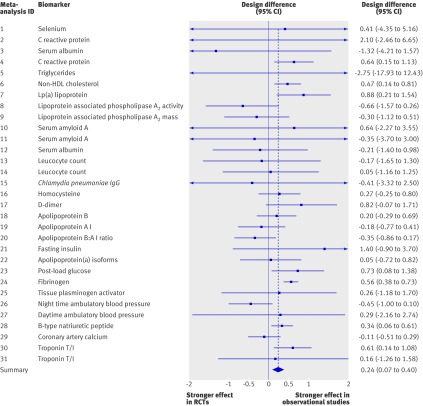
31 eligible meta-analyses were identified. For seven major biomarkers (C reactive protein, non-HDL cholesterol, lipoprotein(a), post-load glucose, fibrinogen, B-type natriuretic peptide, and troponins), the prognostic effect was significantly stronger in datasets from observational studies than in datasets from randomised controlled trials. For five of the biomarkers the effect was less than half as strong in the randomised controlled trial datasets. Across all 31 meta-analyses, on average datasets from observational studies suggested larger prognostic effects than those from randomised controlled trials; from a random effects meta-analysis, the estimated average difference in the effect size was 24% (95% CI 7% to 40%) of the overall biomarker effect.
Cardiovascular biomarkers often have less promising results in the evidence derived from randomised controlled trials than from observational studies.
比较观察性研究数据集和随机对照试验数据集报告的心血管生物标志物的效应大小。
综述荟萃分析。
通过 Medline(更新日期为 2011 年 1 月),确定了纳入至少一项观察性研究和至少一项随机对照试验数据集的新兴心血管生物标志物(不属于弗雷明汉风险评分)的荟萃分析。
从所有确定的荟萃分析中提取了研究特异性风险比,并进行了随机效应综合分析,(a)用于所有研究,以及(b)分别用于观察性研究和随机对照试验人群,以进行比较。
确定了 31 项符合条件的荟萃分析。对于七种主要生物标志物(C 反应蛋白、非高密度脂蛋白胆固醇、脂蛋白(a)、负荷后血糖、纤维蛋白原、B 型利钠肽和肌钙蛋白),观察性研究数据集的预后效果明显强于随机对照试验数据集。对于五种生物标志物,随机对照试验数据集的效果不到一半。在所有 31 项荟萃分析中,平均而言,观察性研究数据集表明的预后效果强于随机对照试验数据集;从随机效应荟萃分析来看,估计的平均效应大小差异为 24%(95%CI 7%至 40%),为整体生物标志物效应的一部分。
心血管生物标志物在随机对照试验证据中往往不如在观察性研究中具有更有希望的结果。