Department of Biochemistry, Molecular Biology and Physiology, Faculty of Sciences, University of Valladolid, E-47005 Valladolid, Spain.
Toxins (Basel). 2011 May;3(5):420-41. doi: 10.3390/toxins3050420. Epub 2011 Apr 29.
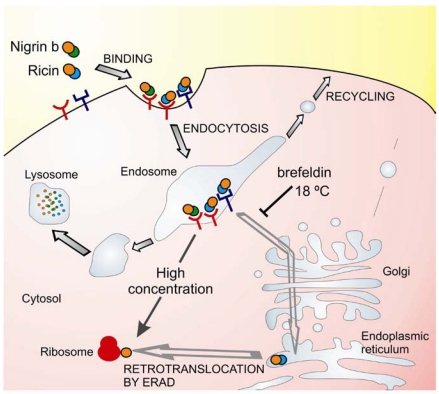
The type 2 ribosome-inactivating proteins (RIPs) isolated from some species belonging to the Sambucus genus, have the characteristic that although being even more active than ricin inhibiting protein synthesis in cell-free extracts, they lack the high toxicity of ricin and related type 2 RIPs to intact cells and animals. This is due to the fact that after internalization, they follow a different intracellular pathway that does not allow them to reach the cytosolic ribosomes. The lack of toxicity of type 2 RIPs from Sambucus make them good candidates as toxic moieties in the construction of immunotoxins and conjugates directed against specific targets. Up to now they have been conjugated with either transferrin or anti-CD105 to target either transferrin receptor- or endoglin-overexpressing cells, respectively.
从某些属于薜荔属的物种中分离得到的 2 型核糖体失活蛋白(RIP)具有以下特征:尽管在无细胞提取物中比蓖麻毒素抑制蛋白合成的活性更高,但它们缺乏蓖麻毒素和相关 2 型 RIP 对完整细胞和动物的高毒性。这是因为在内化后,它们遵循不同的细胞内途径,不允许它们到达胞质核糖体。2 型 RIP 从薜荔属中缺乏毒性,使它们成为构建免疫毒素和针对特定靶标的缀合物的毒性部分的良好候选物。到目前为止,它们已经与转铁蛋白或抗 CD105 缀合,分别针对转铁蛋白受体或内皮糖蛋白过表达的细胞。