Dermatology and Genetic Medicine, Division of Molecular Medicine, University of Dundee, Dundee, UK.
J Invest Dermatol. 2012 Jan;132(1):98-104. doi: 10.1038/jid.2011.342. Epub 2011 Nov 10.
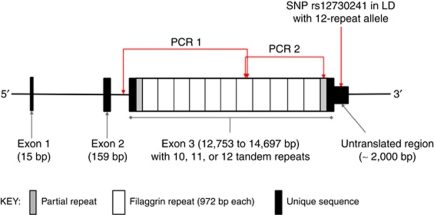
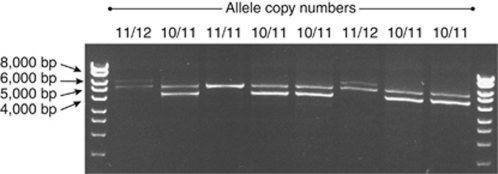
Loss-of-function variants within the filaggrin gene (FLG) increase the risk of atopic dermatitis. FLG also demonstrates intragenic copy number variation (CNV), with alleles encoding 10, 11, or 12 filaggrin monomers; hence, CNV may affect the amount of filaggrin expressed in the epidermis. A total of 876 Irish pediatric atopic dermatitis cases were compared with 928 population controls to test the hypothesis that CNV within FLG affects the risk of atopic dermatitis independently of FLG-null mutations. Cases and controls were screened for CNV and common FLG-null mutations. In this population the 11-repeat allele was most prevalent (allele frequency 51.5%); the 10-repeat allele frequency was 33.9% and the 12-repeat allele frequency was 14.6%. Having excluded FLG mutation carriers, the control group had a significantly higher number of repeats than cases (χ(2) P=0.043), and the odds ratio of disease was reduced by a factor of 0.88 (95% confidence interval 0.78-0.98, P=0.025) for each additional unit of copy number. Breakdown products of filaggrin were quantified in tape-stripped stratum corneum from 31 atopic dermatitis patients and urocanic acid showed a positive correlation with total copy number. CNV within FLG makes a significant, dose-dependent contribution to atopic dermatitis risk, and therefore treatments to increase filaggrin expression may have therapeutic utility.
该基因(FLG)的功能丧失性变异增加了特应性皮炎的风险。FLG 也表现出基因内拷贝数变异(CNV),其等位基因编码 10、11 或 12 个丝聚合蛋白单体;因此,CNV 可能会影响表皮中丝聚合蛋白的表达量。共比较了 876 例爱尔兰儿科特应性皮炎病例和 928 例人群对照,以检验假设,即 CNV 会独立于 FLG 缺失突变影响特应性皮炎的风险。对病例和对照进行了 CNV 和常见 FLG 缺失突变的筛查。在该人群中,11 重复等位基因最为常见(等位基因频率为 51.5%);10 重复等位基因频率为 33.9%,12 重复等位基因频率为 14.6%。在排除了 FLG 突变携带者后,对照组的重复次数明显多于病例组(χ(2) P=0.043),并且每增加一个单位的拷贝数,疾病的优势比降低了 0.88(95%置信区间 0.78-0.98,P=0.025)。从 31 例特应性皮炎患者的胶带剥离的角质层中定量了丝聚合蛋白的降解产物,并且尿刊酸与总拷贝数呈正相关。FLG 内的 CNV 对特应性皮炎风险有显著的、剂量依赖性的贡献,因此增加丝聚合蛋白表达的治疗方法可能具有治疗效用。