Instituto de Óptica, Consejo Superior de Investigaciones Científicas, Madrid, Spain.
PLoS One. 2011;6(11):e27031. doi: 10.1371/journal.pone.0027031. Epub 2011 Nov 2.
The image formed by the eye's optics is inherently blurred by aberrations specific to an individual's eyes. We examined how visual coding is adapted to the optical quality of the eye.
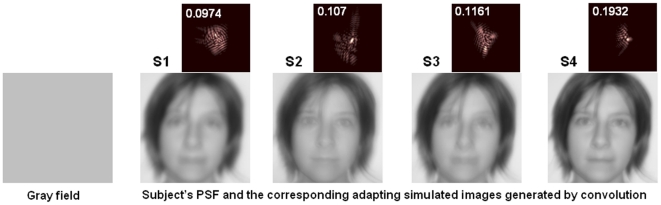
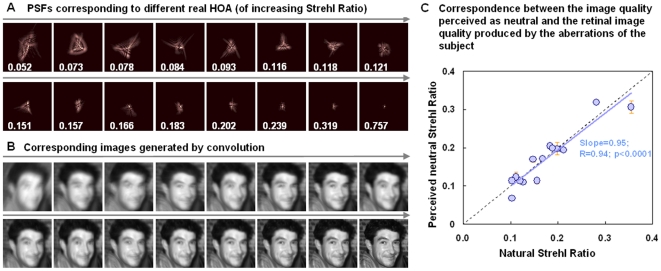
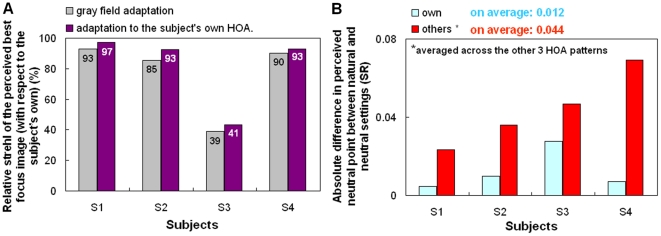
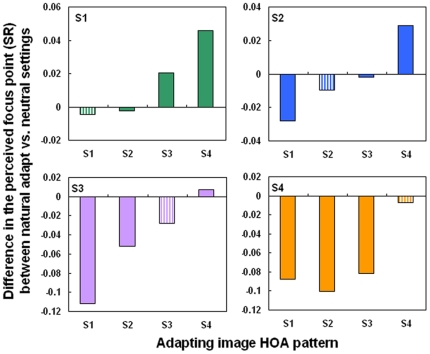
We assessed the relationship between perceived blur and the retinal image blur resulting from high order aberrations in an individual's optics. Observers judged perceptual blur in a psychophysical two-alternative forced choice paradigm, on stimuli viewed through perfectly corrected optics (using a deformable mirror to compensate for the individual's aberrations). Realistic blur of different amounts and forms was computer simulated using real aberrations from a population. The blur levels perceived as best focused were close to the levels predicted by an individual's high order aberrations over a wide range of blur magnitudes, and were systematically biased when observers were instead adapted to the blur reproduced from a different observer's eye.
Our results provide strong evidence that spatial vision is calibrated for the specific blur levels present in each individual's retinal image and that this adaptation at least partly reflects how spatial sensitivity is normalized in the neural coding of blur.
眼睛的光学成像固有地受到个体眼睛特有的像差的模糊。我们研究了视觉编码是如何适应眼睛的光学质量的。
我们评估了个体光学中的高阶像差引起的感知模糊与视网膜图像模糊之间的关系。观察者在心理物理的二选一强制选择范式中判断感知模糊,通过完美矫正的光学元件(使用变形镜来补偿个体的像差)观察刺激。使用来自人群的真实像差,计算机模拟了不同数量和形式的真实模糊。在广泛的模糊程度范围内,被感知为最佳聚焦的模糊水平接近个体高阶像差预测的水平,而当观察者适应来自不同观察者眼睛的再现模糊时,这些水平会被系统地偏向。
我们的结果提供了有力的证据,表明空间视觉是针对每个个体视网膜图像中存在的特定模糊水平进行校准的,这种适应至少部分反映了在模糊的神经编码中,空间灵敏度是如何归一化的。