Song Jaeseon, Brown James M
Department of Psychology, University of Georgia, Athens, GA, 30602, USA.
Department of Psychological and Brain Sciences, University of Delaware, Newark, DE, 19716, USA.
Atten Percept Psychophys. 2024 Nov;86(8):2707-2720. doi: 10.3758/s13414-024-02956-w. Epub 2024 Sep 30.
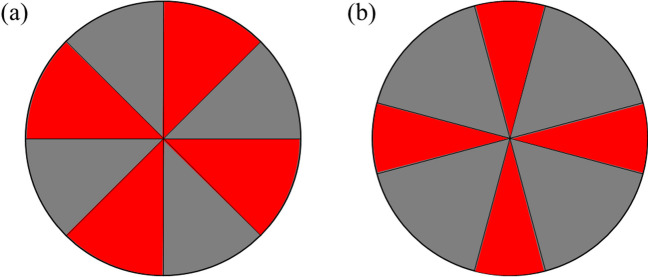
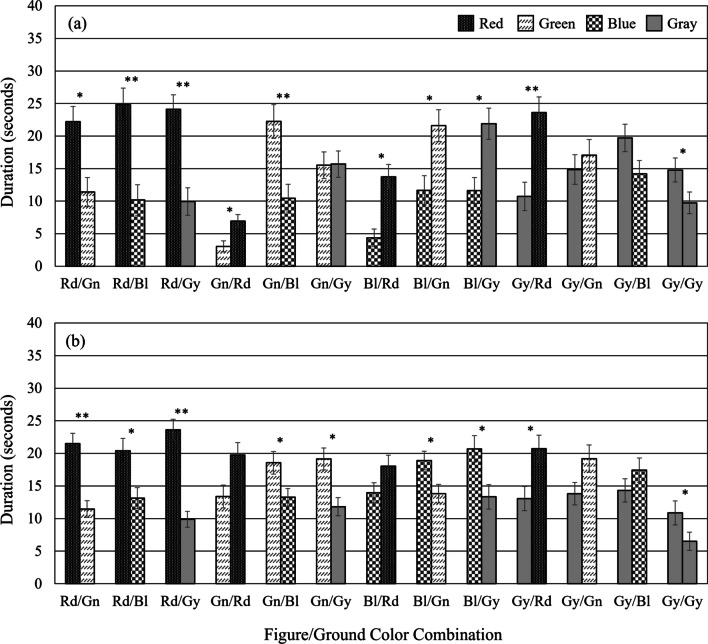
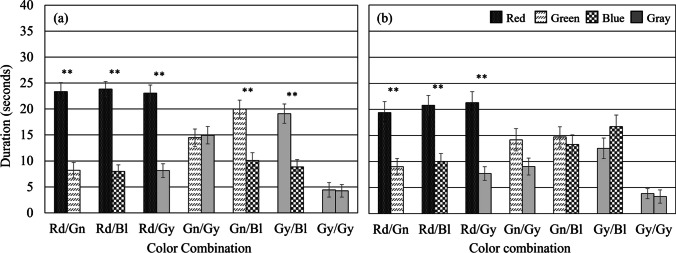
Research on figure-ground perception has consistently found that red images are more likely to be perceived as figure/nearer, yet the mechanisms behind this are not completely clear. The primary theories have pointed to optical chromatic aberrations or cortical mechanisms, such as the antagonistic interactions of the magno-/parvocellular (M/P) systems. Our study explored this color-biased figure-ground perception by examining the duration for which a region was perceived as figure under both binocular and monocular conditions, using all combinations of red, blue, green, and gray. In Experiment 1, we used figure-ground ambiguous Maltese crosses, composed of left- and right-tilting sectors of equal area. In Experiment 2, the crosses were figure-ground biased with size and orientation cues. Here, small sectors of cardinal orientations, likely perceived as figure, were contrasted with larger, obliquely oriented sectors, likely perceived as ground. Under monocular conditions, the results aligned with chromatic aberration predictions: red advanced and blue receded, regardless of size and orientation. However, under binocular conditions, the advancing effect of red continued, but the receding effect of blue was generally not observed. Notably, blue, along with red and green, was more frequently perceived as figure compared to gray. The results under binocular viewing are in line with the expectations of the antagonistic M/P system interactions theory, likely due to the collective input from both eyes, facilitating the anticipated effects. Our findings suggest that color-biased figure-ground perception may arise from the synergistic effect of antagonistic M/P system interactions and other optical and cortical mechanisms, together compensating for chromatic aberrations.
关于图形-背景感知的研究一直发现,红色图像更有可能被视为图形/更近,但背后的机制尚不完全清楚。主要理论指向光学色差或皮层机制,如大细胞/小细胞(M/P)系统的拮抗相互作用。我们的研究通过使用红色、蓝色、绿色和灰色的所有组合,在双眼和单眼条件下检查一个区域被视为图形的持续时间,探索了这种颜色偏向的图形-背景感知。在实验1中,我们使用了图形-背景模糊的马耳他十字,由等面积的左右倾斜扇区组成。在实验2中,十字通过大小和方向线索产生图形-背景偏向。在这里,主要方向的小扇区可能被视为图形,与较大的、倾斜方向的扇区形成对比,后者可能被视为背景。在单眼条件下,结果与色差预测一致:无论大小和方向如何,红色靠前而蓝色靠后。然而,在双眼条件下,红色的靠前效应持续存在,但蓝色的靠后效应通常未被观察到。值得注意的是,与灰色相比,蓝色以及红色和绿色更常被视为图形。双眼观察下的结果符合拮抗M/P系统相互作用理论的预期,这可能是由于双眼的共同输入,促进了预期效果。我们的研究结果表明,颜色偏向的图形-背景感知可能源于拮抗M/P系统相互作用与其他光学和皮层机制的协同效应,共同补偿色差。