Marcos Susana, Artal Pablo, Atchison David A, Hampson Karen, Legras Richard, Lundström Linda, Yoon Geunyoung
Center for Visual Sciences; The Institute of Optics and Flaum Eye Institute, University of Rochester, New York 14642, USA.
Laboratorio de Optica, Universidad de Murcia, Campus Universitario de Espinardo, 30100, Spain.
Biomed Opt Express. 2022 Nov 17;13(12):6508-6532. doi: 10.1364/BOE.473458. eCollection 2022 Dec 1.
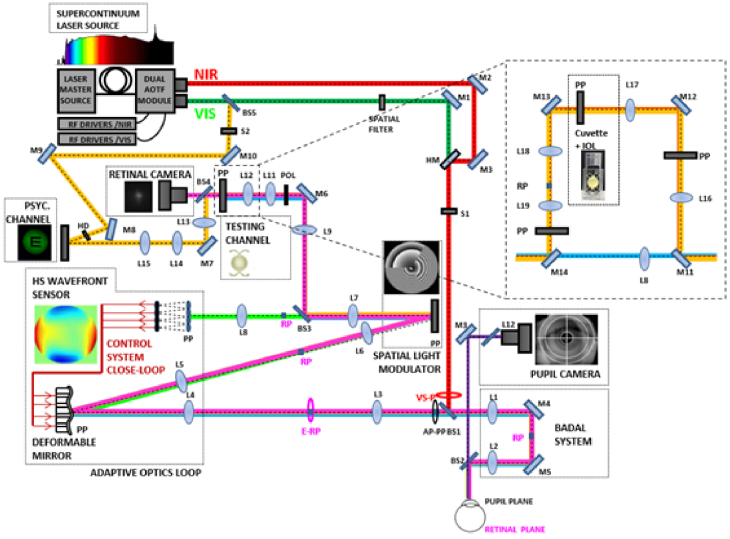
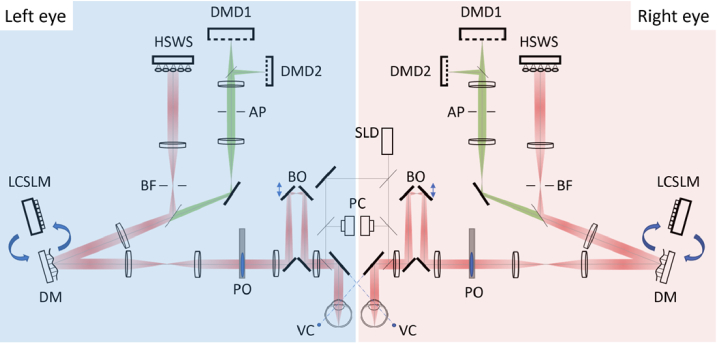
In their pioneering work demonstrating measurement and full correction of the eye's optical aberrations, Liang, Williams and Miller, [JOSA A14, 2884 (1997)10.1364/JOSAA.14.002884] showed improvement in visual performance using adaptive optics (AO). Since then, AO visual simulators have been developed to explore the spatial limits to human vision and as platforms to test non-invasively optical corrections for presbyopia, myopia, or corneal irregularities. These applications have allowed new psychophysics bypassing the optics of the eye, ranging from studying the impact of the interactions of monochromatic and chromatic aberrations on vision to neural adaptation. Other applications address new paradigms of lens designs and corrections of ocular errors. The current paper describes a series of AO visual simulators developed in laboratories around the world, key applications, and current trends and challenges. As the field moves into its second quarter century, new available technologies and a solid reception by the clinical community promise a vigorous and expanding use of AO simulation in years to come.
在他们关于展示眼睛光学像差测量和完全矫正的开创性工作中,梁、威廉姆斯和米勒[《美国光学学会志A》14, 2884 (1997)10.1364/JOSAA.14.002884]表明使用自适应光学(AO)可改善视觉性能。从那时起,AO视觉模拟器就被开发出来,用于探索人类视觉的空间极限,并作为平台对老花眼、近视或角膜不规则进行非侵入性光学矫正测试。这些应用使得新的心理物理学能够绕过眼睛的光学系统,范围从研究单色像差和色差相互作用对视觉的影响到神经适应。其他应用涉及镜片设计和眼误差矫正的新范例。本文描述了世界各地实验室开发的一系列AO视觉模拟器、关键应用以及当前的趋势和挑战。随着该领域进入其第二个25年,新的可用技术以及临床界的热烈接受预示着AO模拟在未来几年将得到广泛且不断扩展的应用。