Villar Margarita, Ayllón Nieves, Busby Ann T, Galindo Ruth C, Blouin Edmour F, Kocan Katherine M, Bonzón-Kulichenko Elena, Zivkovic Zorica, Almazán Consuelo, Torina Alessandra, Vázquez Jesús, de la Fuente José
Instituto de Investigación en Recursos Cinegéticos IREC (CSIC-UCLM-JCCM), Ronda de Toledo s/n, 13005 Ciudad Real, Spain.
Int J Proteomics. 2010;2010:657261. doi: 10.1155/2010/657261. Epub 2010 Sep 29.
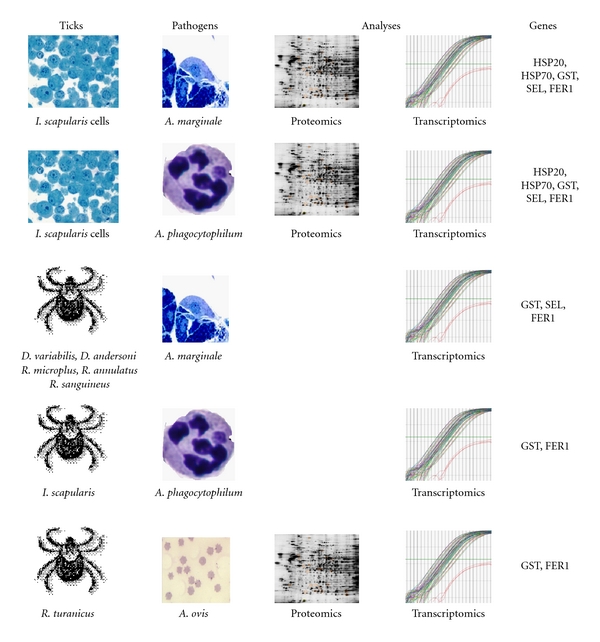
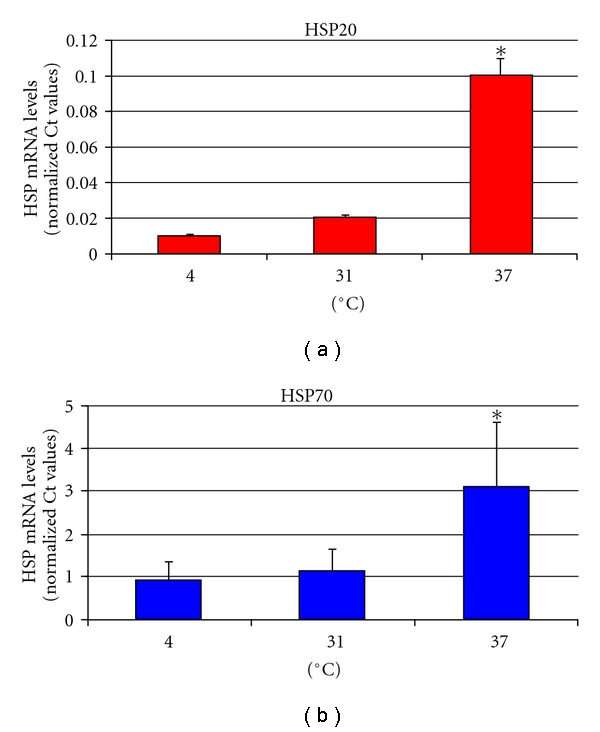
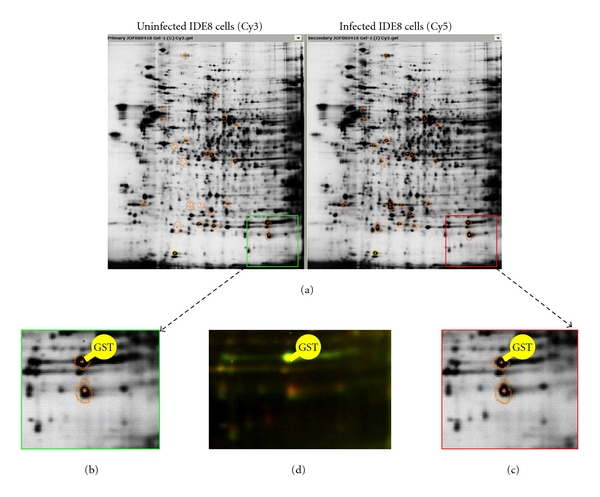
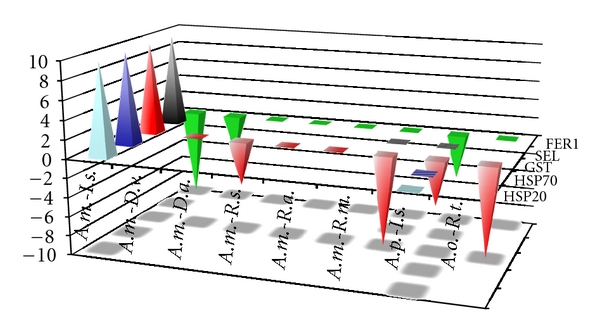
Ticks are ectoparasites of animals and humans that serve as vectors of Anaplasma and other pathogens that affect humans and animals worldwide. Ticks and the pathogens that they transmit have coevolved molecular interactions involving genetic traits of both the tick and the pathogen that mediate their development and survival. In this paper, the expression of heat shock proteins (HSPs) and other stress response proteins (SRPs) was characterized in ticks and cultured tick cells by proteomics and transcriptomics analyses in response to Anaplasma spp. infection and heat shock. The results of these studies demonstrated that the stress response was activated in ticks and cultured tick cells after Anaplasma spp. infection and heat shock. However, in the natural vector-pathogen relationship, HSPs and other SRPs were not strongly activated, which likely resulted from tick-pathogen coevolution. These results also demonstrated pathogen- and tick-specific differences in the expression of HSPs and other SRPs in ticks and cultured tick cells infected with Anaplasma spp. and suggested the existence of post-transcriptional mechanisms induced by Anaplasma spp. to control tick response to infection. These results illustrated the complexity of the stress response in ticks and suggested a function for the HSPs and other SRPs during Anaplasma spp. infection.
蜱是动物和人类的体外寄生虫,是无形体及其他病原体的传播媒介,这些病原体在全球范围内影响着人类和动物。蜱及其传播的病原体已经共同进化出分子相互作用,涉及蜱和病原体的遗传特征,这些特征介导了它们的发育和生存。在本文中,通过蛋白质组学和转录组学分析,对蜱及培养的蜱细胞中热休克蛋白(HSPs)和其他应激反应蛋白(SRPs)在无形体感染和热休克后的表达进行了表征。这些研究结果表明,无形体感染和热休克后,蜱及培养的蜱细胞中的应激反应被激活。然而,在自然的媒介-病原体关系中,HSPs和其他SRPs并未被强烈激活,这可能是蜱-病原体共同进化的结果。这些结果还表明,在感染无形体的蜱及培养的蜱细胞中,HSPs和其他SRPs的表达存在病原体和蜱特异性差异,并提示存在无形体诱导的转录后机制来控制蜱对感染的反应。这些结果说明了蜱应激反应的复杂性,并提示了HSPs和其他SRPs在无形体感染过程中的作用。