Giorgio Valentina, Petronilli Valeria, Ghelli Anna, Carelli Valerio, Rugolo Michela, Lenaz Giorgio, Bernardi Paolo
Department of Biomedical Sciences, University of Padova, Padova, Italy.
Biochim Biophys Acta. 2012 Feb;1817(2):363-9. doi: 10.1016/j.bbabio.2011.10.012. Epub 2011 Nov 4.
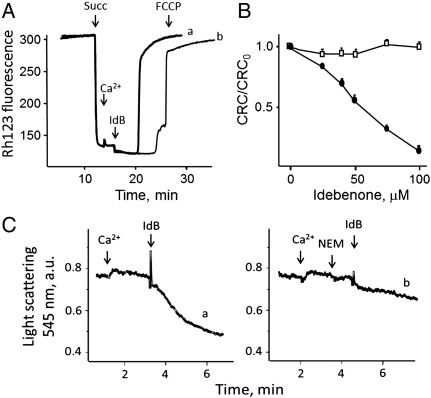
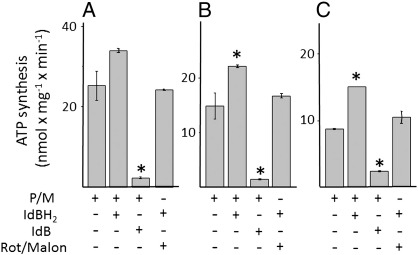
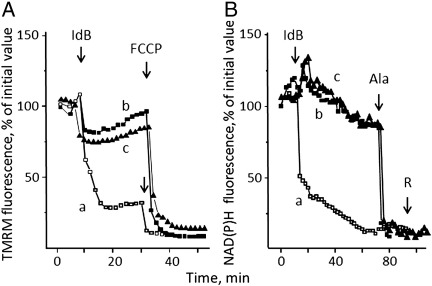
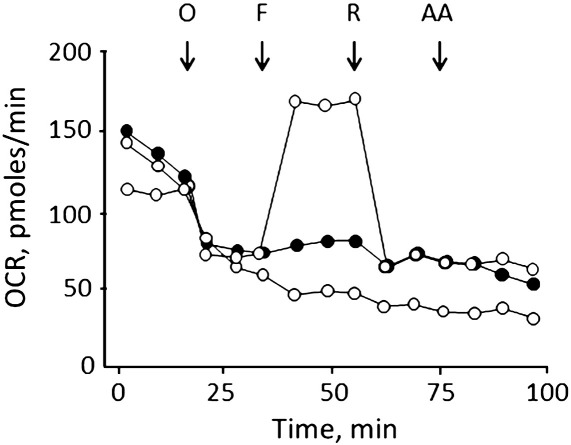
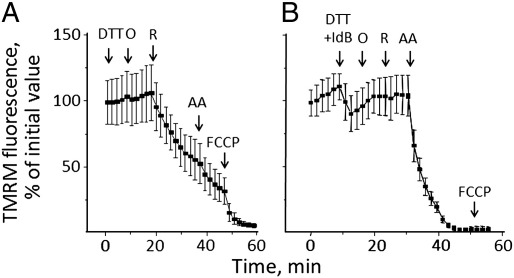
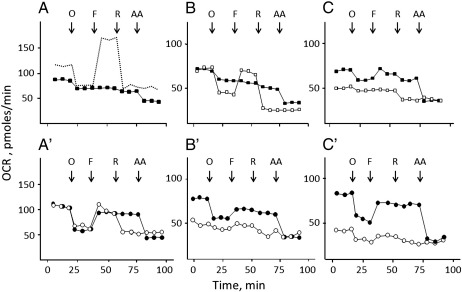
We have studied the effects of idebenone on mitochondrial function in cybrids derived from one normal donor (HQB17) and one patient harboring the G3460A/MT-ND1 mutation of Leber's Hereditary Optic Neuropathy (RJ206); and in XTC.UC1 cells bearing a premature stop codon at amino acid 101 of MT-ND1 that hampers complex I assembly. Addition of idebenone to HQB17 cells caused mitochondrial depolarization and NADH depletion, which were inhibited by cyclosporin (Cs) A and decylubiquinone, suggesting an involvement of the permeability transition pore (PTP). On the other hand, addition of dithiothreitol together with idebenone did not cause PTP opening and allowed maintenance of the mitochondrial membrane potential even in the presence of rotenone. Addition of dithiothreitol plus idebenone, or of idebenol, to HQB17, RJ206 and XTC.UC1 cells sustained membrane potential in intact cells and ATP synthesis in permeabilized cells even in the presence of rotenone and malonate, and restored a good level of coupled respiration in complex I-deficient XTC.UC1 cells. These findings demonstrate that idebenol can feed electrons at complex III. If the quinone is maintained in the reduced state, a task that in some cell types appears to be performed by dicoumarol-sensitive NAD(P)H:quinone oxidoreductase 1 [Haefeli et al. (2011) PLoS One 6, e17963], electron transfer to complex III may allow reoxidation of NADH in complex I deficiencies.
我们研究了艾地苯醌对由一名正常供体(HQB17)和一名携带Leber遗传性视神经病变G3460A/MT-ND1突变的患者(RJ206)的胞质杂种中线粒体功能的影响;以及对MT-ND1第101位氨基酸处带有过早终止密码子从而阻碍复合体I组装的XTC.UC1细胞的影响。向HQB17细胞中添加艾地苯醌会导致线粒体去极化和NADH耗竭,这被环孢菌素(Cs)A和癸基泛醌抑制,提示通透性转换孔(PTP)参与其中。另一方面,二硫苏糖醇与艾地苯醌一起添加不会导致PTP开放,即使在存在鱼藤酮的情况下也能维持线粒体膜电位。向HQB17、RJ206和XTC.UC1细胞中添加二硫苏糖醇加艾地苯醌或艾地苯酚,即使在存在鱼藤酮和丙二酸的情况下,也能维持完整细胞的膜电位以及通透细胞中的ATP合成,并在复合体I缺陷的XTC.UC1细胞中恢复良好水平的偶联呼吸。这些发现表明,艾地苯酚可以在复合体III处提供电子。如果醌保持在还原状态,在某些细胞类型中这一任务似乎由双香豆素敏感的NAD(P)H:醌氧化还原酶1[Haefeli等人(2011年)《公共科学图书馆·综合》6,e17963]执行,那么向复合体III的电子转移可能允许在复合体I缺陷中使NADH再氧化。