Department of Psychology, University of California at Berkeley, Berkeley, California, USA.
Nat Neurosci. 2011 Nov 20;15(1):13-9. doi: 10.1038/nn.2956.
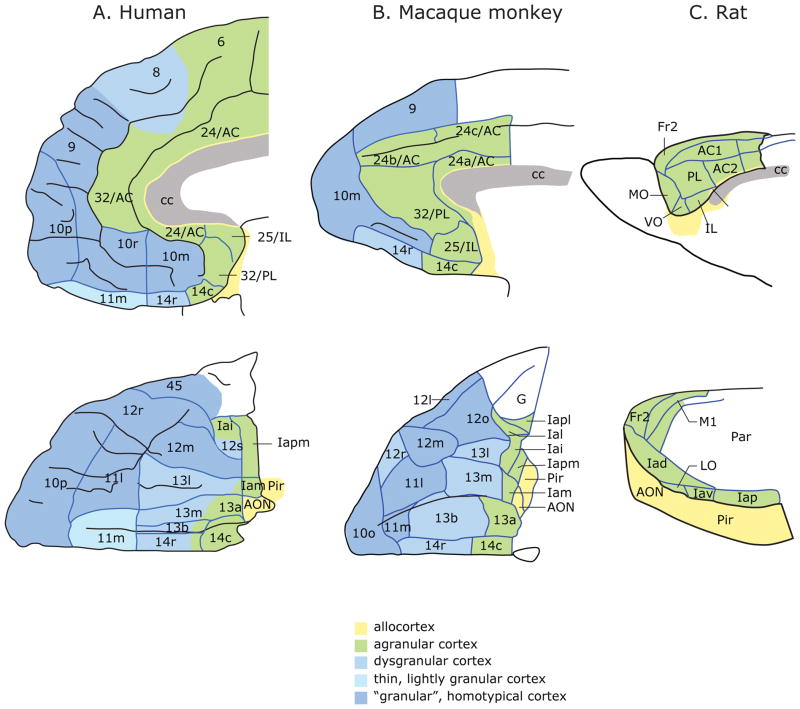
Recent work has emphasized the role that orbitofrontal cortex (OFC) has in value-based decision-making. However, it is also clear that a number of discrepancies have arisen when comparing the findings from animal models to those from humans. Here, we examine several possibilities that might explain these discrepancies, including anatomical difference between species, the behavioral tasks used to probe decision-making and the methodologies used to assess neural function. Understanding how these differences affect the interpretation of experimental results will help us to better integrate future results from animal models. This will enable us to fully realize the benefits of using multiple approaches to understand OFC function.
最近的研究强调了眶额皮层(OFC)在基于价值的决策中的作用。然而,当比较动物模型和人类的研究结果时,也很明显出现了一些差异。在这里,我们研究了几种可能的解释,包括物种间的解剖差异、用于探测决策的行为任务以及用于评估神经功能的方法。了解这些差异如何影响实验结果的解释,将有助于我们更好地整合来自动物模型的未来研究结果。这将使我们能够充分利用使用多种方法来理解 OFC 功能的好处。