Elston Thomas W, Wallis Joni D
Department of Neuroscience, University of California, Berkeley, Berkeley, CA, USA.
Department of Neuroscience, University of Texas at Austin, Austin, TX, USA.
Nat Neurosci. 2025 Feb;28(2):374-382. doi: 10.1038/s41593-024-01839-5. Epub 2025 Jan 6.
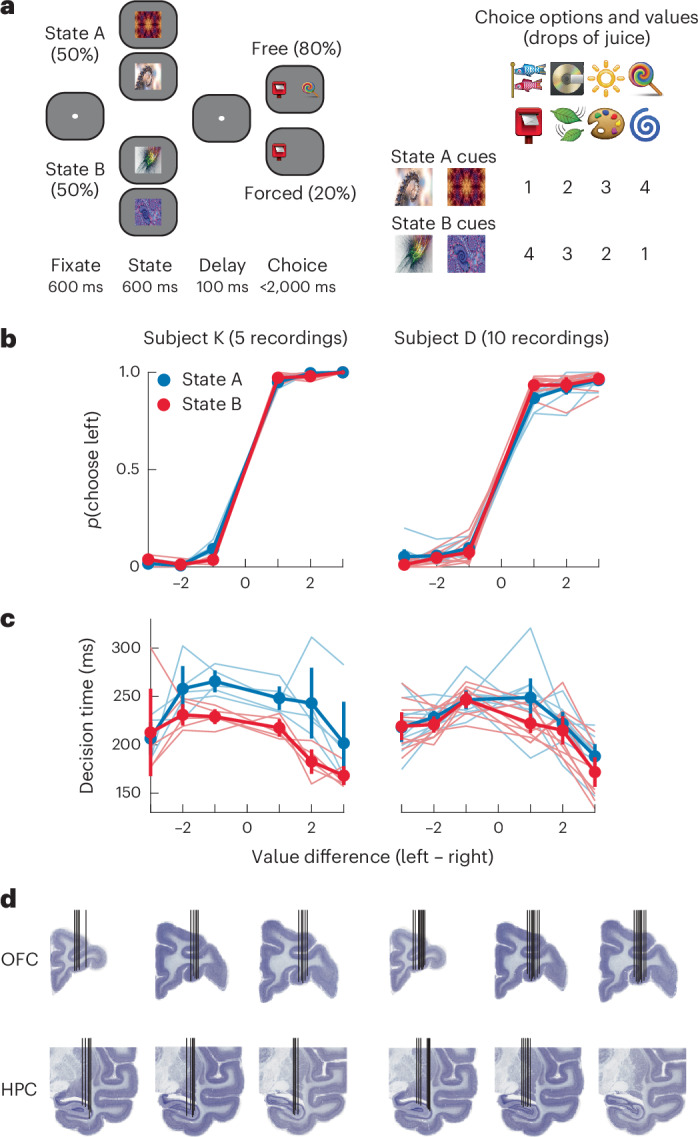
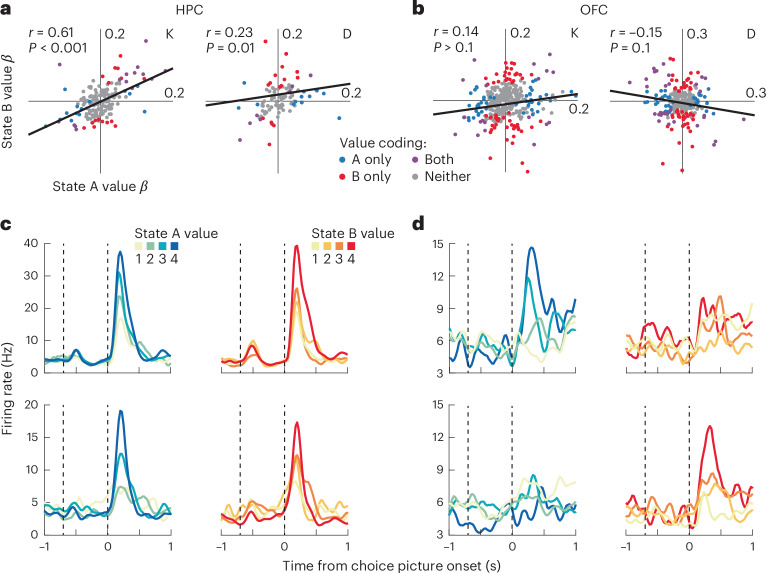
What is good in one scenario may be bad in another. Despite the ubiquity of such contextual reasoning in everyday choice, how the brain flexibly uses different valuation schemes across contexts remains unknown. We addressed this question by monitoring neural activity from the hippocampus (HPC) and orbitofrontal cortex (OFC) of two monkeys performing a state-dependent choice task. We found that HPC neurons encoded state information as it became available and then, at the time of choice, relayed this information to the OFC via theta synchronization. During choice, the OFC represented value in a state-dependent manner; many OFC neurons uniquely coded for value in only one state but not the other. This suggests a functional dissociation whereby the HPC encodes contextual information that is broadcast to the OFC via theta synchronization to select a state-appropriate value subcircuit, thereby allowing for contextual reasoning in value-based choice.
在一种情境中是好的情况在另一种情境中可能就是坏的。尽管这种情境推理在日常选择中无处不在,但大脑如何在不同情境下灵活使用不同的评估方案仍不为人知。我们通过监测两只执行状态依赖选择任务的猴子的海马体(HPC)和眶额皮质(OFC)的神经活动来解决这个问题。我们发现,海马体神经元在状态信息可用时对其进行编码,然后在选择时通过θ同步将该信息传递给眶额皮质。在选择过程中,眶额皮质以状态依赖的方式表征价值;许多眶额皮质神经元仅在一种状态下对价值进行独特编码,而在另一种状态下则不然。这表明了一种功能分离,即海马体编码通过θ同步广播到眶额皮质的情境信息,以选择适合状态的价值子回路,从而在基于价值的选择中实现情境推理。