Institute of Infection, Immunity and Inflammation, Sir Graeme Davies Bldg., 120 University Ave., University of Glasgow, Glasgow, G12 8TA UK.
FASEB J. 2012 Mar;26(3):1272-9. doi: 10.1096/fj.11-184556. Epub 2011 Nov 21.
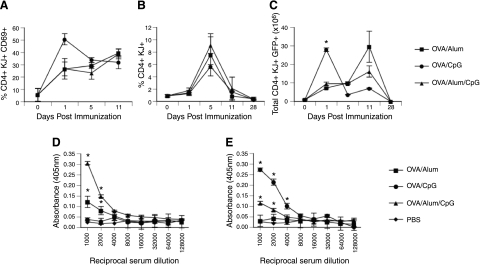
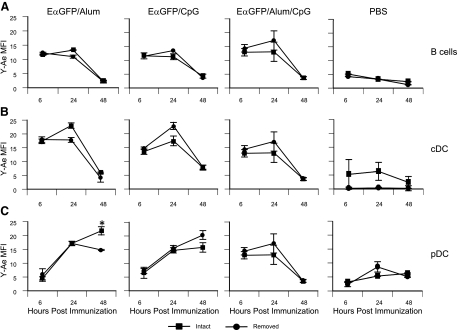
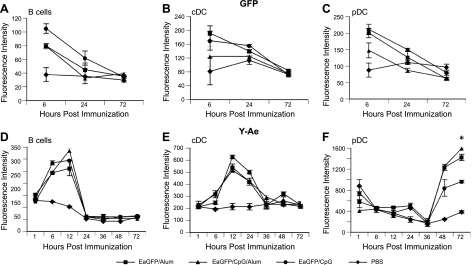
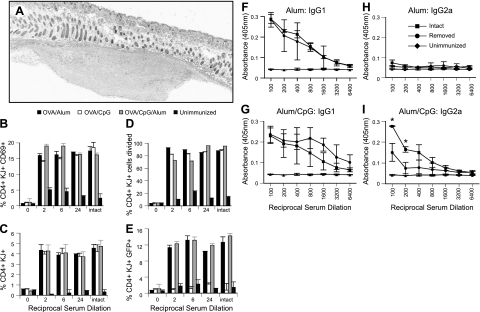
Alum adjuvants have been in continuous clinical use for more than 80 yr. While the prevailing theory has been that depot formation and the associated slow release of antigen and/or inflammation are responsible for alum enhancement of antigen presentation and subsequent T- and B-cell responses, this has never been formally proven. To examine antigen persistence, we used the chimeric fluorescent protein EαGFP, which allows assessment of antigen presentation in situ, using the Y-Ae antibody. We demonstrate that alum and/or CpG adjuvants induced similar uptake of antigen, and in all cases, GFP signal did not persist beyond 24 h in draining lymph node antigen-presenting cells. Antigen presentation was first detectable on B cells within 6-12 h of antigen administration, followed by conventional dendritic cells (DCs) at 12-24 h, then finally plasmacytoid DCs at 48 h or later. Again, alum and/or CpG adjuvants did not have an effect on the magnitude or sequence of this response; furthermore, they induced similar antigen-specific T-cell activation in vivo. Notably, removal of the injection site and associated alum depot, as early as 2 h after administration, had no appreciable effect on antigen-specific T- and B-cell responses. This study clearly rules out a role for depot formation in alum adjuvant activity.
铝佐剂已经在临床中连续使用了 80 多年。虽然普遍的理论认为,形成储存库以及随之而来的抗原和/或炎症的缓慢释放负责增强抗原呈递以及随后的 T 细胞和 B 细胞反应,但这从未得到正式证明。为了检查抗原的持久性,我们使用了嵌合荧光蛋白 EαGFP,它允许使用 Y-Ae 抗体原位评估抗原呈递。我们证明,铝佐剂和/或 CpG 佐剂诱导了类似的抗原摄取,在所有情况下,GFP 信号在引流淋巴结抗原呈递细胞中不会超过 24 小时持续存在。抗原呈递最早可在抗原给药后 6-12 小时内在 B 细胞中检测到,随后在 12-24 小时内是常规树突状细胞 (DCs),然后在 48 小时或更晚是浆细胞样 DCs。同样,铝佐剂和/或 CpG 佐剂对这种反应的幅度或顺序没有影响;此外,它们在体内诱导了类似的抗原特异性 T 细胞激活。值得注意的是,在给药后 2 小时内去除注射部位和相关的铝佐剂储存库,对抗原特异性 T 细胞和 B 细胞反应几乎没有影响。这项研究明确排除了储存库形成在铝佐剂活性中的作用。