Department of Bio and Brain Engineering, KAIST, Daejeon 305-701, Korea.
Exp Neurobiol. 2011 Jun;20(2):110-5. doi: 10.5607/en.2011.20.2.110. Epub 2011 Jun 30.
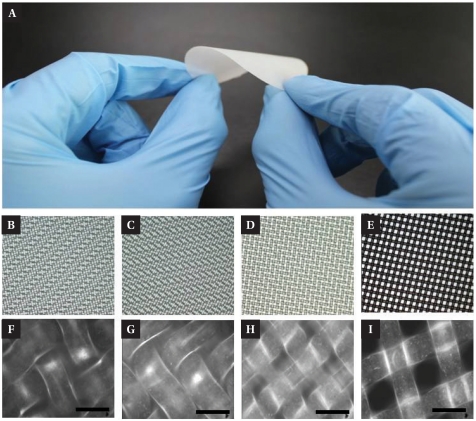
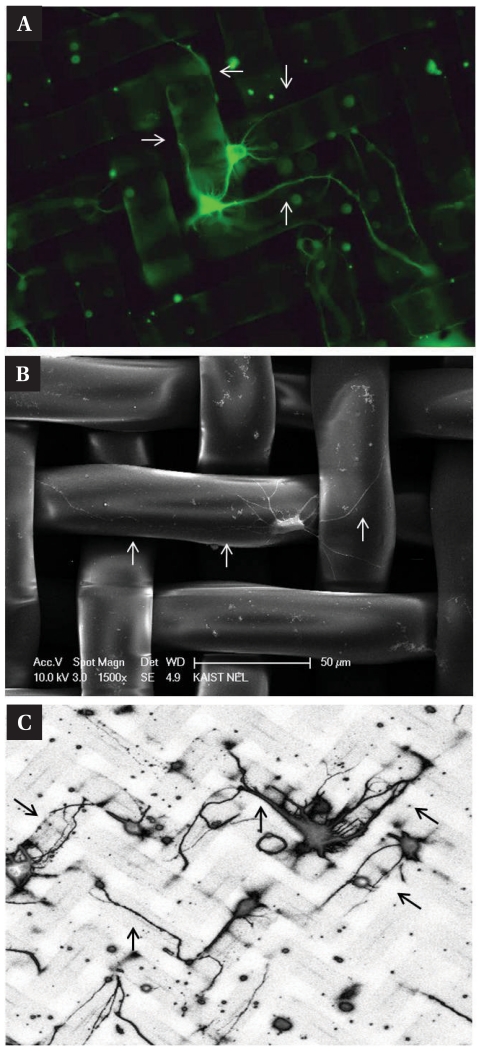
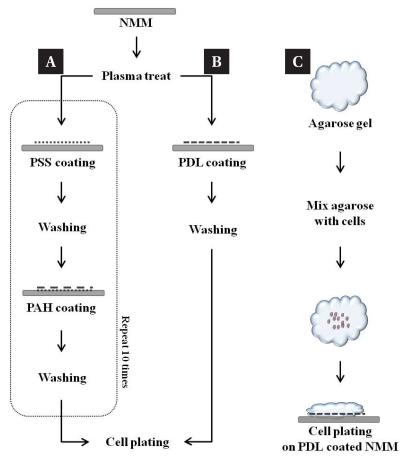
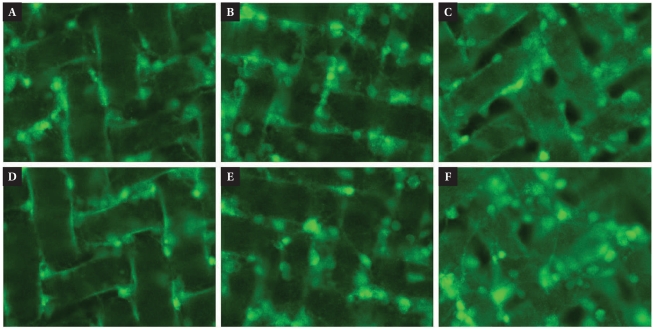
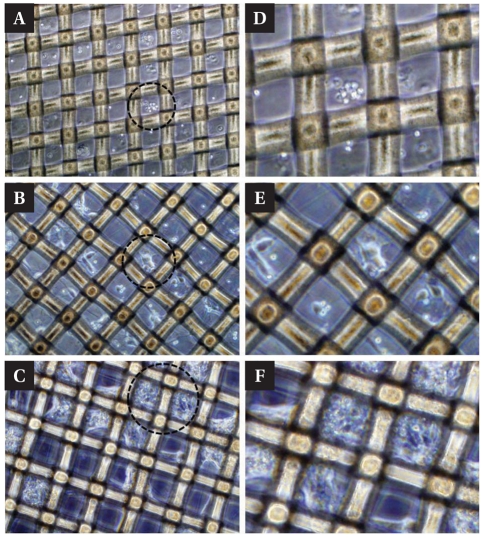
Conventional method of cell culture studies has been performed on two-dimensional substrates. Recently, three-dimensional (3D) cell culture platforms have been a subject of interest as cells in 3D has significant differences in cell differentiation and behavior. Here we report a novel approach of 3D cell culture using a nylon micro mesh (NMM) as a cell culture scaffold. NMM is commonly used in cell culture laboratory, which eliminates the requirement of special technicality for biological laboratories. Furthermore, it is made of a micro-meter thick nylon fibers, which was adequate to engineer in cellular scales. We demonstrate the feasibility of the NMM as a 3D scaffold using E18 rat hippocampal neurons. NMM could be coated with cell adhesive coatings (polylysine or polyelectrolyte) and neurons showed good viability. Cells were also encapsulated in an agarose hydrogel and cultured in 3D using NMM. In addition, the 3D pattern of NMM could be used as a guidance cue for neurite outgrowth. The flexible and elastic properties of NMMs made it easier to handle the scaffold and also readily applicable for large-scale tissue engineering applications.
传统的细胞培养方法是在二维基质上进行的。最近,三维(3D)细胞培养平台成为研究的热点,因为 3D 中的细胞在细胞分化和行为上有显著的差异。在这里,我们报告了一种使用尼龙微网(NMM)作为细胞培养支架的新型 3D 细胞培养方法。NMM 常用于细胞培养实验室,不需要特殊的技术即可进行生物学实验。此外,它由厚度为微米级的尼龙纤维制成,足以在细胞尺度上进行工程设计。我们使用 E18 大鼠海马神经元证明了 NMM 作为 3D 支架的可行性。NMM 可以涂覆细胞黏附涂层(多聚赖氨酸或聚电解质),神经元具有良好的活力。细胞也可以在琼脂糖水凝胶中被包裹,并在 3D 中使用 NMM 进行培养。此外,NMM 的 3D 图案可以作为神经突生长的导向线索。NMM 的灵活性和弹性使其更容易处理支架,并且非常适用于大规模的组织工程应用。