Faculdade de Farmácia, Universidade de Coimbra Coimbra, Portugal.
Front Physiol. 2011 Nov 15;2:82. doi: 10.3389/fphys.2011.00082. eCollection 2011.
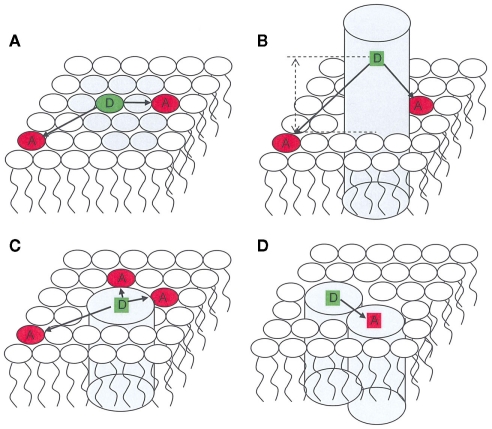
Förster resonance energy transfer (FRET), in most applications used as a "spectroscopic ruler," allows an easy determination of the donor-acceptor intermolecular distance. However, the situation becomes complex in membranes, since around each donor there is an ensemble of acceptors at non-correlated distances. In this review, state-of-the-art methodologies for this situation are presented, usually involving time-resolved data and model fitting. This powerful approach can be used to study the occurrence of phase separation ("rafts" or other type of domains), allowing their detection as well as size evaluation. Formalisms for studying lipid-protein and protein-protein interactions according to specific topologies are also addressed. The advantages and added complexity of a specific type of FRET (energy homotransfer or energy migration) are described, as well as applications of FRET under the microscope.
Förster 共振能量转移(FRET),在大多数应用中被用作“光谱标尺”,可以轻松确定供体-受体分子间的距离。然而,在膜中情况变得复杂,因为在每个供体周围都有一组在非相关距离处的受体。在这篇综述中,介绍了针对这种情况的最新方法,通常涉及时间分辨数据和模型拟合。这种强大的方法可用于研究相分离(“筏”或其他类型的域)的发生,允许检测和大小评估。还介绍了根据特定拓扑结构研究脂质-蛋白质和蛋白质-蛋白质相互作用的形式。描述了特定类型的 FRET(能量同转移或能量迁移)的优点和增加的复杂性,以及在显微镜下的 FRET 应用。