Schneider P, Dubus I, Gouel F, Legrand E, Vannier J P, Vasse M
Laboratoire MERCI-EA3829, Rouen University, 22 rue Gambetta, 76000 Rouen, France.
Adv Hematol. 2011;2011:274628. doi: 10.1155/2011/274628. Epub 2011 Nov 9.
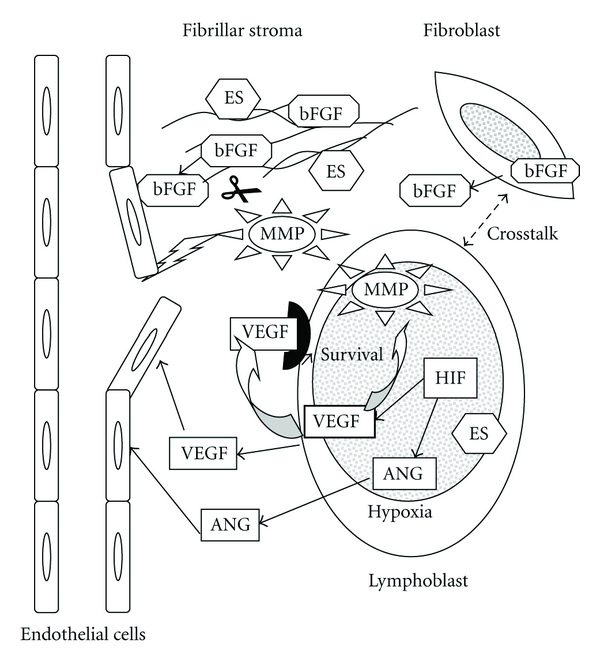
The role of angiogenesis in acute leukaemia has been discussed since the cloning of the gene of vascular endothelial growth factor (VEGF) from the acute myelogenous leukemia cell line (HL60) and, thereafter, when the first studies reported increased bone marrow vascularity and elevation of angiogenic cytokines in acute lymphoblastic leukaemia (ALL). VEGF and basic fibroblast growth factor (bFGF) are the major proangiogenic cytokines that have been studied, and evaluation of their prognostic impact in childhood ALL has been reported in several studies, though with controversial results. The antiangiogenic response, contributing to the angiogenic balance, has scarcely been reported. The origin of the factors, their prognostic value, and their relevance as good markers of what really happens in the bone marrow are discussed in this paper. The place of antiangiogenic drugs in ALL has to be defined in the global treatment strategy.
自从从急性髓性白血病细胞系(HL60)中克隆出血管内皮生长因子(VEGF)基因,以及随后有首批研究报告急性淋巴细胞白血病(ALL)患者骨髓血管增多和血管生成细胞因子升高以来,血管生成在急性白血病中的作用就一直被人们所讨论。VEGF和碱性成纤维细胞生长因子(bFGF)是已被研究的主要促血管生成细胞因子,多项研究报告了对它们在儿童ALL中的预后影响的评估,不过结果存在争议。几乎没有关于有助于血管生成平衡的抗血管生成反应的报告。本文讨论了这些因子的来源、它们的预后价值以及它们作为骨髓中实际情况的良好标志物的相关性。抗血管生成药物在ALL治疗中的地位必须在整体治疗策略中加以明确。