Department of Pharmacology, the University of Melbourne, Parkville, Victoria, Australia.
PLoS One. 2011;6(11):e27465. doi: 10.1371/journal.pone.0027465. Epub 2011 Nov 16.
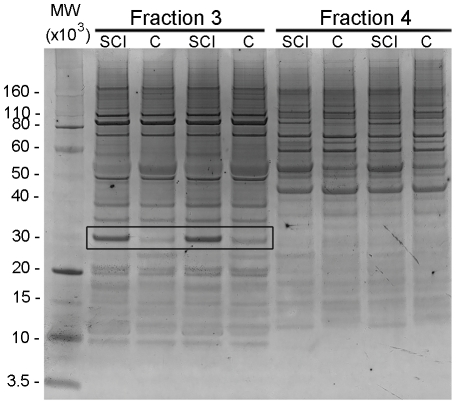
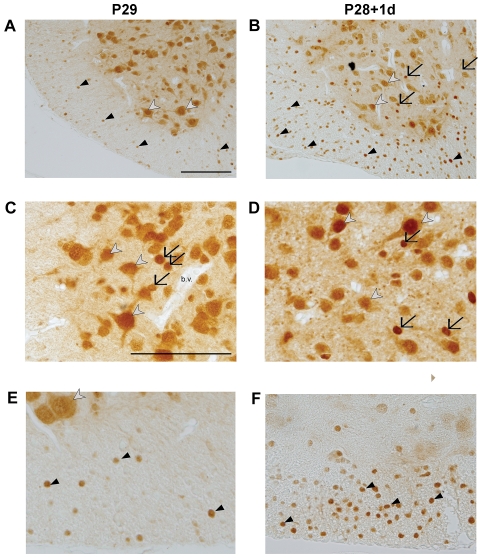
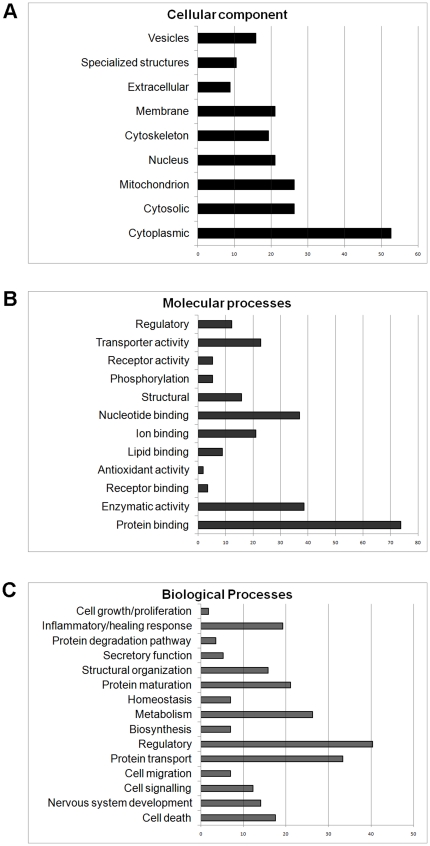
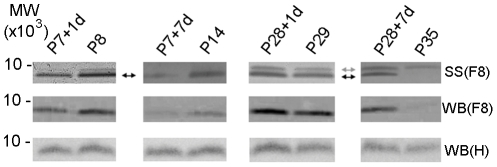
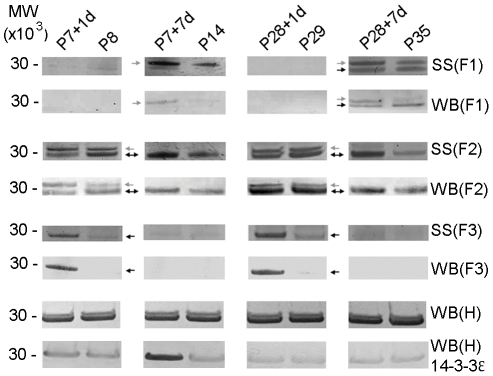
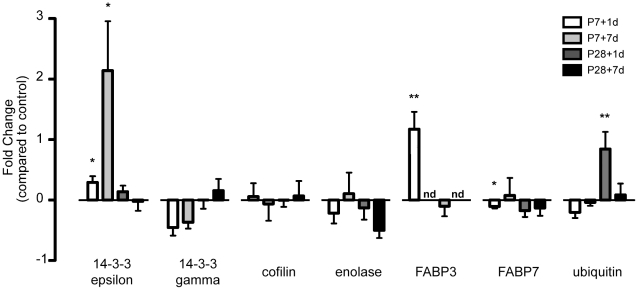
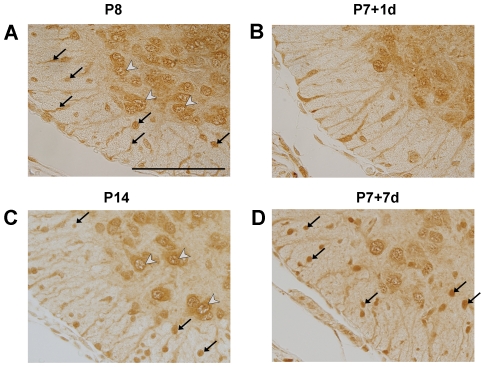
Recovery from severe spinal injury in adults is limited, compared to immature animals who demonstrate some capacity for repair. Using laboratory opossums (Monodelphis domestica), the aim was to compare proteomic responses to injury at two ages: one when there is axonal growth across the lesion and substantial behavioural recovery and one when no axonal growth occurs. Anaesthetized pups at postnatal day (P) 7 or P28 were subjected to complete transection of the spinal cord at thoracic level T10. Cords were collected 1 or 7 days after injury and from age-matched controls. Proteins were separated based on isoelectric point and subunit molecular weight; those whose expression levels changed following injury were identified by densitometry and analysed by mass spectrometry. Fifty-six unique proteins were identified as differentially regulated in response to spinal transection at both ages combined. More than 50% were cytoplasmic and 70% belonged to families of proteins with characteristic binding properties. Proteins were assigned to groups by biological function including regulation (40%), metabolism (26%), inflammation (19%) and structure (15%). More changes were detected at one than seven days after injury at both ages. Seven identified proteins: 14-3-3 epsilon, 14-3-3 gamma, cofilin, alpha enolase, heart fatty acid binding protein (FABP3), brain fatty acid binding protein (FABP7) and ubiquitin demonstrated age-related differential expression and were analysed by qRT-PCR. Changes in mRNA levels for FABP3 at P7+1day and ubiquitin at P28+1day were statistically significant. Immunocytochemical staining showed differences in ubiquitin localization in younger compared to older cords and an increase in oligodendrocyte and neuroglia immunostaining following injury at P28. Western blot analysis supported proteomic results for ubiquitin and 14-3-3 proteins. Data obtained at the two ages demonstrated changes in response to injury, compared to controls, that were different for different functional protein classes. Some may provide targets for novel drug or gene therapies.
与具有一定修复能力的未成熟动物相比,成人严重脊髓损伤的恢复能力有限。本研究采用实验室袋貂(Monodelphis domestica),旨在比较两个年龄阶段(一个是轴突穿过损伤部位且有大量行为恢复,另一个是没有轴突生长)的蛋白质组对损伤的反应。在出生后第 7 天或第 28 天,将麻醉后的幼崽的 T10 胸椎脊髓完全横断。在损伤后 1 天或 7 天以及与年龄匹配的对照组收集脊髓。根据等电点和亚基分子量分离蛋白质;通过密度测定法鉴定表达水平在损伤后发生变化的蛋白质,并通过质谱分析法进行分析。将两个年龄阶段脊髓横断后差异表达的 56 种蛋白质鉴定为差异调节。超过 50%的蛋白质是细胞质的,70%属于具有特征结合特性的蛋白质家族。根据生物学功能,将蛋白质分为调节(40%)、代谢(26%)、炎症(19%)和结构(15%)等组。两个年龄阶段在损伤后 1 天和 7 天检测到更多的变化。在两个年龄阶段,有 7 种鉴定出的蛋白质:14-3-3 ε、14-3-3 γ、丝切蛋白、α烯醇酶、心脏脂肪酸结合蛋白(FABP3)、脑脂肪酸结合蛋白(FABP7)和泛素表现出年龄相关的差异表达,并通过 qRT-PCR 进行了分析。P7+1 天 FABP3 和 P28+1 天泛素的 mRNA 水平变化具有统计学意义。免疫细胞化学染色显示,年轻脊髓的泛素定位与年老脊髓不同,P28 后损伤导致少突胶质细胞和神经胶质免疫染色增加。Western blot 分析支持泛素和 14-3-3 蛋白的蛋白质组学结果。两个年龄阶段的结果显示,与对照组相比,不同功能蛋白类别的损伤反应不同,其中一些可能为新型药物或基因治疗提供靶点。