Saunders Norman R, Dziegielewska Katarzyna M, Whish Sophie C, Hinds Lyn A, Wheaton Benjamin J, Huang Yifan, Henry Steve, Habgood Mark D
Department of Pharmacology and Therapeutics, The University of Melbourne, Melbourne, VIC, 3010, Australia.
Health and Biosecurity Business Unit, Commonwealth Science and Industrial Research Organisation (CSIRO), Canberra, ACT, 2601, Australia.
F1000Res. 2017 Jun 15;6:921. doi: 10.12688/f1000research.11712.1. eCollection 2017.
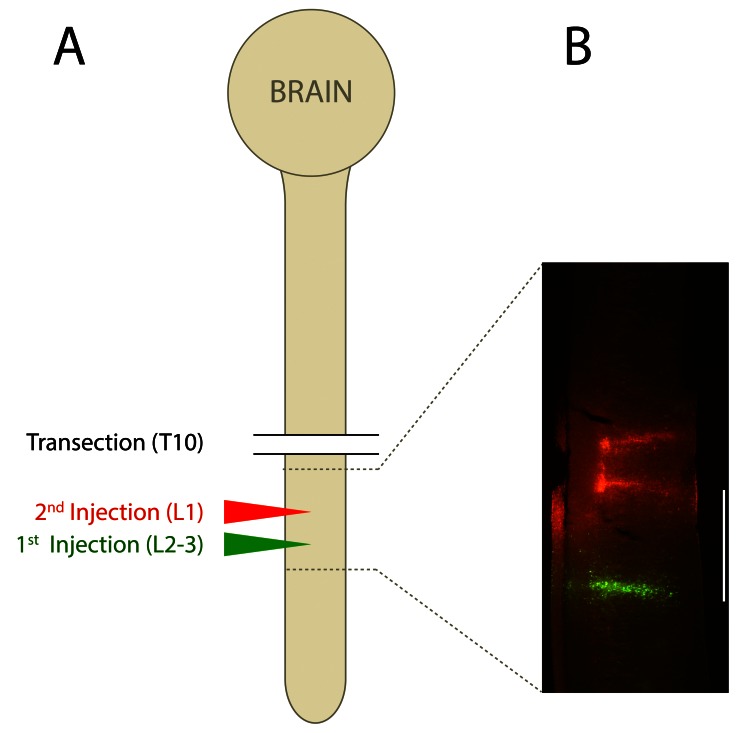
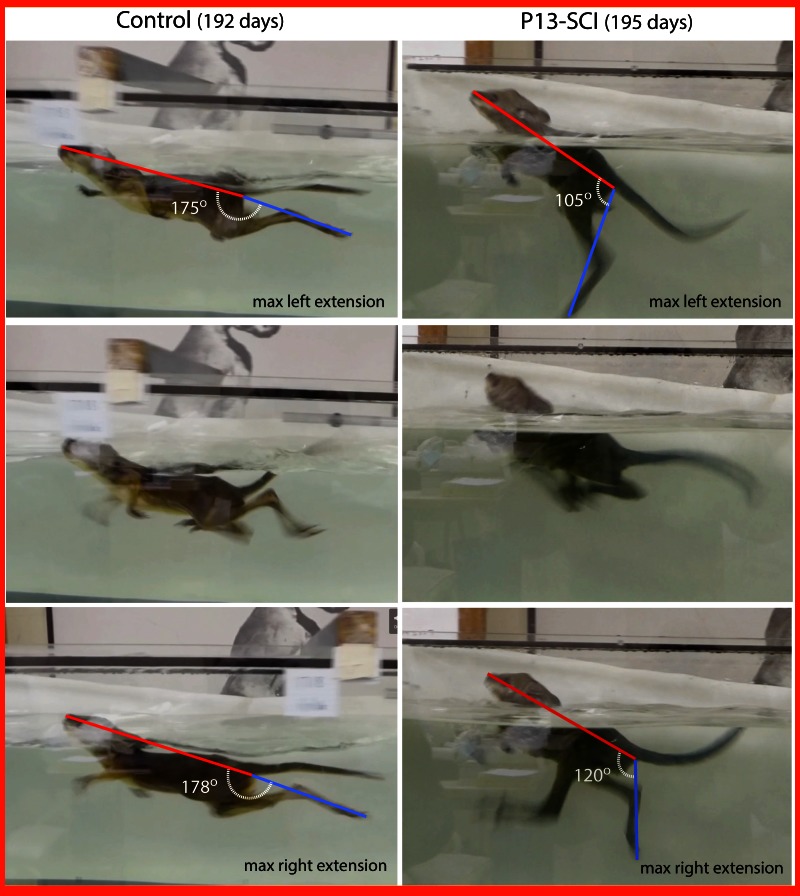
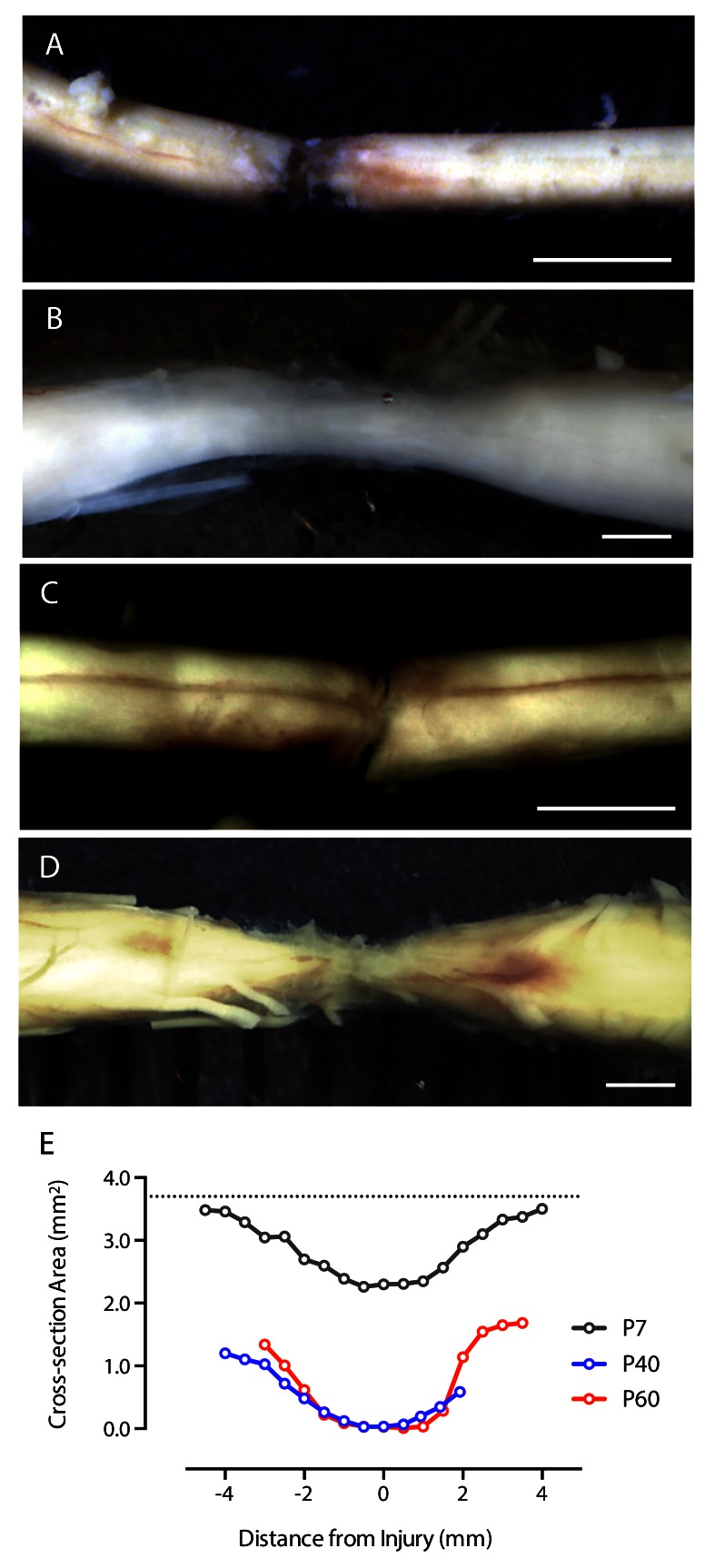
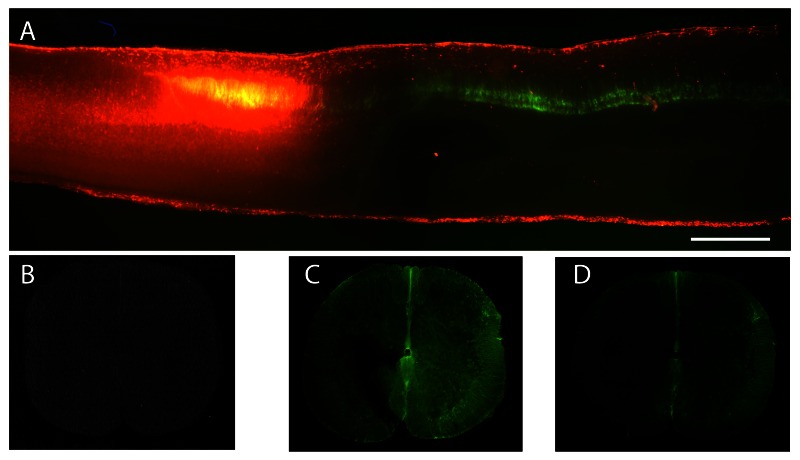
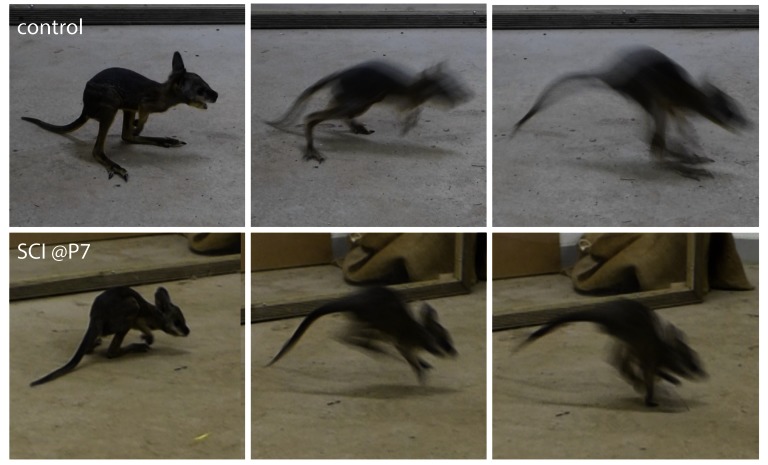
: Most animal studies of spinal cord injury are conducted in quadrupeds, usually rodents. It is unclear to what extent functional results from such studies can be translated to bipedal species such as humans because bipedal and quadrupedal locomotion involve very different patterns of spinal control of muscle coordination. Bipedalism requires upright trunk stability and coordinated postural muscle control; it has been suggested that peripheral sensory input is less important in humans than quadrupeds for recovery of locomotion following spinal injury. : We used an Australian macropod marsupial, the tammar wallaby ), because tammars exhibit an upright trunk posture, human-like alternating hindlimb movement when swimming and bipedal over-ground locomotion. Regulation of their muscle movements is more similar to humans than quadrupeds. At different postnatal (P) days (P7-60) tammars received a complete mid-thoracic spinal cord transection. Morphological repair, as well as functional use of hind limbs, was studied up to the time of their pouch exit. Growth of axons across the lesion restored supraspinal innervation in animals injured up to 3 weeks of age but not in animals injured after 6 weeks of age. At initial pouch exit (P180), the young injured at P7-21 were able to hop on their hind limbs similar to age-matched controls and to swim albeit with a different stroke. Those animals injured at P40-45 appeared to be incapable of normal use of hind limbs even while still in the pouch. : Data indicate that the characteristic over-ground locomotion of tammars provides a model in which regrowth of supraspinal connections across the site of injury can be studied in a bipedal animal. Forelimb weight-bearing motion and peripheral sensory input appear not to compensate for lack of hindlimb control, as occurs in quadrupeds. Tammars may be a more appropriate model for studies of therapeutic interventions relevant to humans.
大多数脊髓损伤的动物研究是在四足动物中进行的,通常是啮齿动物。目前尚不清楚这些研究的功能结果在多大程度上可以转化到两足动物物种(如人类)身上,因为两足和四足运动涉及非常不同的脊髓对肌肉协调的控制模式。两足行走需要直立的躯干稳定性和协调的姿势肌肉控制;有人认为,在脊髓损伤后的运动恢复中,外周感觉输入在人类中比在四足动物中不那么重要。我们使用了一种澳大利亚有袋类大袋鼠——短尾矮袋鼠,因为短尾矮袋鼠表现出直立的躯干姿势,在游泳时具有类似人类的交替后肢运动以及两足地面行走。它们肌肉运动的调节比四足动物更类似于人类。在不同的出生后(P)天数(P7 - 60),短尾矮袋鼠接受了完全的胸段脊髓横断。在它们出袋前,对其形态修复以及后肢的功能使用情况进行了研究。在损伤后3周龄以内受伤的动物中,轴突穿过损伤部位的生长恢复了脊髓上神经支配,但在6周龄后受伤的动物中则没有。在最初出袋时(P180),在P7 - 21受伤的幼崽能够用后肢跳跃,类似于年龄匹配的对照组,并且能够游泳,尽管划水方式不同。那些在P40 - 45受伤的动物即使还在育儿袋中似乎也无法正常使用后肢。数据表明,短尾矮袋鼠特有的地面运动提供了一个模型,在这个模型中,可以在两足动物中研究脊髓上连接在损伤部位的再生情况。前肢负重运动和外周感觉输入似乎无法像在四足动物中那样弥补后肢控制的缺失。短尾矮袋鼠可能是更适合进行与人类相关治疗干预研究的模型。