Department of Cellular Pathology, John Radcliffe Hospital, Oxford, UK.
Lancet. 2012 Jan 14;379(9811):136-42. doi: 10.1016/S0140-6736(11)61483-9. Epub 2011 Nov 21.
Public objection to autopsy has led to a search for minimally invasive alternatives. Imaging has potential, but its accuracy is unknown. We aimed to identify the accuracy of post-mortem CT and MRI compared with full autopsy in a large series of adult deaths.
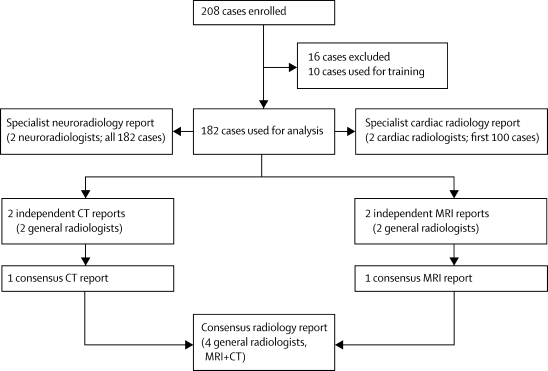
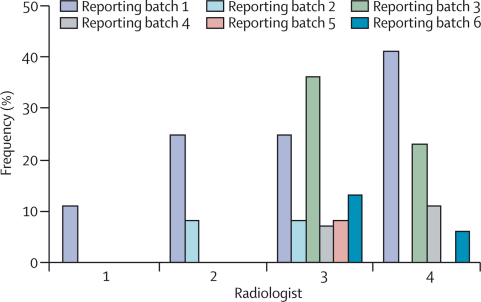
This study was undertaken at two UK centres in Manchester and Oxford between April, 2006, and November, 2008. We used whole-body CT and MRI followed by full autopsy to investigate a series of adult deaths that were reported to the coroner. CT and MRI scans were reported independently, each by two radiologists who were masked to the autopsy findings. All four radiologists then produced a consensus report based on both techniques, recorded their confidence in cause of death, and identified whether autopsy was needed.
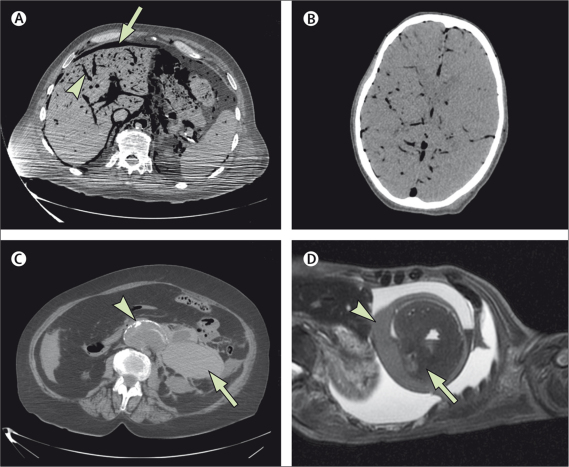
We assessed 182 unselected cases. The major discrepancy rate between cause of death identified by radiology and autopsy was 32% (95% CI 26-40) for CT, 43% (36-50) for MRI, and 30% (24-37) for the consensus radiology report; 10% (3-17) lower for CT than for MRI. Radiologists indicated that autopsy was not needed in 62 (34%; 95% CI 28-41) of 182 cases for CT reports, 76 (42%; 35-49) of 182 cases for MRI reports, and 88 (48%; 41-56) of 182 cases for consensus reports. Of these cases, the major discrepancy rate compared with autopsy was 16% (95% CI 9-27), 21% (13-32), and 16% (10-25), respectively, which is significantly lower (p<0·0001) than for cases with no definite cause of death. The most common imaging errors in identification of cause of death were ischaemic heart disease (n=27), pulmonary embolism (11), pneumonia (13), and intra-abdominal lesions (16).
We found that, compared with traditional autopsy, CT was a more accurate imaging technique than MRI for providing a cause of death. The error rate when radiologists provided a confident cause of death was similar to that for clinical death certificates, and could therefore be acceptable for medicolegal purposes. However, common causes of sudden death are frequently missed on CT and MRI, and, unless these weaknesses are addressed, systematic errors in mortality statistics would result if imaging were to replace conventional autopsy.
Policy Research Programme, Department of Health, UK.
公众对尸检的反对导致人们寻求微创替代品。影像学具有潜力,但准确性尚不清楚。我们旨在确定在一系列成人死亡中,死后 CT 和 MRI 与全尸检相比的准确性。
这项研究在英国曼彻斯特和牛津的两个中心进行,时间为 2006 年 4 月至 2008 年 11 月。我们使用全身 CT 和 MRI 检查,然后进行全尸检,以调查死因向验尸官报告的一系列成人死亡案例。CT 和 MRI 扫描由两位放射科医生独立报告,他们对尸检结果不知情。然后,所有四位放射科医生根据这两种技术都撰写了一份共识报告,记录了他们对死因的信心,并确定是否需要尸检。
我们评估了 182 例未经选择的病例。放射科医生确定的死因与尸检结果之间的主要差异率为 CT 为 32%(95%CI 26-40),MRI 为 43%(36-50),共识放射学报告为 30%(24-37);CT 比 MRI 低 10%。对于 CT 报告,放射科医生认为 182 例中有 62 例(34%;95%CI 28-41),MRI 报告中有 76 例(42%;35-49),共识报告中有 88 例(48%;41-56)不需要尸检。在这些病例中,与尸检相比,主要差异率分别为 16%(95%CI 9-27)、21%(13-32)和 16%(10-25),这明显低于(p<0.0001)无明确死因的病例。识别死因时最常见的影像学错误是缺血性心脏病(n=27)、肺栓塞(n=11)、肺炎(n=13)和腹部病变(n=16)。
我们发现,与传统尸检相比,CT 是一种比 MRI 更准确的成像技术,可以提供死因。当放射科医生提供明确的死因时,错误率与临床死亡证明相似,因此从法医学角度来看可以接受。然而,CT 和 MRI 经常遗漏常见的猝死原因,如果影像学取代传统尸检,死亡率统计数据将出现系统误差。
英国卫生部政策研究计划。