• 文献检索
  • 文档翻译
  • 深度研究
  • 学术资讯
  • Suppr Zotero 插件Zotero 插件
  • 邀请有礼
  • 套餐&价格
  • 历史记录
应用&插件
Suppr Zotero 插件Zotero 插件浏览器插件Mac 客户端Windows 客户端微信小程序
定价
高级版会员购买积分包购买API积分包
服务
文献检索文档翻译深度研究API 文档MCP 服务
关于我们
关于 Suppr公司介绍联系我们用户协议隐私条款
关注我们

Suppr 超能文献

核心技术专利:CN118964589B侵权必究
粤ICP备2023148730 号-1Suppr @ 2026

文献检索

告别复杂PubMed语法,用中文像聊天一样搜索,搜遍4000万医学文献。AI智能推荐,让科研检索更轻松。

立即免费搜索

文件翻译

保留排版,准确专业,支持PDF/Word/PPT等文件格式,支持 12+语言互译。

免费翻译文档

深度研究

AI帮你快速写综述,25分钟生成高质量综述,智能提取关键信息,辅助科研写作。

立即免费体验

唾液蛋白与幼儿龋齿:凝胶电泳分析

Salivary proteins and early childhood caries: A gel electrophoretic analysis.

作者信息

Bhalla Sumati, Tandon Shobha, Satyamoorthy K

机构信息

Department of Pedodontics and Preventive Dentistry, Manipal College of Dental Sciences, Manipal, India.

出版信息

Contemp Clin Dent. 2010 Jan;1(1):17-22. doi: 10.4103/0976-237X.62515.

DOI:10.4103/0976-237X.62515
PMID:22114372
原文链接:https://pmc.ncbi.nlm.nih.gov/articles/PMC3220062/
Abstract

BACKGROUND

Early childhood caries (ECC) is a common disease process that afflicts a large proportion of the child population worldwide. Extensive research in past indicates that it is the result of bacterial infection, also influenced by host and dietary factors. Current caries research seeks to identify risk factors as well as natural oral defenses that may protect against or prevent caries development. Saliva, in spite of being the strongest defense system, still has a wide array of properties and proteins whose role is yet not clearly known.

AIM

To compare the resting human whole salivary characteristics in children with ECC and those who are caries free.

SETTINGS AND DESIGN

The study was conducted over a period of 9 months in 4- to 6-year-old 100 children comprising two groups - 50 with ECC and 50 caries free.

MATERIALS AND METHODS

The whole salivary flow rate, pH, mean protein concentration, and the electrophoretic profile of salivary proteins by sodium dodecyl sulfate-polyacrylamide gel electrophoresis (SDS-PAGE) were compared among both groups.

STATISTICAL ANALYSIS

The SPSS (version 11.0) software package was used to conduct the chi-square, Fisher's exact and Pearson's chi-square tests to compare the data.

RESULTS

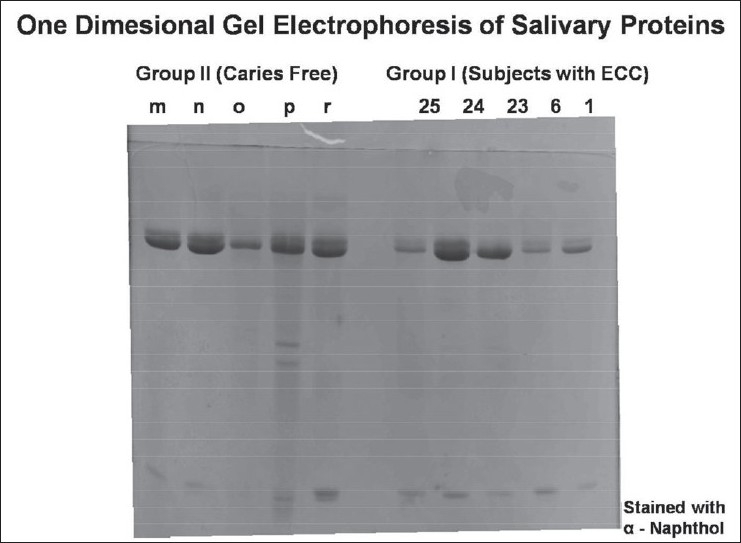
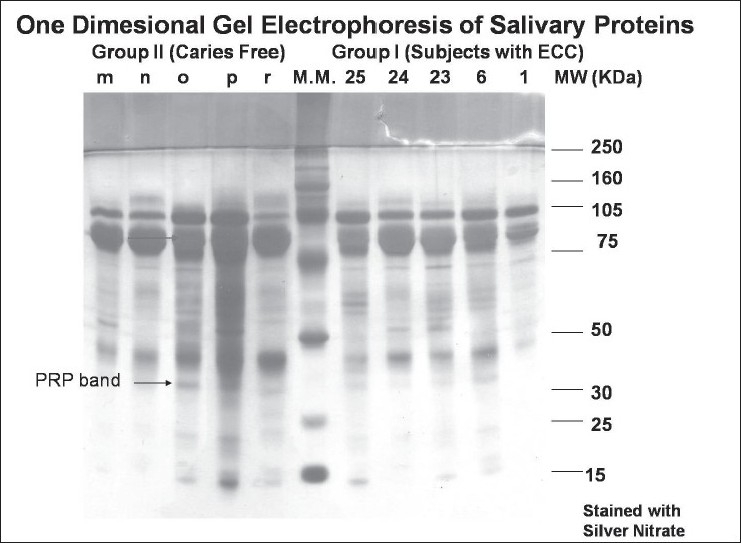
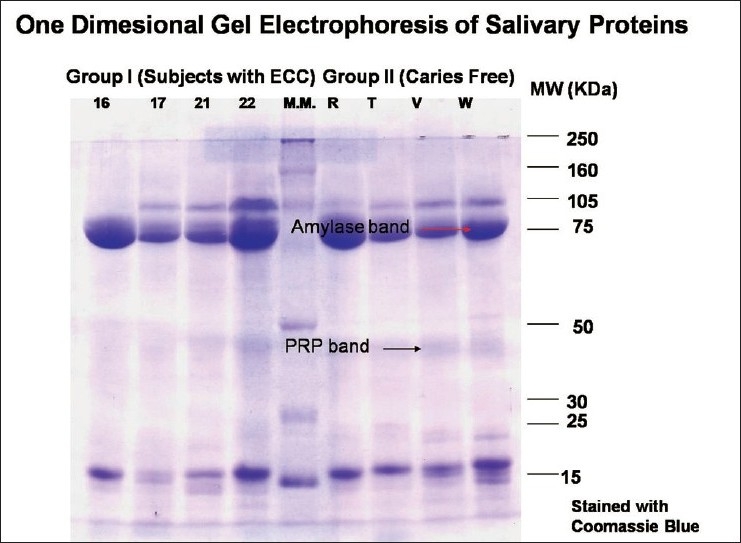
On gel electrophoresis, there was a significant difference among both groups with caries-free subjects having a higher number of proline-rich protein bands, substantiating the protective role of this protein. A significantly higher number of glycoprotein bands were observed in the whole saliva of subjects with ECC. A significant inverse correlation between the mean protein concentration and the whole salivary flow rate was observed in both groups.

摘要

背景

幼儿龋齿(ECC)是一种常见的疾病过程,困扰着全球很大一部分儿童群体。过去的大量研究表明,它是细菌感染的结果,也受宿主和饮食因素的影响。当前的龋齿研究旨在确定可能预防或防止龋齿发展的风险因素以及天然口腔防御机制。唾液尽管是最强的防御系统,但仍有大量特性和蛋白质,其作用尚不清楚。

目的

比较患ECC儿童和无龋儿童的静息人全唾液特征。

设置与设计

该研究在4至6岁的100名儿童中进行,为期9个月,分为两组——50名患ECC儿童和50名无龋儿童。

材料与方法

比较两组的全唾液流速、pH值、平均蛋白质浓度以及通过十二烷基硫酸钠 - 聚丙烯酰胺凝胶电泳(SDS - PAGE)得到的唾液蛋白质电泳图谱。

统计分析

使用SPSS(版本11.0)软件包进行卡方检验、Fisher精确检验和Pearson卡方检验以比较数据。

结果

在凝胶电泳中,两组之间存在显著差异,无龋受试者富含脯氨酸的蛋白带数量更多,证实了该蛋白的保护作用。在患ECC受试者的全唾液中观察到糖蛋白带数量显著更多。两组中均观察到平均蛋白质浓度与全唾液流速之间存在显著负相关。
https://cdn.ncbi.nlm.nih.gov/pmc/blobs/6442/3220062/2a587beb1f3b/CCD-1-17-g003.jpg
https://cdn.ncbi.nlm.nih.gov/pmc/blobs/6442/3220062/34e129b556a9/CCD-1-17-g001.jpg
https://cdn.ncbi.nlm.nih.gov/pmc/blobs/6442/3220062/b1ab237e5157/CCD-1-17-g002.jpg
https://cdn.ncbi.nlm.nih.gov/pmc/blobs/6442/3220062/2a587beb1f3b/CCD-1-17-g003.jpg
https://cdn.ncbi.nlm.nih.gov/pmc/blobs/6442/3220062/34e129b556a9/CCD-1-17-g001.jpg
https://cdn.ncbi.nlm.nih.gov/pmc/blobs/6442/3220062/b1ab237e5157/CCD-1-17-g002.jpg
https://cdn.ncbi.nlm.nih.gov/pmc/blobs/6442/3220062/2a587beb1f3b/CCD-1-17-g003.jpg

相似文献

1
Salivary proteins and early childhood caries: A gel electrophoretic analysis.唾液蛋白与幼儿龋齿:凝胶电泳分析
Contemp Clin Dent. 2010 Jan;1(1):17-22. doi: 10.4103/0976-237X.62515.
2
Estimation of salivary proteins in early childhood caries before and after treatment using gel electrophoresis.采用凝胶电泳技术对治疗前后幼儿龋齿唾液蛋白进行评估。
J Indian Soc Pedod Prev Dent. 2021 Oct-Dec;39(4):403-408. doi: 10.4103/jisppd.jisppd_452_20.
3
Comparison of Salivary Flow Rate, pH, Buffering Capacity, and Secretory Immunoglobulin A Levels between Children with Early Childhood Caries and Caries-free Children.患有幼儿龋齿的儿童与无龋齿儿童的唾液流速、pH值、缓冲能力及分泌型免疫球蛋白A水平的比较
Int J Clin Pediatr Dent. 2024 Mar;17(3):334-340. doi: 10.5005/jp-journals-10005-2751.
4
Electrophoretic analysis of whole saliva and prevalence of dental caries. A study in Mexican dental students.全唾液的电泳分析与龋齿患病率。一项针对墨西哥牙科学生的研究。
Arch Med Res. 2002 Sep-Oct;33(5):499-505. doi: 10.1016/s0188-4409(02)00395-8.
5
Resemblance of salivary protein profiles between children with early childhood caries and caries-free controls.患有幼儿龋齿的儿童与无龋齿对照儿童唾液蛋白质谱的相似性。
Eur J Oral Sci. 2009 Aug;117(4):369-73. doi: 10.1111/j.1600-0722.2009.00641.x.
6
Evaluation of salivary nitric oxide level in children with early childhood caries.幼儿龋患儿唾液一氧化氮水平的评估
Dent Res J (Isfahan). 2016 Jul-Aug;13(4):338-41. doi: 10.4103/1735-3327.187882.
7
Comparative evaluation and correlation of salivary total antioxidant capacity and salivary pH in caries-free and severe early childhood caries children.无龋和重度幼儿早期龋儿童唾液总抗氧化能力与唾液pH值的比较评估及相关性研究
J Contemp Dent Pract. 2015 Mar 1;16(3):234-7. doi: 10.5005/jp-journals-10024-1667.
8
Mutans Streptococci counts from saliva and its protein profile in early childhood caries.幼儿龋中唾液变形链球菌计数及其蛋白质谱
Interv Med Appl Sci. 2018 Dec;10(4):222-225. doi: 10.1556/1646.10.2018.42.
9
Comparison of total antioxidant capacity in saliva of children with severe early childhood caries and caries-free children.重度幼儿龋齿患儿与无龋儿童唾液中总抗氧化能力的比较。
Caries Res. 2014;48(4):271-5. doi: 10.1159/000355581.
10
Salivary cystatin S levels in children with early childhood caries in comparison with caries-free children; statistical analysis and machine learning.唾液cystatin S 水平在幼儿龋病患儿与无龋病患儿中的比较;统计分析和机器学习。
BMC Oral Health. 2021 Dec 18;21(1):650. doi: 10.1186/s12903-021-02016-x.

引用本文的文献

1
Saliva-Based Protein Analysis in Pediatric Dentofacial Inflammation.基于唾液的小儿牙颌面炎症蛋白质分析
Pediatric Health Med Ther. 2024 Feb 27;15:95-102. doi: 10.2147/PHMT.S440223. eCollection 2024.
2
Maxillofacial Morphology as a Predictive Factor for Caries Risk in Orthodontic Patients: A Cross-Sectional Study.颌面形态作为正畸患者龋齿风险的预测因素:一项横断面研究。
J Clin Med. 2024 Jan 22;13(2):622. doi: 10.3390/jcm13020622.
3
Comparison of oral cavity protein abundance among caries-free and caries-affected individuals-a systematic review and meta-analysis.

本文引用的文献

1
Large-scale identification of proteins in human salivary proteome by liquid chromatography/mass spectrometry and two-dimensional gel electrophoresis-mass spectrometry.通过液相色谱/质谱联用和二维凝胶电泳-质谱联用技术对人唾液蛋白质组中的蛋白质进行大规模鉴定。
Proteomics. 2005 Apr;5(6):1714-28. doi: 10.1002/pmic.200401037.
2
Salivary proteins: protective and diagnostic value in cariology?唾液蛋白:在龋病学中的保护和诊断价值?
Caries Res. 2004 May-Jun;38(3):247-53. doi: 10.1159/000077762.
3
Salivary antibodies, amylase and protein from children with early childhood caries.
无龋和患龋个体口腔蛋白质丰度的比较——一项系统评价和荟萃分析
Front Oral Health. 2023 Sep 15;4:1265817. doi: 10.3389/froh.2023.1265817. eCollection 2023.
4
Physical and chemical properties of saliva and its role in Early Childhood caries - A systematic review and meta-analysis.唾液的物理和化学性质及其在幼儿龋齿中的作用——一项系统综述和荟萃分析
J Oral Biol Craniofac Res. 2023 Sep-Oct;13(5):527-538. doi: 10.1016/j.jobcr.2023.05.011. Epub 2023 Jun 17.
5
Correlation of Carbonic Anhydrase VI Enzyme, Total Proteins, Antioxidant Levels of Saliva and Dental Caries in Caries-Free and Caries-Active Children - A Case-Control Study.无龋和患龋儿童唾液中碳酸酐酶 VI 酶、总蛋白、抗氧化水平与龋齿的相关性——一项病例对照研究
Contemp Clin Dent. 2022 Oct-Dec;13(4):315-321. doi: 10.4103/ccd.ccd_276_21. Epub 2022 Nov 3.
6
Caries Experience and Increment in Children Attending Kindergartens with an Early Childhood Caries Preventive Program Compared to Basic Prophylaxis Measures-A Retrospective Cohort Study.与基本预防措施相比,参加有幼儿龋预防项目的幼儿园儿童的龋病经历和龋病增量——一项回顾性队列研究
J Clin Med. 2022 May 19;11(10):2864. doi: 10.3390/jcm11102864.
7
Correlation between the extent of smoking, salivary protein profiles, and dental caries in young adult smokers.年轻成年吸烟者的吸烟程度、唾液蛋白质谱与龋齿之间的相关性。
Saudi Dent J. 2021 Nov;33(7):533-537. doi: 10.1016/j.sdentj.2020.09.002. Epub 2020 Sep 11.
8
Evaluation of salivary thiobarbituric acid reactive substances, total protein, and pH in children with various degrees of early childhood caries: a case-control study.不同程度幼儿早期龋患儿唾液中硫代巴比妥酸反应性物质、总蛋白和pH值的评估:一项病例对照研究
Eur Arch Paediatr Dent. 2021 Dec;22(6):1095-1099. doi: 10.1007/s40368-021-00672-9. Epub 2021 Oct 9.
9
Salivary biochemical indices related to early childhood caries.唾液生化指标与幼儿龋病的关系。
Hua Xi Kou Qiang Yi Xue Za Zhi. 2021 Jun 1;39(3):300-305. doi: 10.7518/hxkq.2021.03.009.
10
Salivary Protein Roles in Oral Health and as Predictors of Caries Risk.唾液蛋白在口腔健康中的作用以及作为龋齿风险预测指标的作用。
Open Life Sci. 2018 May 18;13:174-200. doi: 10.1515/biol-2018-0023. eCollection 2018 Jan.
患有幼儿龋齿的儿童的唾液抗体、淀粉酶和蛋白质。
Clin Oral Investig. 2003 Sep;7(3):154-7. doi: 10.1007/s00784-003-0222-7. Epub 2003 Aug 12.
4
Electrophoretic analysis of whole saliva and prevalence of dental caries. A study in Mexican dental students.全唾液的电泳分析与龋齿患病率。一项针对墨西哥牙科学生的研究。
Arch Med Res. 2002 Sep-Oct;33(5):499-505. doi: 10.1016/s0188-4409(02)00395-8.
5
Saliva as a diagnostic fluid.唾液作为一种诊断液。
Oral Dis. 2002 Mar;8(2):69-76. doi: 10.1034/j.1601-0825.2002.1o834.x.
6
Physical and chemical aspects of saliva as indicators of risk for dental caries in humans.唾液的物理和化学特性作为人类龋齿风险指标
J Dent Educ. 2001 Oct;65(10):1054-62.
7
Longitudinal analysis of the association of human salivary antimicrobial agents with caries increment and cariogenic micro-organisms: a two-year cohort study.人类唾液抗菌剂与龋齿增量及致龋微生物关联的纵向分析:一项为期两年的队列研究。
J Dent Res. 1998 Jan;77(1):73-80. doi: 10.1177/00220345980770011101.
8
Parotid saliva protein profiles in caries-free and caries-active adults.
Oral Surg Oral Med Oral Pathol Oral Radiol Endod. 1997 Feb;83(2):244-51. doi: 10.1016/s1079-2104(97)90012-3.
9
Salivary parameters of relevance for assessing caries activity in individuals and populations.与评估个体及人群龋齿活动度相关的唾液参数。
Community Dent Oral Epidemiol. 1997 Feb;25(1):82-6. doi: 10.1111/j.1600-0528.1997.tb00903.x.
10
Dental caries in relation to diet, saliva and cariogenic microorganisms in Tanzanians of selected age groups.特定年龄组坦桑尼亚人的龋齿与饮食、唾液及致龋微生物的关系
Community Dent Oral Epidemiol. 1996 Jun;24(3):169-74. doi: 10.1111/j.1600-0528.1996.tb00836.x.