Department of Veterinary Public Health, Faculty of Veterinary Medicine of Bari, Strada per Casamassima Km 3, 70010 Valenzano, Bari, Italy.
Mol Cell Probes. 2012 Feb;26(1):42-6. doi: 10.1016/j.mcp.2011.11.003. Epub 2011 Nov 20.
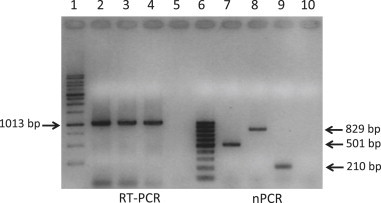
An atypical pestivirus ('Hobi'-like pestivirus, putative bovine viral diarrhoea 3, BVDV-3) was identified firstly in contaminated foetal calf serum batches and isolated subsequently from an outbreak of respiratory disease in a cattle herd in Italy. The isolation of the novel pestivirus from animals affected clinically posed concerns about the validity of BVDV eradication programs, considering that 'Hobi'-like pestivirus (BVDV-3) is undetected or mistyped by the molecular diagnostic tools currently employed. In this paper, the development of a nested PCR (nPCR) assay for unambiguous typing of all bovine pestiviruses is reported. The assay consisted of a first-round amplification using an oligonucleotide pair which binds to conserved sequences located in the 5' untranslated region and capsid gene, followed by a heminested PCR using virus-specific forward primers. The assay performances were evaluated analytically, showing good sensitivity and specificity. By analysis of 100 BVDV-positive samples typed using a nPCR assay discriminating ruminant pestiviruses, five samples recognised previously as BVDV-2 were not typed when submitted to the new assay (n=2) or reacted as 'Hobi'-like pestivirus BVDV-3 (n=3). Sequence analysis of the first-round amplification products showed that the untyped strains were border disease viruses, whereas the other three strains were true 'Hobi'-like viruses. The development of a molecular assay able to identify simultaneously all bovine pestiviruses known currently will help warrant biosafety of live vaccines and other biological products and assess the molecular epidemiology of 'Hobi'-like pestivirus, thus leading to the improvement of the eradication programs through unambiguous typing of pestiviruses infecting cattle.
一种非典型的瘟病毒(“霍比”样瘟病毒,假定为牛病毒性腹泻病毒 3,BVDV-3)最初在受污染的胎牛血清批次中被鉴定出来,随后从意大利一个牛群的呼吸道疾病爆发中分离出来。从临床上受感染的动物中分离出这种新型瘟病毒引起了对 BVDV 根除计划有效性的关注,因为目前使用的分子诊断工具无法检测或错误地检测到“霍比”样瘟病毒(BVDV-3)。本文报道了一种用于明确鉴定所有牛瘟病毒的巢式 PCR(nPCR)检测方法的开发。该检测方法包括第一轮扩增,使用一对与位于 5'非翻译区和衣壳基因中的保守序列结合的寡核苷酸,然后使用病毒特异性正向引物进行半巢式 PCR。该检测方法的分析性能得到了评估,显示出良好的敏感性和特异性。通过对使用区分反刍动物瘟病毒的 nPCR 检测方法分型的 100 个 BVDV 阳性样本进行分析,当提交给新检测方法时,五个以前被鉴定为 BVDV-2 的样本未被分型(n=2)或反应为“霍比”样瘟病毒 BVDV-3(n=3)。第一轮扩增产物的序列分析表明,未分型的毒株为边界病病毒,而其他三个毒株则是真正的“霍比”样病毒。开发一种能够同时识别目前已知的所有牛瘟病毒的分子检测方法,将有助于保证活疫苗和其他生物制品的生物安全性,并评估“霍比”样瘟病毒的分子流行病学,从而通过明确鉴定感染牛的瘟病毒来改进根除计划。