Research Institute Child Development and Education, University of Amsterdam, Nieuwe Prinsengracht 130, 1018 VZ Amsterdam, The Netherlands.
Clin Child Fam Psychol Rev. 2012 Mar;15(1):28-42. doi: 10.1007/s10567-011-0103-6.
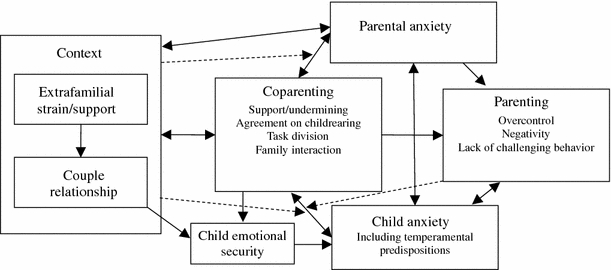
Research into anxiety has largely ignored the dynamics of family systems in anxiety development. Coparenting refers to the quality of coordination between individuals responsible for the upbringing of children and links different subsystems within the family, such as the child, the marital relationship, and the parents. This review discusses the potential mechanisms and empirical findings regarding the bidirectional relations of parent and child anxiety with coparenting. The majority of studies point to bidirectional associations between greater coparenting difficulties and higher levels of anxiety. For example, the few available studies suggest that paternal and perhaps maternal anxiety is linked to lower coparental support. Also, research supports the existence of inverse links between coparenting quality and child anxiety. A child's reactive temperament appears to have adverse effects on particularly coparenting of fathers. A conceptual model is proposed that integrates the role of parental and child anxiety, parenting, and coparenting, to guide future research and the development of clinical interventions. Future research should distinguish between fathers' and mothers' coparenting behaviors, include parental anxiety, and investigate the coparental relationship longitudinally. Clinicians should be aware of the reciprocal relations between child anxiety and coparenting quality, and families presenting for treatment who report child (or parent) anxiety should be assessed for difficulties in coparenting. Clinical approaches to bolster coparenting quality are called for.
研究焦虑症在很大程度上忽视了家庭系统在焦虑症发展中的动态。共同养育是指负责养育孩子的个体之间协调的质量,并将家庭内的不同子系统(如孩子、婚姻关系和父母)联系起来。这篇综述讨论了父母和孩子焦虑与共同养育之间的双向关系的潜在机制和实证发现。大多数研究表明,共同养育困难程度较高与焦虑程度较高之间存在双向关联。例如,为数不多的现有研究表明,父亲(也许还有母亲)的焦虑与较低的共同养育支持有关。此外,研究支持共同养育质量与儿童焦虑之间存在相反的联系。儿童的反应性气质似乎对父亲的共同养育产生不利影响。提出了一个概念模型,该模型整合了父母和孩子焦虑、养育和共同养育的作用,以指导未来的研究和临床干预措施的发展。未来的研究应区分父亲和母亲的共同养育行为,包括父母的焦虑,并从纵向角度研究共同养育关系。临床医生应该意识到儿童焦虑和共同养育质量之间的相互关系,对于前来接受治疗并报告儿童(或父母)焦虑的家庭,应评估其共同养育困难。需要采取增强共同养育质量的临床方法。