Institute of Health Carlos III, National Centre of Epidemiology, c/Monforte de Lemos no,5, 28029 Madrid, Spain.
BMC Public Health. 2011 Nov 30;11:899. doi: 10.1186/1471-2458-11-899.
Physicians of the Spanish Influenza Sentinel Surveillance System report and systematically swab patients attended to their practices for influenza-like illness (ILI). Within the surveillance system, some Spanish regions also participated in an observational study aiming at estimating influenza vaccine effectiveness (cycEVA study). During the season 2009-2010, we estimated pandemic influenza vaccine effectiveness using both the influenza surveillance data and the cycEVA study.
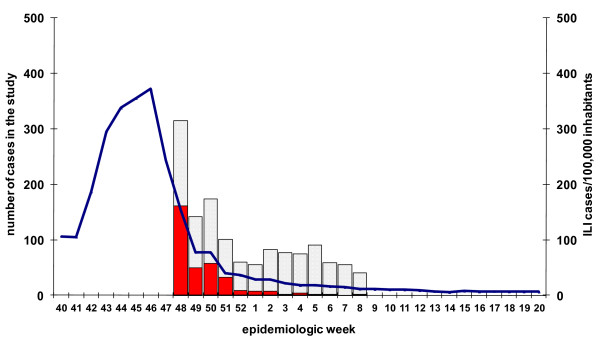
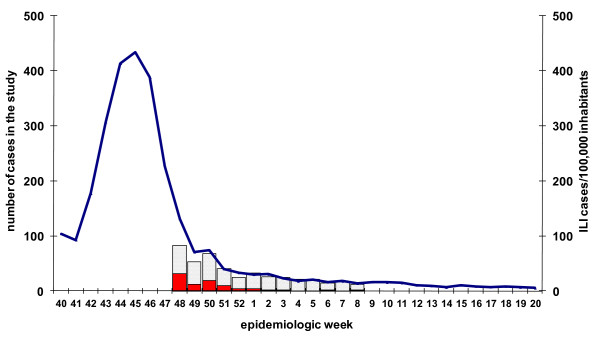
We conducted two case-control studies using the test-negative design, between weeks 48/2009 and 8/2010 of the pandemic season. The surveillance-based study included all swabbed patients in the sentinel surveillance system. The cycEVA study included swabbed patients from seven Spanish regions. Cases were laboratory-confirmed pandemic influenza A(H1N1)2009. Controls were ILI patients testing negative for any type of influenza. Variables collected in both studies included demographic data, vaccination status, laboratory results, chronic conditions, and pregnancy. Additionally, cycEVA questionnaire collected data on previous influenza vaccination, smoking, functional status, hospitalisations, visits to the general practitioners, and obesity. We used logistic regression to calculate adjusted odds ratios (OR), computing pandemic influenza vaccine effectiveness as (1-OR)*100.
We included 331 cases and 995 controls in the surveillance-based study and 85 cases and 351 controls in the cycEVA study. We detected nine (2.7%) and two (2.4%) vaccine failures in the surveillance-based and cycEVA studies, respectively. Adjusting for variables collected in surveillance database and swabbing month, pandemic influenza vaccine effectiveness was 62% (95% confidence interval (CI): -5; 87). The cycEVA vaccine effectiveness was 64% (95%CI: -225; 96) when adjusting for common variables with the surveillance system and 75% (95%CI: -293; 98) adjusting for all variables collected.
Point estimates of the pandemic influenza vaccine effectiveness suggested a protective effect of the pandemic vaccine against laboratory-confirmed influenza A(H1N1)2009 in the season 2009-2010. Both studies were limited by the low vaccine coverage and the late start of the vaccination campaign. Routine influenza surveillance provides reliable estimates and could be used for influenza vaccine effectiveness studies in future seasons taken into account the surveillance system limitations.
西班牙流感监测系统的医生报告并系统地对就诊于他们诊所的流感样疾病(ILI)患者进行拭子采样。在监测系统中,一些西班牙地区还参与了一项旨在估计流感疫苗效果(cycEVA 研究)的观察性研究。在 2009-2010 年季节期间,我们使用流感监测数据和 cycEVA 研究同时估计了大流行性流感疫苗的效果。
我们在大流行季节的第 48/2009 周和第 8/2010 周之间进行了两项基于病例对照的研究,使用了测试阴性设计。基于监测的研究包括监测系统中所有接受拭子采样的患者。cycEVA 研究包括来自西班牙七个地区的拭子采样患者。病例为经实验室确认的大流行性流感 A(H1N1)2009 型。对照组为流感检测为阴性的 ILI 患者。在两项研究中收集的变量包括人口统计学数据、疫苗接种情况、实验室结果、慢性疾病和妊娠。此外,cycEVA 问卷调查还收集了以前流感疫苗接种、吸烟、功能状态、住院、全科医生就诊和肥胖情况的数据。我们使用逻辑回归计算调整后的优势比(OR),将大流行性流感疫苗效果计算为(1-OR)*100。
我们在基于监测的研究中纳入了 331 例病例和 995 例对照,在 cycEVA 研究中纳入了 85 例病例和 351 例对照。我们在基于监测的研究和 cycEVA 研究中分别检测到 9(2.7%)和 2(2.4%)例疫苗失败。在调整监测数据库和拭子采样月份中收集的变量后,大流行性流感疫苗效果为 62%(95%置信区间(CI):-5;87)。当调整与监测系统共同的常见变量时,cycEVA 疫苗效果为 64%(95%CI:-225;96),当调整所有收集的变量时,疫苗效果为 75%(95%CI:-293;98)。
大流行性流感疫苗效果的点估计表明,大流行性流感疫苗对 2009-2010 季节中经实验室确认的甲型 H1N1 流感具有保护作用。这两项研究均受到疫苗接种覆盖率低和疫苗接种运动开始较晚的限制。常规流感监测提供了可靠的估计结果,并可用于未来季节的流感疫苗效果研究,同时考虑到监测系统的局限性。