Escola Nacional de Saúde Pública Sérgio Arouca-Fundação Oswaldo Cruz, Rio de Janeiro, Brazil.
BMC Geriatr. 2011 Nov 30;11:79. doi: 10.1186/1471-2318-11-79.
Inappropriate medication use (IMU) by elderly people is a public health problem associated with adverse effects on health. There are a number of methods for identifying IMU, some involving clinical judgment and others, consensually generated lists of drugs to be avoided. This review aims to describe studies that used information from insurance company and social security administrative databases to assess IMU among community-dwelling elderly and to present the risk factors most often associated with IMU.
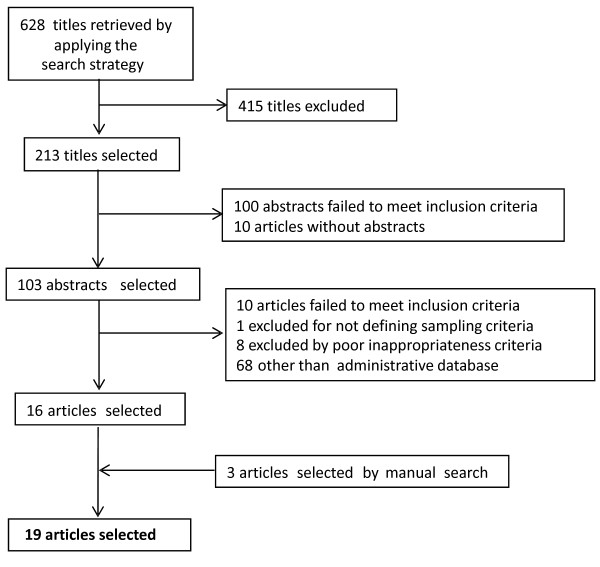
The paper search was conducted in Medline and Embase, using descriptors combined with free terms in the title or abstract. The limits applied were: publication date from January 1990 to June 2010, species (human) and publication type (excluding editorials, letters and reviews). Excluded were: case studies; studies in hospitals, nursing homes, or hospital emergency departments; studies of specific drugs or groups of drugs; studies exclusively of subgroups of ill, frail elderly or rural populations. Additional studies were identified from reference lists. Data were selected and extracted after independent reading by two of the authors, with disagreements resolved by a third author. The primary outcome assessed was prevalence of IMU, defined as the proportion of elderly who received at least one inappropriate medication.
Of the 628 studies, 19 met the inclusion criteria, 78.9% of them conducted in the USA. All papers included used explicit criteria of inappropriateness, most commonly Beers criteria (73.7%) in their three versions (1991, 1997 and 2002). Other methods used included Zhan, which is derived from on Beers criteria and was applied in 21% of the papers selected. The study found that prevalence of IMU ranged from 11.5% to 62.5%. Only 68.4% of the studies included examined inappropriate use-related factors, the most important being female sex, advanced age and larger number of drugs.
The results show that the prevalence of IMU among community-dwelling elderly is high and depends partly on the method used to evaluate improper use. Besides the diversity of methods, other factors, such as patient sex, age and number of drugs used concurrently, appear to have influenced the estimates of IMU.
老年人用药不当(IMU)是一个与健康不良影响相关的公共卫生问题。有许多方法可以识别 IMU,有些涉及临床判断,有些则是基于共识生成的避免药物清单。本综述旨在描述使用保险公司和社会保障行政数据库信息评估社区居住老年人 IMU 的研究,并介绍与 IMU 最常相关的风险因素。
在 Medline 和 Embase 中进行文献检索,使用结合标题或摘要中自由词的描述符。应用的限制是:从 1990 年 1 月至 2010 年 6 月的出版物日期,物种(人类)和出版物类型(不包括社论、信件和评论)。排除的有:病例研究;医院、疗养院或医院急诊部的研究;特定药物或药物组的研究;仅限于患病、体弱老年人或农村人群的亚组研究。从参考文献中还确定了其他研究。数据由两位作者独立阅读后选择和提取,有分歧时由第三位作者解决。主要评估结果是 IMU 的患病率,定义为接受至少一种不适当药物的老年人比例。
在 628 篇研究中,有 19 篇符合纳入标准,其中 78.9%来自美国。所有纳入的论文都使用了明确的不适当标准,最常用的是 Beers 标准(73.7%)及其三个版本(1991 年、1997 年和 2002 年)。其他使用的方法包括 Zhan,它是从 Beers 标准衍生而来的,在所选论文中占 21%。研究发现,IMU 的患病率从 11.5%到 62.5%不等。只有 68.4%的研究检查了与不适当使用相关的因素,最重要的是女性、高龄和使用药物数量较多。
结果表明,社区居住老年人的 IMU 患病率较高,部分取决于用于评估不当使用的方法。除了方法的多样性之外,患者性别、年龄和同时使用的药物数量等其他因素似乎也影响了 IMU 的估计。