Institute of Biology, Humboldt-University of Berlin, Chausseestr 117, 10115 Berlin, Germany.
Nucleic Acids Res. 2012 Apr;40(7):3106-16. doi: 10.1093/nar/gkr1138. Epub 2011 Dec 1.
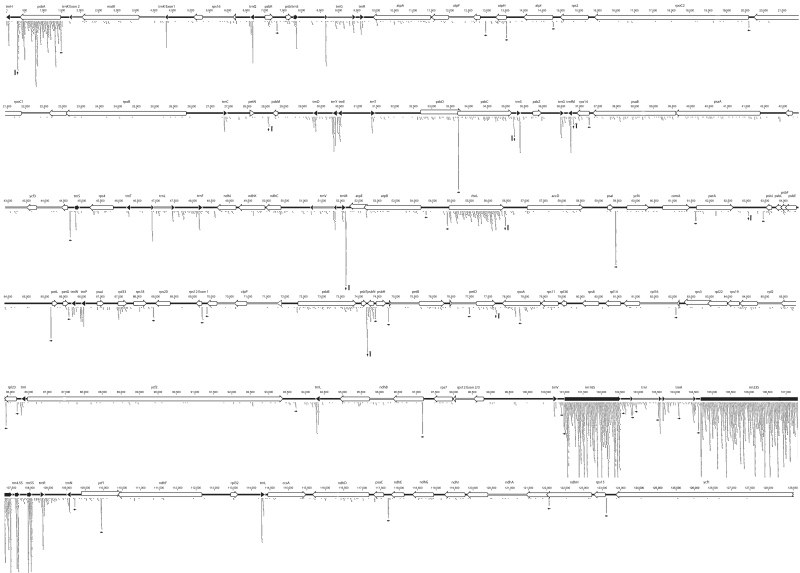
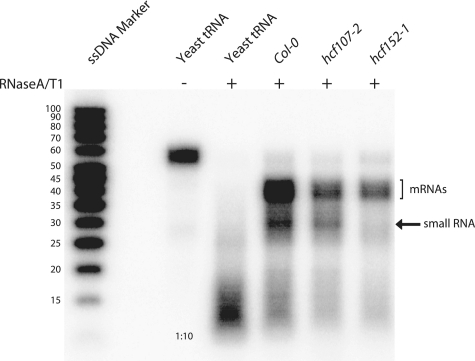
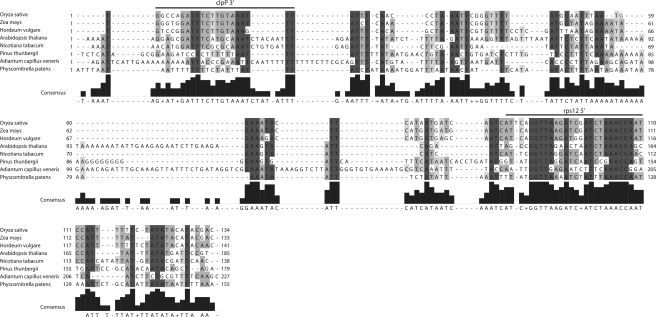
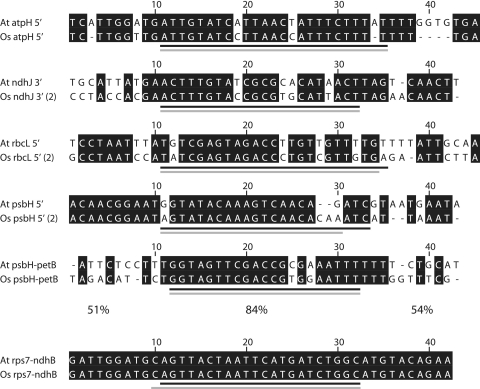
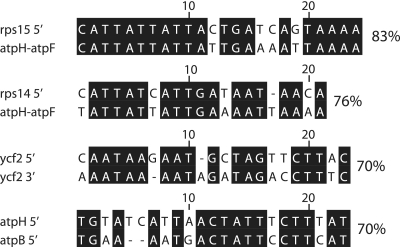
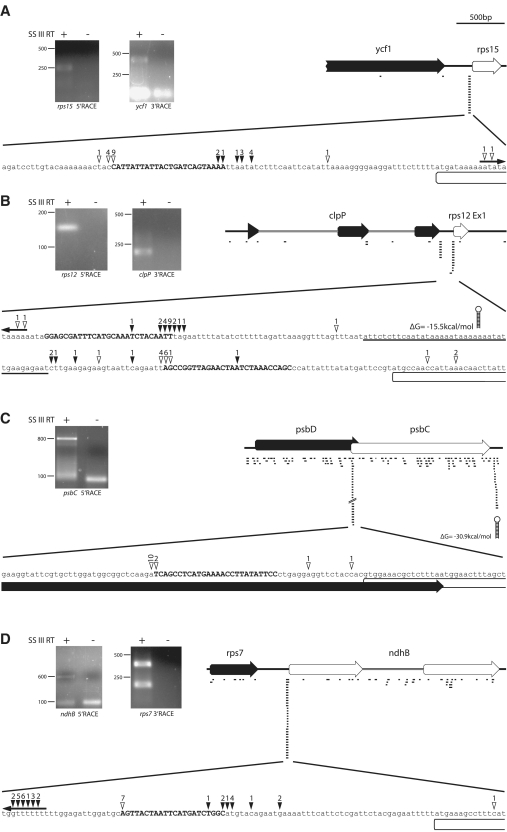
Chloroplast RNA metabolism is controlled and excecuted by hundreds of nuclear-encoded, chloroplast-localized RNA binding proteins. Contrary to the nucleo-cytosolic compartment or bacteria, there is little evidence for non-coding RNAs that play a role as riboregulators of chloroplasts. We mined deep-sequencing datasets to identify short (16-28 nt) RNAs in the chloroplast genome and found 50 abundant small RNAs (sRNAs) represented by multiple, in some cases, thousands of sequencing reads, whereas reads are in general absent from the surrounding sequence space. Other than sRNAs representing the most highly abundant mRNAs, tRNAs and rRNAs, most sRNAs are located in non-coding regions and many are found a short distance upstream of start codons. By transcript end mapping we show that the 5' and 3' termini of chloroplast RNAs coincide with the ends of sRNAs. Sequences of sRNAs identified in Arabidopsis are conserved between different angiosperm species and in several cases, we identified putative orthologs in rice deep sequencing datasets. Recently, it was suggested that small chloroplast RNA fragments could result from the protective action of pentatricopeptide repeat (PPR) proteins against exonucleases, i.e. footprints of RNA binding proteins. Our data support this scenario on a transcriptome-wide level and suggest that a large number of sRNAs are in fact remnants of PPR protein targets.
叶绿体 RNA 代谢受数以百计的核编码、定位于叶绿体的 RNA 结合蛋白控制和执行。与核质或细菌不同,很少有证据表明非编码 RNA 作为叶绿体的核糖调控因子发挥作用。我们挖掘了深度测序数据集,以鉴定叶绿体基因组中的短(16-28nt)RNA,并发现了 50 种丰富的小 RNA(sRNA),它们由多个,在某些情况下,数千个测序reads 代表,而在周围序列空间中通常没有reads。除了代表最丰富的 mRNA、tRNA 和 rRNA 的 sRNA 之外,大多数 sRNA 位于非编码区,许多位于起始密码子上游的短距离内。通过转录末端映射,我们表明叶绿体 RNA 的 5' 和 3' 末端与 sRNA 的末端一致。在拟南芥中鉴定的 sRNA 序列在不同的被子植物物种之间是保守的,在某些情况下,我们在水稻深度测序数据集中鉴定了可能的同源物。最近,有人提出,小的叶绿体 RNA 片段可能是五肽重复(PPR)蛋白对核酸外切酶的保护作用的结果,即 RNA 结合蛋白的足迹。我们的数据在转录组水平上支持这种情况,并表明大量 sRNA 实际上是 PPR 蛋白靶标的残余物。