Chen Jian-Hua, Yu Yong-Sheng, Liu Hong-Hong, Chen Xiao-Hua, Xi Min, Zang Guo-Qing, Tang Zheng-Hao
Department of Infectious Diseases, Sixth People's Hospital Affiliated to Shanghai Jiaotong University, Shanghai, China.
Hepat Mon. 2011 Aug;11(8):620-8. doi: 10.5812/kowsar.1735143x.689.
Nearly 350 million persons worldwide are chronically infected with hepatitis B virus (HBV). Ubiquitin (Ub) is a highly conserved small regulatory protein, ubiquitous in eukaryotes, that usually serves as a signal for the target protein that is recognised and degraded in proteasomes . The Ub-mediated processing of antigens is rapid and efficient and stimulates cell-mediated immune responses. Accordingly, Ub-mediated processing of antigens has been widely used in chronic-infection and cancer studies to improve immune response.
Many clinical trials have shown that DNA vaccine potency needs to be greatly enhanced. Here, we report a new strategy for designing an HBV DNA vaccine using the ubiquitin (Ub) sequence. The aim of this study was to investigate a novel DNA vaccination, based on the expression of HBV core antigen (HBcAg), fused to Ub to enhance DNA vaccine potency.
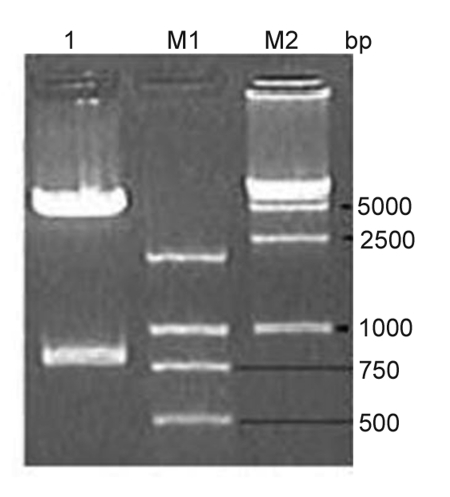
Mouse ubiquitin fused to the HBcAg gene and cloned into the eukaryotic vector pcDNA3.1 (-). BALB/c mice were immunized with recombinant pUb-HBcAg or pHBcAg DNA vaccine. Lymphocyte proliferation assay, intracellular IFN-γ assay, CTL cytotoxicity assay, and antibody assay were performed to analyze the cellular and humoral immune responses to our DNA constructs.
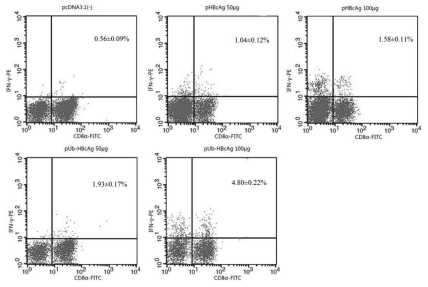
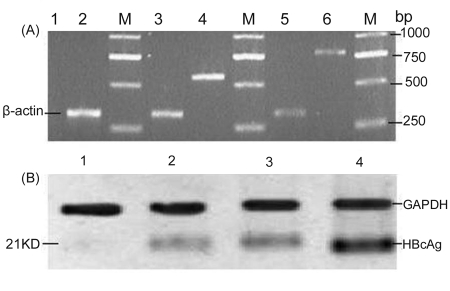
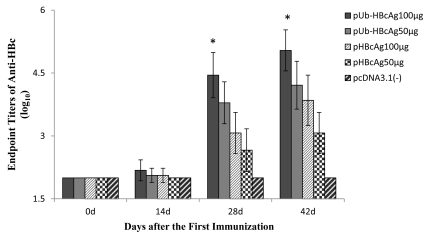
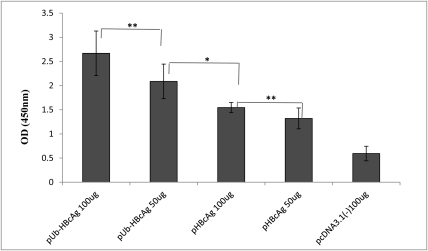
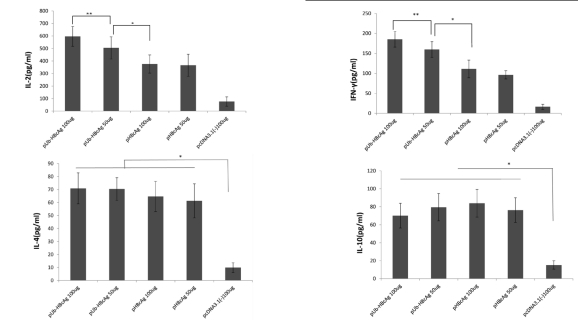
HBcAg was expressed effectively in the COS-7 cells that were transiently transfected with pUb-HBcAg. Strong anti-HBc IgG responses were elicited in mice that were immunized with pUb-HBcAg. The endpoint titers of anti-HBc peaked at 1:656100 on the 42nd day after the third immunization. pUb-HBcAg stimulated greater lymphocyte proliferation and induced higher levels of IL-2 and IFN-γ and a greater percentage of HBcAg-specific CD8+ T cells in mice than pHBcAg. In the CTL assay, the specific lysis rate reached 56.5% at an effector:target ratio of 50:1 in mice that were immunized with pUb-HBcAg.
pUb-HBcAg elicits specific anti-HBc responses and induces HBc-specific CTL responses in immunized BALB/c mice. Our results imply that Ub can be used as a molecular adjuvant that enhances the potency of DNA vaccines.
全球近3.5亿人慢性感染乙型肝炎病毒(HBV)。泛素(Ub)是一种高度保守的小调节蛋白,在真核生物中普遍存在,通常作为靶蛋白的信号,在蛋白酶体中被识别和降解。泛素介导的抗原加工快速有效,并刺激细胞介导的免疫反应。因此,泛素介导的抗原加工已广泛应用于慢性感染和癌症研究以改善免疫反应。
许多临床试验表明,DNA疫苗效力需要大幅提高。在此,我们报告一种使用泛素(Ub)序列设计HBV DNA疫苗的新策略。本研究的目的是研究一种基于与泛素融合表达的乙肝核心抗原(HBcAg)的新型DNA疫苗接种方法,以提高DNA疫苗效力。
将小鼠泛素与HBcAg基因融合并克隆到真核载体pcDNA3.1(-)中。用重组pUb-HBcAg或pHBcAg DNA疫苗免疫BALB/c小鼠。进行淋巴细胞增殖试验、细胞内IFN-γ试验、CTL细胞毒性试验和抗体试验,以分析对我们构建的DNA的细胞免疫和体液免疫反应。
用pUb-HBcAg瞬时转染的COS-7细胞中有效表达了HBcAg。用pUb-HBcAg免疫的小鼠产生了强烈的抗-HBc IgG反应。第三次免疫后第42天,抗-HBc的终点效价峰值达到1:656100。与pHBcAg相比,pUb-HBcAg刺激小鼠淋巴细胞增殖更强,诱导更高水平的IL-2和IFN-γ以及更高比例的HBcAg特异性CD8+T细胞。在CTL试验中,用pUb-HBcAg免疫的小鼠在效应细胞:靶细胞比例为50:1时,特异性裂解率达到56.5%。
pUb-HBcAg在免疫的BALB/c小鼠中引发特异性抗-HBc反应并诱导HBc特异性CTL反应。我们的结果表明,泛素可作为增强DNA疫苗效力的分子佐剂。