School of Life Sciences, Sun Yat-sen University, Guangzhou, China.
PLoS One. 2011;6(11):e27946. doi: 10.1371/journal.pone.0027946. Epub 2011 Nov 28.
Integrin α(L)β₂ (lymphocyte function-associated antigen, LFA-1) bears force upon binding to its ligand intercellular adhesion molecule 1 (ICAM-1) when a leukocyte adheres to vascular endothelium or an antigen presenting cell (APC) during immune responses. The ligand binding propensity of LFA-1 is related to its conformations, which can be regulated by force. Three conformations of the LFA-1 αA domain, determined by the position of its α₇-helix, have been suggested to correspond to three different affinity states for ligand binding.
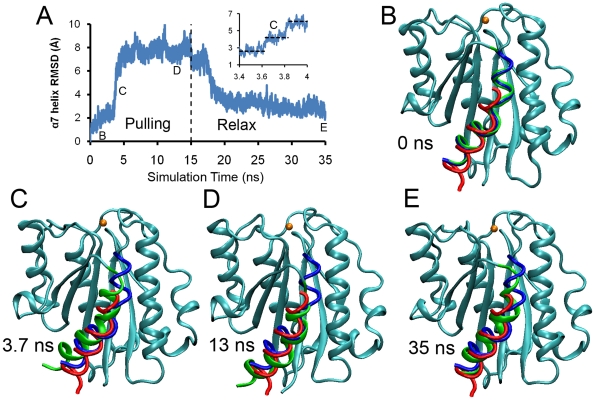
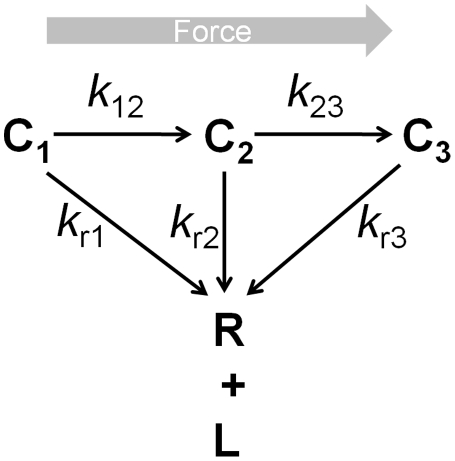
METHODOLOGY/PRINCIPAL FINDINGS: The kinetics of the force-driven transitions between these conformations has not been defined and dynamically coupled to the force-dependent dissociation from ligand. Here we show, by steered molecular dynamics (SMD) simulations, that the αA domain was successively transitioned through three distinct conformations upon pulling the C-terminus of its α₇-helix. Based on these sequential transitions, we have constructed a mathematical model to describe the coupling between the αA domain conformational changes of LFA-1 and its dissociation from ICAM-1 under force. Using this model to analyze the published data on the force-induced dissociation of single LFA-1/ICAM-1 bonds, we estimated the force-dependent kinetic rates of interstate transition from the short-lived to intermediate-lived and from intermediate-lived to long-lived states. Interestingly, force increased these transition rates; hence activation of LFA-1 was accelerated by pulling it via an engaged ICAM-1.
CONCLUSIONS/SIGNIFICANCE: Our study defines the structural basis for mechanical regulation of the kinetics of LFA-1 αA domain conformational changes and relates these simulation results to experimental data of force-induced dissociation of single LFA-1/ICAM-1 bonds by a new mathematical model, thus provided detailed structural and kinetic characterizations for force-stabilization of LFA-1/ICAM-1 interaction.
整合素 α(L)β₂(淋巴细胞功能相关抗原,LFA-1)在白细胞黏附于血管内皮细胞或抗原呈递细胞(APC)时,与配体细胞间黏附分子 1(ICAM-1)结合,会承受一定的力。LFA-1 的配体结合倾向与其构象有关,而构象又可以受到力的调节。已经提出,LFA-1 的αA 结构域的三个构象,由其α7 螺旋的位置决定,对应于三种不同的配体结合亲和力状态。
方法/主要发现:这些构象之间力驱动的转变动力学尚未确定,也没有与配体解离的力依赖性相关联。在这里,我们通过定向分子动力学(SMD)模拟表明,当拉动其α7 螺旋的 C 端时,αA 结构域依次转变为三种不同的构象。基于这些连续的转变,我们构建了一个数学模型来描述 LFA-1 的αA 结构域构象变化与在力作用下与 ICAM-1 的解离之间的耦合。使用该模型分析已发表的关于单 LFA-1/ICAM-1 键在力作用下解离的实验数据,我们估计了力依赖性的中间态到长寿命态的构象转变的动力学速率。有趣的是,力增加了这些转变速率;因此,通过与已结合的 ICAM-1 一起拉动 LFA-1 可以加速其激活。
结论/意义:我们的研究定义了 LFA-1 αA 结构域构象变化的力学调节的结构基础,并通过新的数学模型将这些模拟结果与单 LFA-1/ICAM-1 键在力作用下解离的实验数据相关联,从而为 LFA-1/ICAM-1 相互作用的力稳定提供了详细的结构和动力学特征。