Engineering and Wind Erosion Research Unit, Center for Grain and Animal Health Research, United States Department of Agriculture, Agricultural Research Service, Manhattan, Kansas 66502, USA.
Am J Trop Med Hyg. 2011 Dec;85(6):1093-6. doi: 10.4269/ajtmh.2011.11-0438.
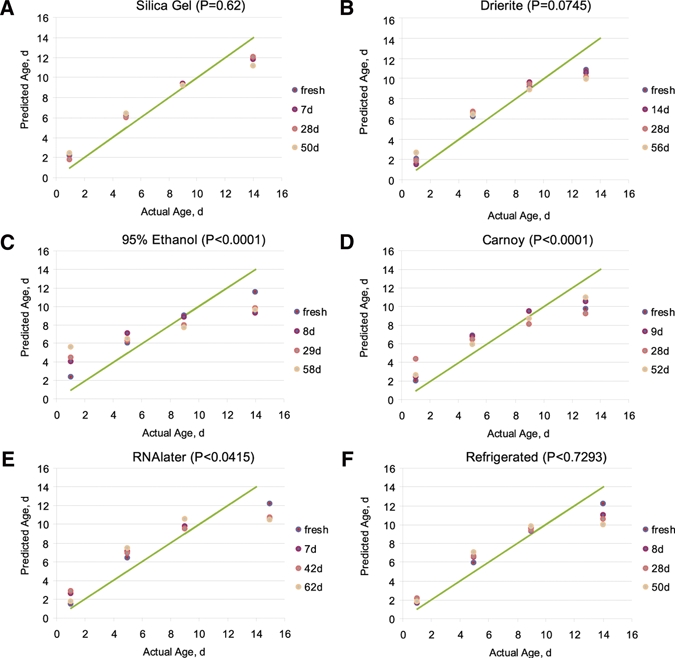
Determining mosquito age is important to evaluate vector control programs because the ability to transmit diseases is age dependent. Current age-grading techniques require dissection or RNA extraction. Near infrared spectroscopy has been used to rapidly and nondestructively determine the age of fresh mosquitoes and specimens stored in RNAlater, but other preservation techniques have not been examined. Thus, in this study, we investigate whether age can be predicted from insects preserved by various common methods. Results from this study show that age can be predicted from mosquitoes preserved with desiccants, ethanol, Carnoy, RNAlater, or refrigeration with confidence intervals < 1.4 days. The best results were generally obtained from mosquitoes stored using desiccants, RNAlater, or refrigeration.
确定蚊子的年龄对于评估病媒控制项目非常重要,因为其传播疾病的能力与年龄有关。目前的年龄分级技术需要解剖或提取 RNA。近红外光谱技术已被用于快速且无损地确定新鲜蚊子和保存在 RNAlater 中的标本的年龄,但其他保存技术尚未进行检查。因此,在这项研究中,我们研究了是否可以通过各种常见的方法来预测昆虫的年龄。研究结果表明,用干燥剂、乙醇、卡诺氏液、RNAlater 或冷藏保存的蚊子,其年龄可以有信心地预测到 1.4 天以内。通常,使用干燥剂、RNAlater 或冷藏保存的蚊子可以获得最佳结果。