Program in Public Health, University of California Irvine, Irvine, California, United States of America.
PLoS One. 2010 Oct 13;5(10):e13359. doi: 10.1371/journal.pone.0013359.
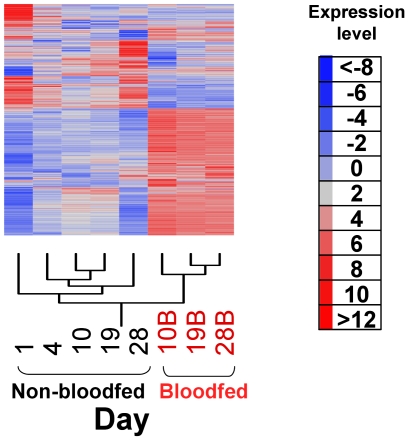
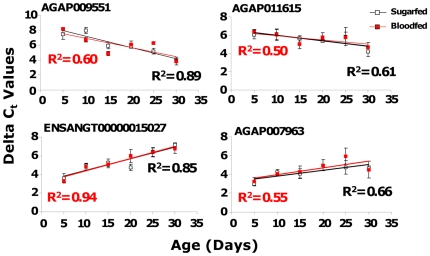
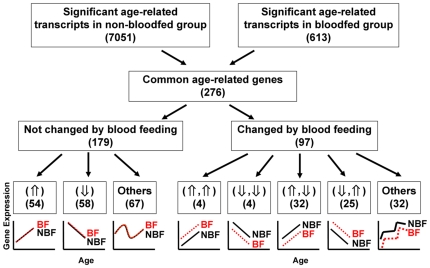
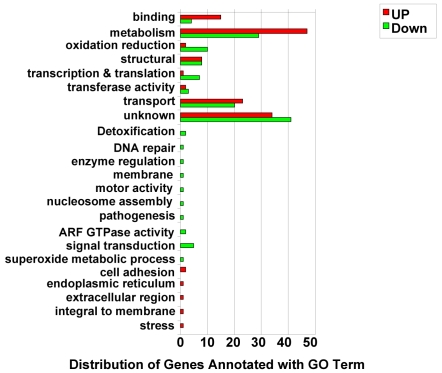
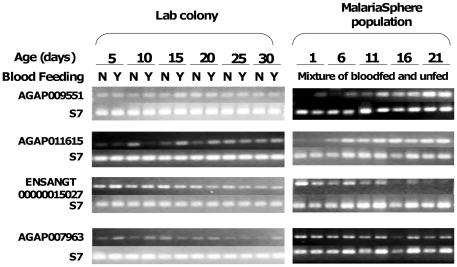
The primary means of reducing malaria transmission is through reduction in longevity in days of the adult female stage of the Anopheles vector. However, assessing chronological age is limited to crude physiologic methods which categorize the females binomially as either very young (nulliparous) or not very young (parous). Yet the epidemiologically relevant reduction in life span falls within the latter category. Age-grading methods that delineate chronological age, using accurate molecular surrogates based upon gene expression profiles, will allow quantification of the longevity-reducing effects of vector control tools aimed at the adult, female mosquito. In this study, microarray analyses of gene expression profiles in the African malaria vector Anopheles gambiae were conducted during natural senescence of females in laboratory conditions. Results showed that detoxification-related and stress-responsive genes were up-regulated as mosquitoes aged. A total of 276 transcripts had age-dependent expression, independently of blood feeding and egg laying events. Expression of 112 (40.6%) of these transcripts increased or decreased monotonically with increasing chronologic age. Seven candidate genes for practical age assessment were tested by quantitative gene amplification in the An. gambiae G3 strain in a laboratory experiment and the Mbita strain in field enclosures set up in western Kenya under conditions closely resembling natural ones. Results were similar between experiments, indicating that senescence is marked by changes in gene expression and that chronological age can be gauged accurately and repeatedly with this method. These results indicate that the method may be suitable for accurate gauging of the age in days of field-caught, female An. gambiae.
减少疟疾传播的主要手段是通过减少按蚊传播媒介的雌性成虫期的寿命。然而,评估年龄仅限于粗略的生理方法,这些方法将雌性按蚊分为非常年轻(未生育)或不太年轻(生育)两类。然而,与流行病学相关的寿命缩短属于后者。使用基于基因表达谱的准确分子替代物来划分年龄的年龄分级方法,将允许量化针对成年雌性蚊子的媒介控制工具的寿命缩短效果。在这项研究中,在实验室条件下对自然衰老的雌性非洲疟蚊 Anopheles gambiae 的基因表达谱进行了微阵列分析。结果表明,随着蚊子年龄的增长,解毒相关和应激反应相关的基因被上调。共有 276 个转录本具有年龄依赖性表达,与吸血和产卵事件无关。这些转录本中有 112 个(40.6%)的表达随着年龄的增长而单调增加或减少。在实验室实验中,对 7 个候选基因进行了定量基因扩增测试,实验对象为 An. gambiae G3 品系,在肯尼亚西部的野外围栏中进行了实验,实验条件与自然条件非常相似。实验结果相似,表明衰老的标志是基因表达的变化,并且可以通过这种方法准确和反复地衡量实际年龄。这些结果表明,该方法可能适合准确衡量野外捕获的雌性 An. gambiae 的日龄。