Department of Bioengineering, University of Washington, Seattle, WA, USA.
Phys Med Biol. 2012 Jan 21;57(2):309-28. doi: 10.1088/0031-9155/57/2/309. Epub 2011 Dec 9.
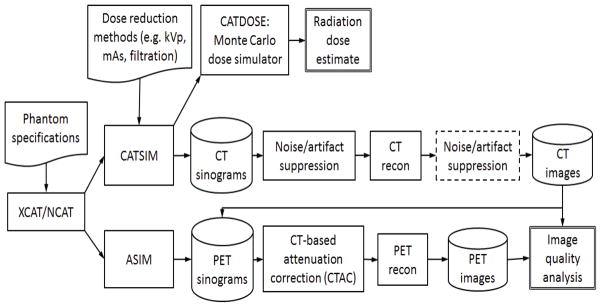
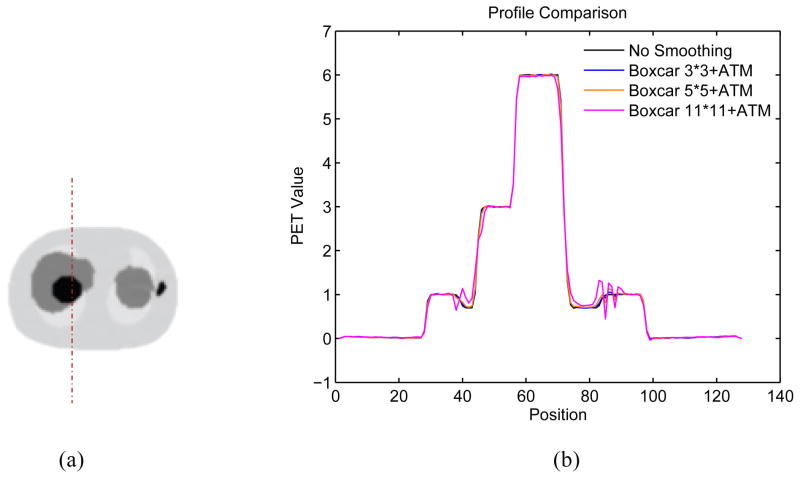
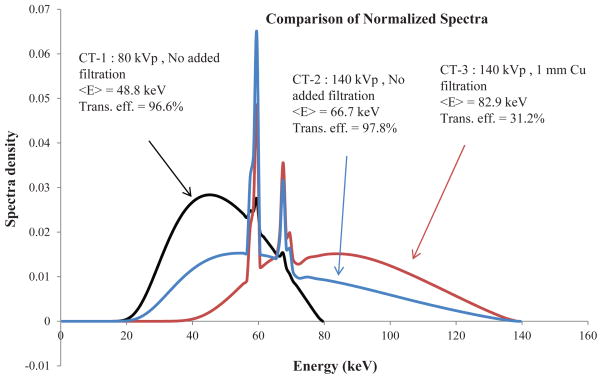
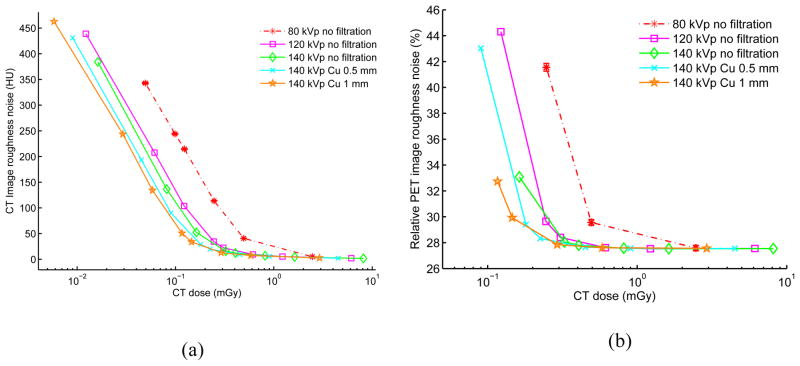
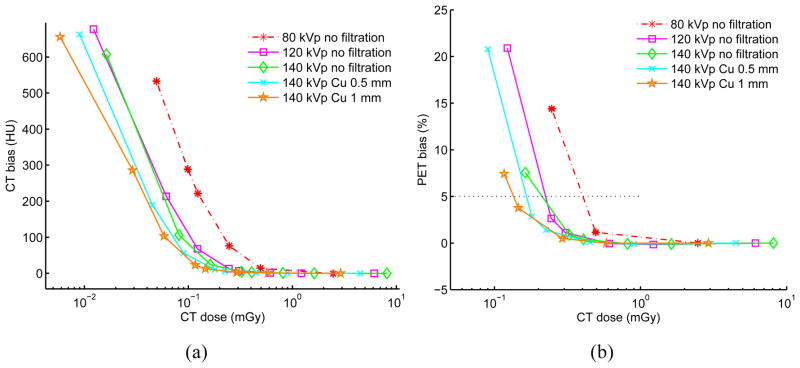
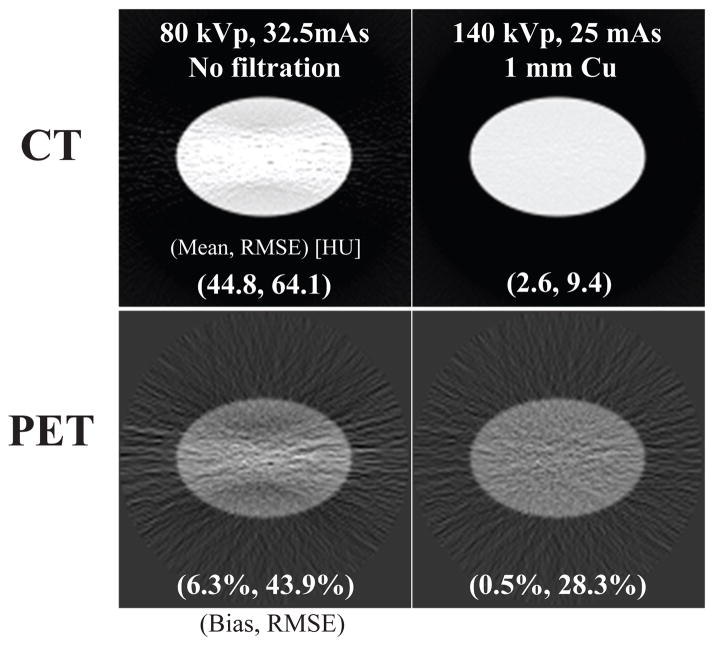
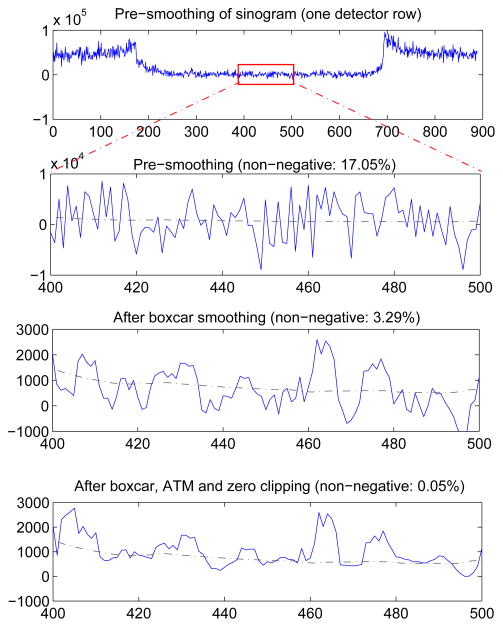
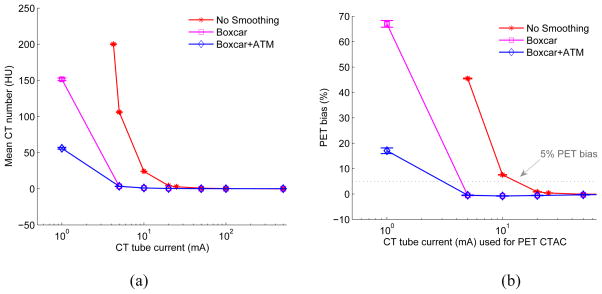
A challenge for positron emission tomography/computed tomography (PET/CT) quantitation is patient respiratory motion, which can cause an underestimation of lesion activity uptake and an overestimation of lesion volume. Several respiratory motion correction methods benefit from longer duration CT scans that are phase matched with PET scans. However, even with the currently available, lowest dose CT techniques, extended duration cine CT scans impart a substantially high radiation dose. This study evaluates methods designed to reduce CT radiation dose in PET/CT scanning. We investigated selected combinations of dose reduced acquisition and noise suppression methods that take advantage of the reduced requirement of CT for PET attenuation correction (AC). These include reducing CT tube current, optimizing CT tube voltage, adding filtration, CT sinogram smoothing and clipping. We explored the impact of these methods on PET quantitation via simulations on different digital phantoms. CT tube current can be reduced much lower for AC than that in low dose CT protocols. Spectra that are higher energy and narrower are generally more dose efficient with respect to PET image quality. Sinogram smoothing could be used to compensate for the increased noise and artifacts at radiation dose reduced CT images, which allows for a further reduction of CT dose with no penalty for PET image quantitation. When CT is not used for diagnostic and anatomical localization purposes, we showed that ultra-low dose CT for PET/CT is feasible. The significant dose reduction strategies proposed here could enable respiratory motion compensation methods that require extended duration CT scans and reduce radiation exposure in general for all PET/CT imaging.
正电子发射断层扫描/计算机断层扫描(PET/CT)定量的一个挑战是患者的呼吸运动,这可能导致病变活性摄取的低估和病变体积的高估。几种呼吸运动校正方法受益于与 PET 扫描相位匹配的更长持续时间的 CT 扫描。然而,即使使用目前可用的、最低剂量的 CT 技术,扩展的电影 CT 扫描也会带来相当高的辐射剂量。本研究评估了旨在降低 PET/CT 扫描中 CT 辐射剂量的方法。我们研究了利用减少 CT 衰减校正(AC)对 PET 的需求的减少来获得的降低采集和噪声抑制方法的选择组合。这些方法包括降低 CT 管电流、优化 CT 管电压、增加过滤、CT 正弦图平滑和修剪。我们通过在不同数字体模上进行模拟来研究这些方法对 PET 定量的影响。对于 AC 来说,CT 管电流可以比低剂量 CT 协议中的管电流降低得更低。对于 PET 图像质量而言,能量更高、更窄的光谱通常在剂量效率方面更有优势。正弦图平滑可以用于补偿降低剂量 CT 图像中的噪声和伪影,这允许进一步降低 CT 剂量,而不会对 PET 图像定量造成影响。当 CT 不用于诊断和解剖定位目的时,我们表明 PET/CT 的超低剂量 CT 是可行的。这里提出的显著剂量降低策略可以使需要长时间 CT 扫描的呼吸运动补偿方法得以实现,并减少一般情况下所有 PET/CT 成像的辐射暴露。