
探讨尿殖道血吸虫病与人类免疫缺陷病毒感染的关系。
Examining the relationship between urogenital schistosomiasis and HIV infection.
机构信息
Department of Control of Neglected Tropical Diseases, World Health Organization, Geneva, Switzerland.
出版信息
PLoS Negl Trop Dis. 2011 Dec;5(12):e1396. doi: 10.1371/journal.pntd.0001396. Epub 2011 Dec 6.
BACKGROUND
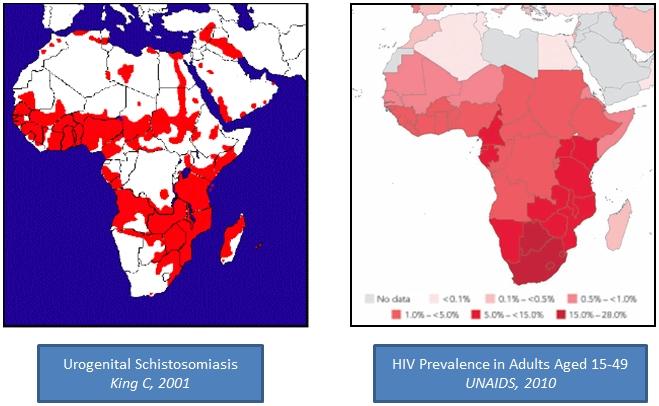
Urogenital schistosomiasis, caused by infection with Schistosoma haematobium, is widespread and causes substantial morbidity on the African continent. The infection has been suggested as an unrecognized risk factor for incident HIV infection. Current guidelines recommend preventive chemotherapy, using praziquantel as a public health tool, to avert morbidity due to schistosomiasis. In individuals of reproductive age, urogenital schistosomiasis remains highly prevalent and, likely, underdiagnosed. This comprehensive literature review was undertaken to examine the evidence for a cause-effect relationship between urogenital schistosomiasis and HIV/AIDS. The review aims to support discussions of urogenital schistosomiasis as a neglected yet urgent public health challenge.
METHODOLOGY/PRINCIPAL FINDINGS: We conducted a systematic search of the literature including online databases, clinical guidelines, and current medical textbooks. We describe plausible local and systemic mechanisms by which Schistosoma haematobium infection could increase the risk of HIV acquisition in both women and men. We also detail the effects of S. haematobium infection on the progression and transmissibility of HIV in co-infected individuals. We briefly summarize available evidence on the immunomodulatory effects of chronic schistosomiasis and the implications this might have for populations at high risk of both schistosomiasis and HIV.
CONCLUSIONS/SIGNIFICANCE: Studies support the hypothesis that urogenital schistosomiasis in women and men constitutes a significant risk factor for HIV acquisition due both to local genital tract and global immunological effects. In those who become HIV-infected, schistosomal co-infection may accelerate HIV disease progression and facilitate viral transmission to sexual partners. Establishing effective prevention strategies using praziquantel, including better definition of treatment age, duration, and frequency of treatment for urogenital schistosomiasis, is an important public health priority. Our findings call attention to this pressing yet neglected public health issue and the potential added benefit of scaling up coverage of schistosomal treatment for populations in whom HIV infection is prevalent.
背景
尿路血吸虫病由感染埃及血吸虫引起,在非洲大陆广泛流行,导致大量发病。该感染被认为是艾滋病毒感染新发病例的一个未被认识的危险因素。目前的指南建议使用吡喹酮作为公共卫生工具进行预防性化疗,以避免因血吸虫病导致发病。在育龄人群中,尿路血吸虫病仍然高度流行,而且可能诊断不足。进行这项全面的文献综述,是为了研究尿路血吸虫病与艾滋病毒/艾滋病之间因果关系的证据。综述旨在支持讨论尿路血吸虫病作为一个被忽视但紧迫的公共卫生挑战。
方法/主要发现:我们对文献进行了系统检索,包括在线数据库、临床指南和当前的医学教科书。我们描述了埃及血吸虫感染可能增加女性和男性艾滋病毒感染风险的合理局部和全身机制。我们还详细说明了埃及血吸虫感染对合并感染个体中艾滋病毒进展和传播的影响。我们简要总结了慢性血吸虫病的免疫调节作用的现有证据及其对同时面临血吸虫病和艾滋病毒高风险人群的影响。
结论/意义:研究支持这样一种假设,即女性和男性的尿路血吸虫病构成艾滋病毒感染的一个重要危险因素,这既是由于局部生殖道的影响,也是由于全身免疫的影响。在那些感染艾滋病毒的人中,血吸虫合并感染可能会加速艾滋病毒疾病的进展,并促进病毒向性伴侣传播。使用吡喹酮制定有效的预防策略,包括更好地定义治疗年龄、治疗持续时间和治疗尿路血吸虫病的频率,是一个重要的公共卫生优先事项。我们的研究结果引起了对这一紧迫但被忽视的公共卫生问题的关注,以及扩大对艾滋病毒流行人群进行血吸虫病治疗覆盖面的潜在附加效益。
 Zotero 插件