Department of Medical Laboratory Sciences, College of Health Sciences, Jimma University, Jimma, Ethiopia.
Centre for Global Health Research, Kenya Medical Research Institute, Kisumu, Kenya.
Malar J. 2017 Nov 6;16(1):443. doi: 10.1186/s12936-017-2098-z.
The widespread use of indoor-based malaria vector control interventions has been shown to alter the behaviour of vectors in Africa. There is an increasing concern that such changes could sustain residual transmission. This study was conducted to assess vector species composition, feeding behaviour and their contribution to indoor and outdoor malaria transmission in western Kenya.
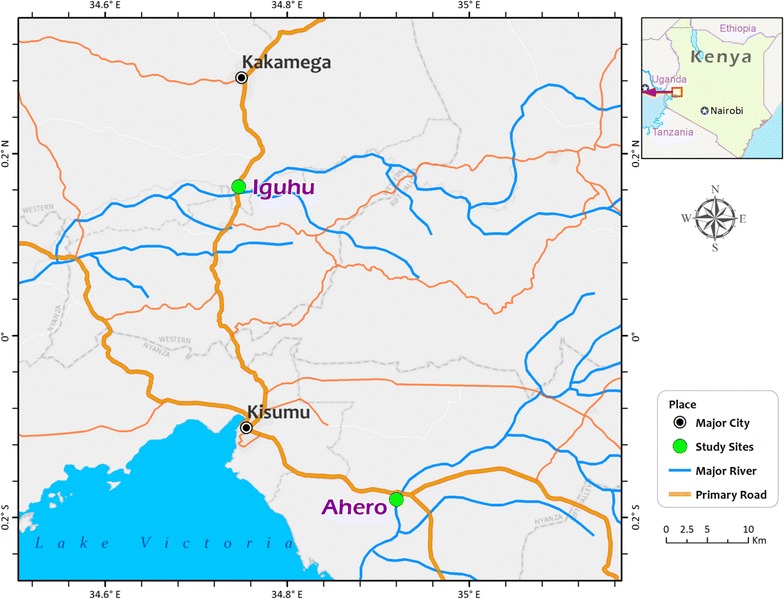
Anopheles mosquito collections were carried out from September 2015 to April 2016 in Ahero and Iguhu sites, western Kenya using CDC light traps (indoor and outdoor), pyrethrum spray catches (PSCs) (indoor) and pit shelters (outdoor). Species within Anopheles gambiae s.l. and Anopheles funestus s.l. were identified using polymerase chain reaction (PCR). Enzyme-linked immunosorbent assay (ELISA) was used to determine mosquito blood meal sources and sporozoite infections.
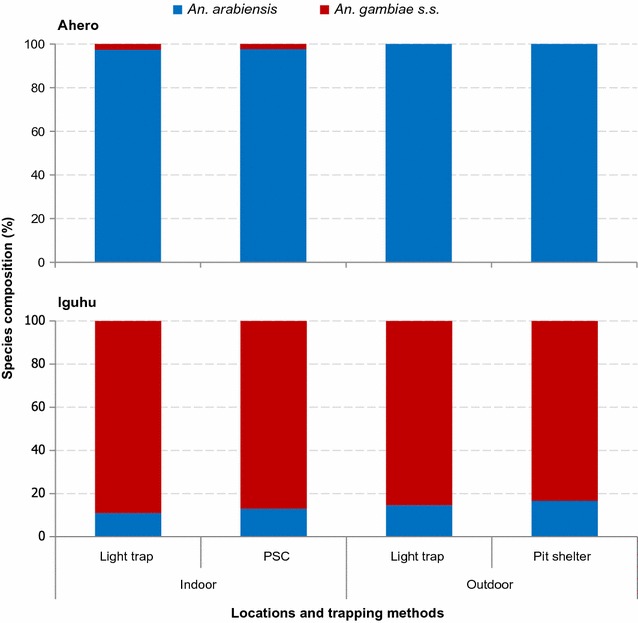
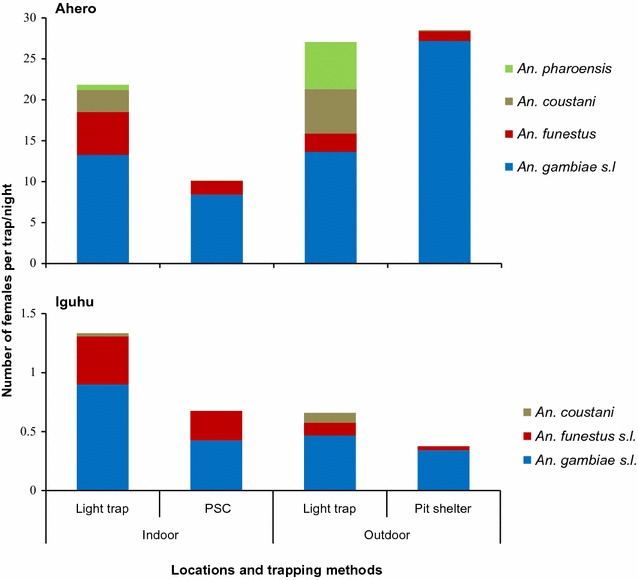
A total of 10,864 female Anopheles mosquitoes comprising An. gambiae s.l. (71.4%), An. funestus s.l. (12.3%), Anopheles coustani (9.2%) and Anopheles pharoensis (7.1%) were collected. The majority (61.8%) of the anopheline mosquitoes were collected outdoors. PCR result (n = 581) revealed that 98.9% An. arabiensis and 1.1% An. gambiae s.s. constituted An. gambiae s.l. in Ahero while this was 87% An. gambiae s.s. and 13% An. arabiensis in Iguhu. Of the 108 An. funestus s.l. analysed by PCR, 98.1% belonged to An. funestus s.s. and 1.9% to Anopheles leesoni. The human blood index (HBI) and bovine blood index (BBI) of An. arabiensis was 2.5 and 73.1%, respectively. Anopheles gambiae s.s. had HBI and BBI of 50 and 28%, respectively. The HBI and BBI of An. funestus was 60 and 22.3%, respectively. Forage ratio estimate revealed that An. arabiensis preferred to feed on cattle, An. gambiae s.s. showed preference for both human and cattle, while An. funestus preferred human over other hosts. In Ahero, the sporozoite rates for An. arabiensis and An. funestus were 0.16 and 1.8%, respectively, whereas in Iguhu, the sporozoite rates for An. gambiae s.s. and An. funestus were 2.3 and 2.4%, respectively. In Ahero, the estimated indoor and outdoor entomological inoculation rate (EIR) was 108.6 infective bites/person/year (79.0 from An. funestus and 29.6 from An. arabiensis) and 43.5 infective bites/person/year (27.9 from An. arabiensis and 15.6 from An. funestus), respectively. In Iguhu, the estimated indoor and outdoor EIR was 24.5 infective bites/person/year (18.8 from An. gambiae s.s. and 5.7 from An. funestus) and 5.5 infective bites/person/year (all from An. gambiae s.s.), respectively.
Anopheles gambiae s.s. showed an increasing tendency to feed on cattle. Anopheles arabiensis was highly zoophagic, whereas An. funestus showed anthropophagic behaviour. While the majority of malaria transmission occurred indoor, the magnitude of outdoor transmission was considerably high. Additional control tools that complement the existing interventions are required to control residual transmission.
室内基疟疾媒介控制干预措施的广泛应用已被证明会改变非洲蚊子的行为。人们越来越担心这种变化会维持残留的传播。本研究旨在评估肯尼亚西部的蚊子物种组成、摄食行为及其对室内和室外疟疾传播的贡献。
2015 年 9 月至 2016 年 4 月,在肯尼亚西部的 Ahero 和 Iguhu 站点,使用 CDC 诱蚊灯(室内和室外)、除虫菊酯喷雾(室内)和坑式避难所(室外)进行了疟蚊采集。利用聚合酶链反应(PCR)鉴定冈比亚按蚊和芬尼斯按蚊属内的物种。酶联免疫吸附试验(ELISA)用于确定蚊子的血液来源和孢子感染。
共采集到 10864 只雌性疟蚊,包括冈比亚按蚊(71.4%)、芬尼斯按蚊(12.3%)、库斯按蚊(9.2%)和法罗按蚊(7.1%)。大多数(61.8%)按蚊在室外采集。PCR 结果(n=581)显示,Ahero 地区 98.9%的安蚊为阿拉伯按蚊,1.1%为冈比亚按蚊 s.s.,而 Iguhu 地区 87%为冈比亚按蚊 s.s.,13%为阿拉伯按蚊。在 108 只芬尼斯按蚊中,98.1%属于芬尼斯按蚊 s.s.,1.9%属于莱氏按蚊。阿拉伯按蚊的人血指数(HBI)和牛血指数(BBI)分别为 2.5%和 73.1%。冈比亚按蚊 s.s.的 HBI 和 BBI 分别为 50%和 28%。芬尼斯按蚊的 HBI 和 BBI 分别为 60%和 22.3%。觅食比例估计显示,阿拉伯按蚊偏爱牛,冈比亚按蚊 s.s.既喜欢人和牛,而芬尼斯按蚊则更喜欢人而不是其他宿主。在 Ahero,阿拉伯按蚊和芬尼斯按蚊的孢子率分别为 0.16%和 1.8%,而在 Iguhu,冈比亚按蚊 s.s.和芬尼斯按蚊的孢子率分别为 2.3%和 2.4%。在 Ahero,室内和室外昆虫接种率(EIR)估计为 108.6 感染性叮咬/人/年(79.0 来自芬尼斯按蚊,29.6 来自阿拉伯按蚊)和 43.5 感染性叮咬/人/年(27.9 来自阿拉伯按蚊,15.6 来自芬尼斯按蚊)。在 Iguhu,室内和室外 EIR 估计分别为 24.5 感染性叮咬/人/年(18.8 来自冈比亚按蚊 s.s.,5.7 来自芬尼斯按蚊)和 5.5 感染性叮咬/人/年(全部来自冈比亚按蚊 s.s.)。
冈比亚按蚊 s.s. 表现出越来越倾向于以牛为食的趋势。阿拉伯按蚊高度食虫,而芬尼斯按蚊则表现出嗜人行为。虽然大多数疟疾传播发生在室内,但室外传播的幅度相当高。需要补充现有干预措施的额外控制工具来控制残留传播。