Montreal Heart Institute, 5000 Belanger, Montréal (QC) H1T 1C8, Canada.
Diabetol Metab Syndr. 2011 Dec 14;3:34. doi: 10.1186/1758-5996-3-34.
Adverse effects of high-fat diets (HFD) on metabolic homeostasis are linked to adipose tissue dysfunction. The goal of this study was to examine the effect of the HFD nature on adipose tissue activity, metabolic disturbances and glucose homeostasis alterations in male mice compared with female mice.
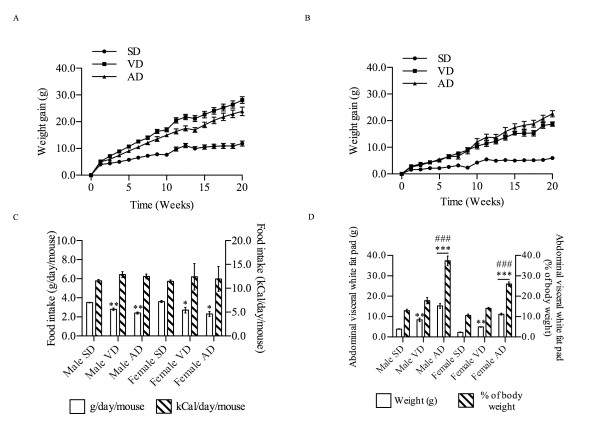
C57BL/6J mice were fed either a chow diet or HFD including vegetal (VD) or animal (AD) fat. Body weight, plasmatic parameters and adipose tissue mRNA expression levels of key genes were evaluated after 20 weeks of HFD feeding.
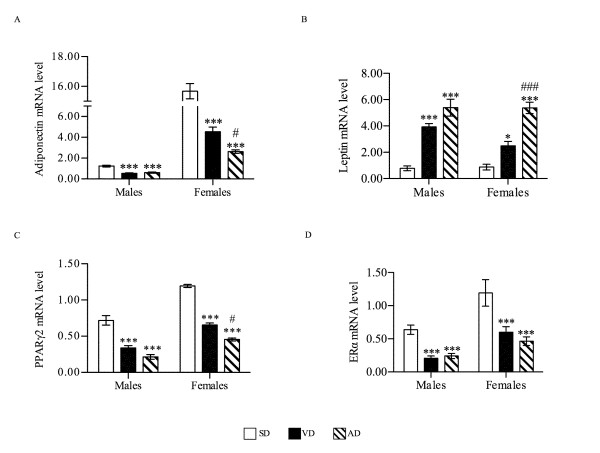
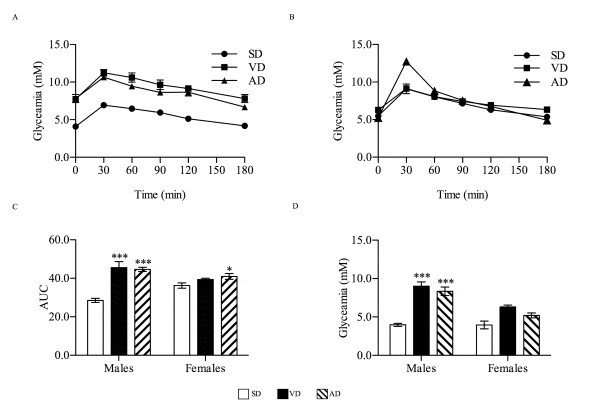
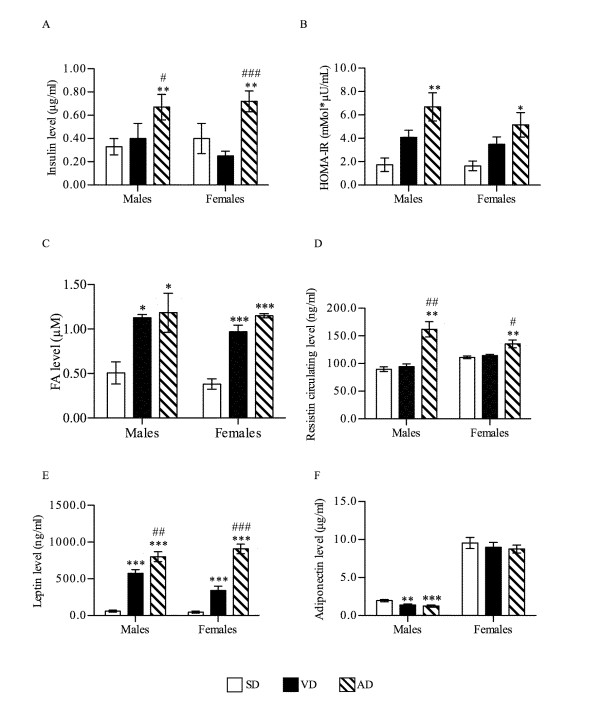
HFD-fed mice were significantly heavier than control at the end of the protocol. Greater abdominal visceral fat accumulation was observed in mice fed with AD compared to those fed a chow diet or VD. Correlated with weight gain, leptin levels in systemic circulation were increased in HFD-fed mice in both sexes with a significant higher level in AD group compared to VD group. Circulating adiponectin levels as well as adipose tissue mRNA expression levels were significantly decreased in HFD-fed male mice. Although its plasma levels remained unchanged in females, adiponectin mRNA levels were significantly reduced in adipose tissue of both HFD-fed groups with a more marked decrease in AD group compared to VD group. Only HFD-fed male mice were diabetic with increased fasting glycaemia. On the other hand, insulin levels were only increased in AD-fed group in both sexes associated with increased resistin levels. VD did not induce any apparent metabolic alteration in females despite the increased weight gain. Peroxisome Proliferator-Activated Receptors gamma-2 (PPARγ2) and estrogen receptor alpha (ERα) mRNA expression levels in adipose tissue were decreased up to 70% in HFD-fed mice but were more markedly reduced in male mice as compared with female mice.
The nature of dietary fat determines the extent of metabolic alterations reflected in adipocytes through modifications in the pattern of adipokines secretion and modulation of key genes mRNA expression. Compared with males, female mice demonstrate higher capacity in controlling glucose homeostasis in response to 20 weeks HFD feeding. Our data suggest gender specific interactions between the diet's fatty acid source, the adipocyte-secreted proteins and metabolic disorders.
高脂肪饮食(HFD)对代谢稳态的不良影响与脂肪组织功能障碍有关。本研究的目的是研究 HFD 性质对雄性和雌性小鼠脂肪组织活性、代谢紊乱和葡萄糖稳态改变的影响。
C57BL/6J 小鼠分别用标准饮食或包括植物(VD)或动物(AD)脂肪的 HFD 喂养。在 HFD 喂养 20 周后,评估体重、血浆参数和脂肪组织关键基因的 mRNA 表达水平。
HFD 喂养的小鼠在实验结束时比对照组明显更重。与食用标准饮食或 VD 相比,AD 喂养的小鼠腹部内脏脂肪积累更多。与体重增加相关,HFD 喂养的雄性和雌性小鼠的循环瘦素水平均升高,AD 组比 VD 组显著升高。HFD 喂养的雄性小鼠的循环脂联素水平以及脂肪组织的 mRNA 表达水平均显著降低。尽管在雌性小鼠中其血浆水平保持不变,但 HFD 喂养的两组小鼠的脂肪组织中的脂联素 mRNA 水平均显著降低,AD 组比 VD 组降低更为明显。只有 HFD 喂养的雄性小鼠出现空腹血糖升高的糖尿病。另一方面,在两性中,只有 AD 喂养组的胰岛素水平升高,同时抵抗素水平升高。VD 喂养并未引起雌性任何明显的代谢改变,尽管体重增加。脂肪组织中的过氧化物酶体增殖物激活受体γ-2(PPARγ2)和雌激素受体α(ERα)mRNA 表达水平在 HFD 喂养的小鼠中降低了 70%,但在雄性小鼠中比在雌性小鼠中降低更为明显。
饮食脂肪的性质通过改变脂肪细胞分泌的脂肪因子模式和调节关键基因的 mRNA 表达水平,决定了代谢改变的程度。与雄性相比,雌性小鼠在 20 周 HFD 喂养后对葡萄糖稳态的控制能力更高。我们的数据表明,饮食脂肪酸来源、脂肪细胞分泌的蛋白质和代谢紊乱之间存在性别特异性相互作用。