Department of Microbiology, University of Washington, Seattle, Washington, United States of America.
PLoS Pathog. 2011 Dec;7(12):e1002424. doi: 10.1371/journal.ppat.1002424. Epub 2011 Dec 8.
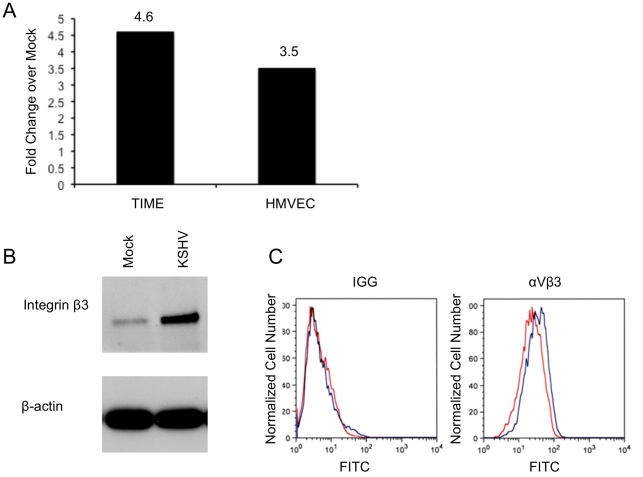
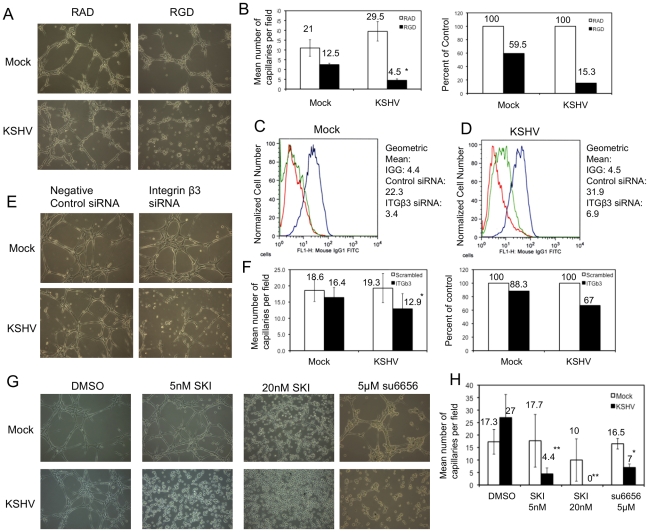
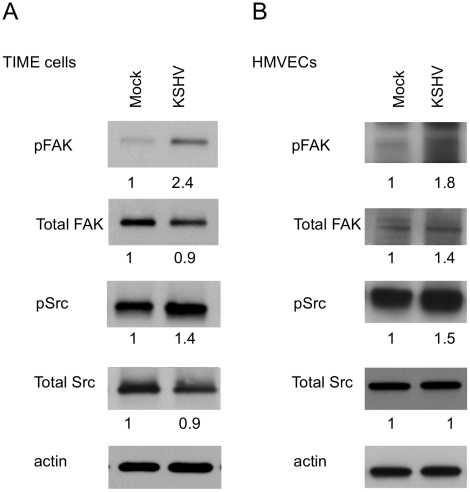
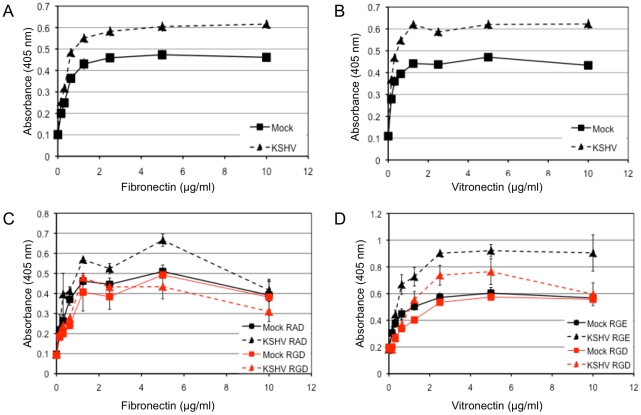
Kaposi's Sarcoma (KS), the most common tumor of AIDS patients, is a highly vascularized tumor supporting large amounts of angiogenesis. The main cell type of KS tumors is the spindle cell, a cell of endothelial origin, the primary cell type involved in angiogenesis. Kaposi's Sarcoma-associated herpesvirus (KSHV) is the etiologic agent of KS and is likely involved in both tumor formation and the induction of angiogenesis. Integrins, and specifically integrin αVβ3, have known roles in both tumor induction and angiogenesis. αVβ3 is also important for KSHV infection as it has been shown to be involved in KSHV entry into cells. We found that during latent infection of endothelial cells KSHV induces the expression of integrin β3 leading to increased surface levels of αVβ3. Signaling molecules downstream of integrins, including FAK and Src, are activated during viral latency. Integrin activation by KSHV is necessary for the KSHV-associated upregulation of a number of angiogenic phenotypes during latent infection including adhesion and motility. Additionally, KSHV-infected cells become more reliant on αVβ3 for capillary like formation in three dimensional culture. KSHV induction of integrin β3, leading to induction of angiogenic and cancer cell phenotypes during latency, is likely to be important for KS tumor formation and potentially provides a novel target for treating KS tumors.
卡波西肉瘤(KS)是 AIDS 患者最常见的肿瘤,是一种高度血管化的肿瘤,支持大量血管生成。KS 肿瘤的主要细胞类型是梭形细胞,这是一种内皮细胞起源的细胞,是参与血管生成的主要细胞类型。卡波济肉瘤相关疱疹病毒(KSHV)是 KS 的病原体,可能参与肿瘤形成和血管生成的诱导。整合素,特别是整合素αVβ3,在肿瘤诱导和血管生成中都有已知的作用。αVβ3 对于 KSHV 感染也很重要,因为它已被证明参与 KSHV 进入细胞。我们发现,在血管内皮细胞的潜伏感染过程中,KSHV 诱导整合素β3 的表达,导致αVβ3 的表面水平增加。整合素下游的信号分子,包括 FAK 和 Src,在病毒潜伏期间被激活。KSHV 通过整合素的激活对于 KSHV 相关的潜伏感染期间多种血管生成表型的上调是必需的,包括粘附和迁移。此外,在三维培养中,感染 KSHV 的细胞对αVβ3 的依赖性更强,以形成毛细血管样结构。KSHV 诱导整合素β3 的表达,导致潜伏期间血管生成和癌细胞表型的诱导,这可能对 KS 肿瘤的形成很重要,并为治疗 KS 肿瘤提供了一个新的靶点。