Institute of Biochemistry, Biological Research Center, Hungarian Academy of Sciences, Szeged, Hungary.
PLoS One. 2011;6(12):e28818. doi: 10.1371/journal.pone.0028818. Epub 2011 Dec 12.
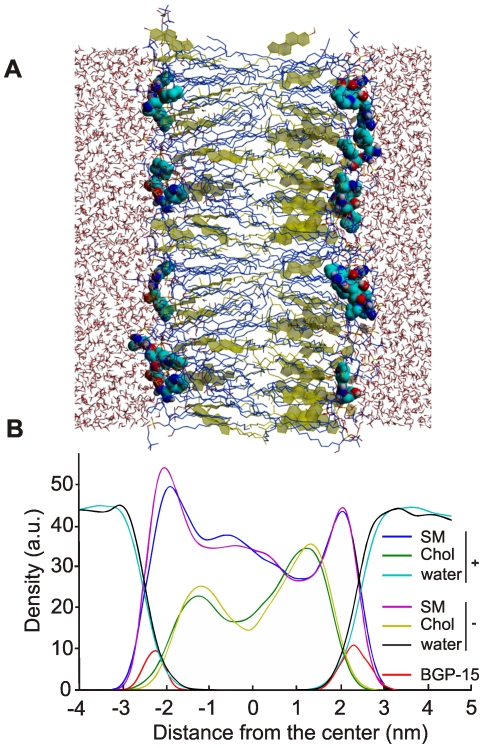
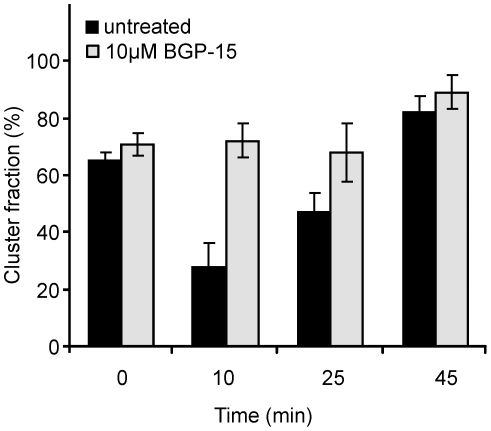
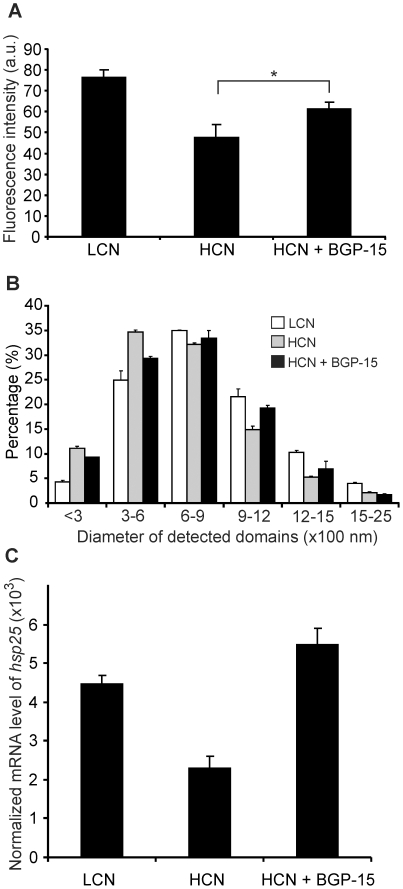
Aging and pathophysiological conditions are linked to membrane changes which modulate membrane-controlled molecular switches, causing dysregulated heat shock protein (HSP) expression. HSP co-inducer hydroxylamines such as BGP-15 provide advanced therapeutic candidates for many diseases since they preferentially affect stressed cells and are unlikely have major side effects. In the present study in vitro molecular dynamic simulation, experiments with lipid monolayers and in vivo ultrasensitive fluorescence microscopy showed that BGP-15 alters the organization of cholesterol-rich membrane domains. Imaging of nanoscopic long-lived platforms using the raft marker glycosylphosphatidylinositol-anchored monomeric green fluorescent protein diffusing in the live Chinese hamster ovary (CHO) cell plasma membrane demonstrated that BGP-15 prevents the transient structural disintegration of rafts induced by fever-type heat stress. Moreover, BGP-15 was able to remodel cholesterol-enriched lipid platforms reminiscent of those observed earlier following non-lethal heat priming or membrane stress, and were shown to be obligate for the generation and transmission of stress signals. BGP-15 activation of HSP expression in B16-F10 mouse melanoma cells involves the Rac1 signaling cascade in accordance with the previous observation that cholesterol affects the targeting of Rac1 to membranes. Finally, in a human embryonic kidney cell line we demonstrate that BGP-15 is able to inhibit the rapid heat shock factor 1 (HSF1) acetylation monitored during the early phase of heat stress, thereby promoting a prolonged duration of HSF1 binding to heat shock elements. Taken together, our results indicate that BGP-15 has the potential to become a new class of pharmaceuticals for use in 'membrane-lipid therapy' to combat many various protein-misfolding diseases associated with aging.
衰老和病理生理状况与膜变化有关,这些变化调节膜控制的分子开关,导致热休克蛋白(HSP)表达失调。BGP-15 等羟基胺类 HSP 共诱导剂为许多疾病提供了先进的治疗候选药物,因为它们优先影响应激细胞,不太可能产生重大副作用。在本研究中,通过体外分子动力学模拟、脂质单层实验和体内超灵敏荧光显微镜观察,表明 BGP-15 改变了富含胆固醇的膜域的组织。使用糖基磷脂酰肌醇锚定单体绿色荧光蛋白作为筏标记物,对活中国仓鼠卵巢(CHO)细胞膜中的扩散进行纳米级长寿命平台的成像,表明 BGP-15 可防止发热型热应激诱导的筏短暂结构解体。此外,BGP-15 能够重塑富含胆固醇的脂质平台,这些平台类似于之前观察到的非致死性热引发或膜应激后观察到的平台,并且被证明是应激信号产生和传递的必需条件。BGP-15 激活 B16-F10 小鼠黑色素瘤细胞中的 HSP 表达涉及 Rac1 信号级联,这与之前观察到的胆固醇影响 Rac1 靶向膜的观点一致。最后,在人胚肾细胞系中,我们证明 BGP-15 能够抑制在热应激早期阶段监测到的快速热休克因子 1(HSF1)乙酰化,从而延长 HSF1 与热休克元件结合的时间。总之,我们的结果表明,BGP-15 有可能成为一类新的药物,用于“膜脂质治疗”,以对抗与衰老相关的许多各种蛋白质错误折叠疾病。