Department of Immunology, Genetics and Pathology, Science for Life Laboratory, Uppsala University, Uppsala, Sweden.
J Med Genet. 2012 Feb;49(2):104-9. doi: 10.1136/jmedgenet-2011-100534. Epub 2011 Dec 17.
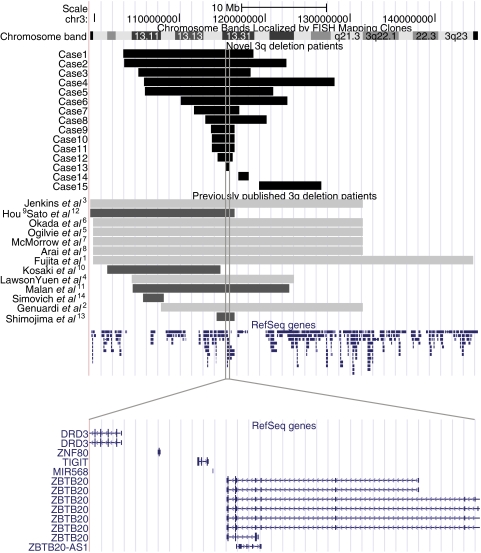
Congenital deletions affecting 3q11q23 have rarely been reported and only five cases have been molecularly characterised. Genotype-phenotype correlation has been hampered by the variable sizes and breakpoints of the deletions. In this study, 14 novel patients with deletions in 3q11q23 were investigated and compared with 13 previously reported patients.
Clinical data were collected from 14 novel patients that had been investigated by high resolution microarray techniques. Molecular investigation and updated clinical information of one cytogenetically previously reported patient were also included.
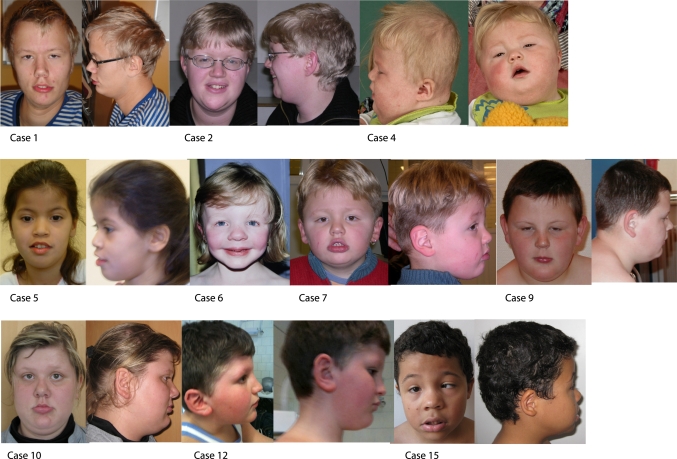
The molecular investigation identified deletions in the region 3q12.3q21.3 with different boundaries and variable sizes. The smallest studied deletion was 580 kb, located in 3q13.31. Genotype-phenotype comparison in 24 patients sharing this shortest region of overlapping deletion revealed several common major characteristics including significant developmental delay, muscular hypotonia, a high arched palate, and recognisable facial features including a short philtrum and protruding lips. Abnormal genitalia were found in the majority of males, several having micropenis. Finally, a postnatal growth pattern above the mean was apparent. The 580 kb deleted region includes five RefSeq genes and two of them are strong candidate genes for the developmental delay: DRD3 and ZBTB20.
A newly recognised 3q13.31 microdeletion syndrome is delineated which is of diagnostic and prognostic value. Furthermore, two genes are suggested to be responsible for the main phenotype.
涉及 3q11q23 的先天性缺失很少被报道,仅有 5 例通过分子方法进行了特征描述。由于缺失的大小和断点不同,基因型-表型相关性受到了阻碍。在这项研究中,对 14 名患有 3q11q23 缺失的新患者进行了研究,并与 13 名以前报道的患者进行了比较。
从 14 名新患者中收集临床数据,这些患者均通过高分辨率微阵列技术进行了检查。还包括一名以前通过细胞遗传学报道的患者的分子研究和更新的临床信息。
分子研究鉴定出了位于 3q12.3q21.3 区域的缺失,其边界和大小不同。研究的最小缺失为 580kb,位于 3q13.31。在 24 名共享这一最短重叠缺失区域的患者中进行的基因型-表型比较显示出几个共同的主要特征,包括严重的发育迟缓、肌肉张力减退、高拱形腭和可识别的面部特征,包括短人中、突出的嘴唇。大多数男性存在生殖器异常,其中一些人存在小阴茎。最后,出现了高于平均值的产后生长模式。缺失的 580kb 区域包括五个 RefSeq 基因,其中两个基因是导致发育迟缓的强候选基因:DRD3 和 ZBTB20。
描绘了一种新的可诊断和预测预后的 3q13.31 微缺失综合征。此外,有两个基因被认为是主要表型的原因。