van de Laar Maria C, van den Wildenberg Wery P M, van Boxtel Geert J M, van der Molen Maurits W
Amsterdam Center for the Study of Adaptive Control in Brain and Behavior, Department of Psychology, University of Amsterdam Amsterdam, Netherlands.
Front Psychol. 2011 Dec 15;2:357. doi: 10.3389/fpsyg.2011.00357. eCollection 2011.
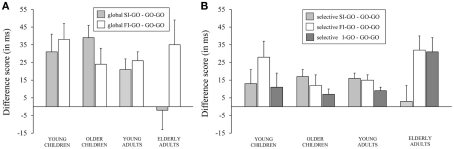
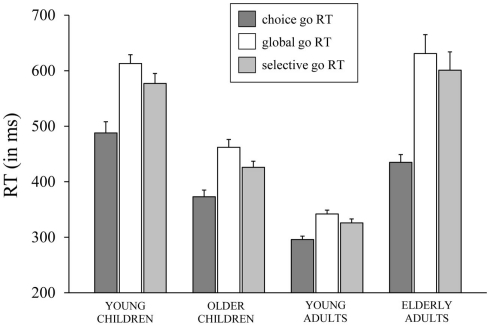
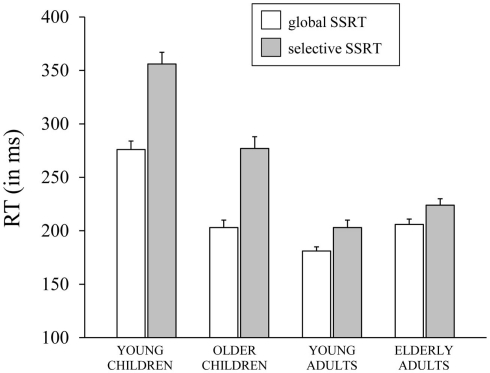
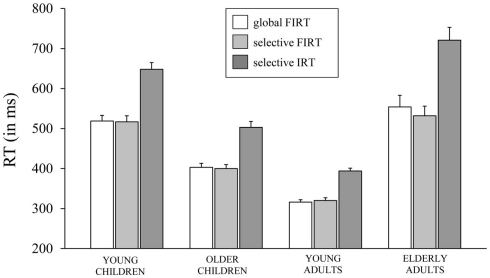
This study examined stopping and performance adjustments in four age groups (M ages: 8, 12, 21, and 76 years). All participants performed on three tasks, a standard two-choice task and the same task in which stop-signal trials were inserted requiring either the suppression of the response activated by the choice stimulus (global stop task) or the suppression of the response when one stop-signal was presented but not when the other stop-signal occurred (selective stop task). The results showed that global stopping was faster than selective stopping in all age groups. Global stopping matured more rapidly than selective stopping. The developmental gain in stopping was considerably more pronounced compared to the loss observed during senescence. All age groups slowed the response on trials without a stop-signal in the stop task compared to trials in the choice task, the elderly in particular. In addition, all age groups slowed on trials following stop-signal trials, except the elderly who did not slow following successful inhibits. By contrast, the slowing following failed inhibits was disproportionally larger in the elderly compared to young adults. Finally, sequential effects did not alter the pattern of performance adjustments. The results were interpreted in terms of developmental change in the balance between proactive and reactive control.
本研究考察了四个年龄组(平均年龄:8岁、12岁、21岁和76岁)的停止反应和表现调整情况。所有参与者完成三项任务,一项标准二选一任务,以及在相同任务中插入停止信号试验,要求要么抑制由选择刺激激活的反应(整体停止任务),要么在呈现一个停止信号时抑制反应,而在呈现另一个停止信号时不抑制反应(选择性停止任务)。结果表明,在所有年龄组中,整体停止反应比选择性停止反应更快。整体停止反应比选择性停止反应成熟得更快。与衰老过程中观察到的表现下降相比,停止反应的发展性提升更为显著。与选择任务中的试验相比,所有年龄组在停止任务中无停止信号的试验上反应均减慢,尤其是老年人。此外,除了在成功抑制后未减慢反应的老年人外,所有年龄组在停止信号试验后的试验中反应均减慢。相比之下,与年轻人相比,老年人在抑制失败后的反应减慢幅度更大。最后,序列效应并未改变表现调整的模式。研究结果从主动控制和反应控制之间平衡的发展变化角度进行了解释。