Department of Clinical Physics and Psychological Medicine, College of Medicine, Veterinary and Life Sciences, University of Glasgow, UK.
BMC Med Imaging. 2011 Dec 21;11:23. doi: 10.1186/1471-2342-11-23.
Brain morphometry is extensively used in cross-sectional studies. However, the difference in the estimated values of the morphometric measures between patients and healthy subjects may be small and hence overshadowed by the scanner-related variability, especially with multicentre and longitudinal studies. It is important therefore to investigate the variability and reliability of morphometric measurements between different scanners and different sessions of the same scanner.
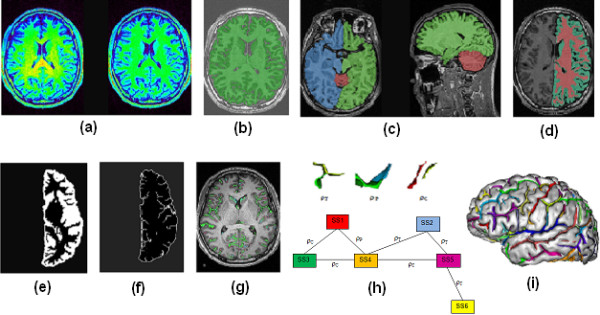
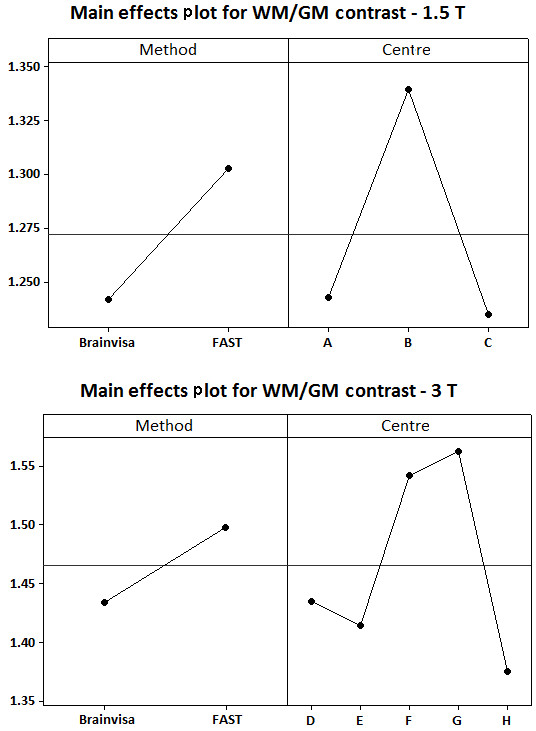
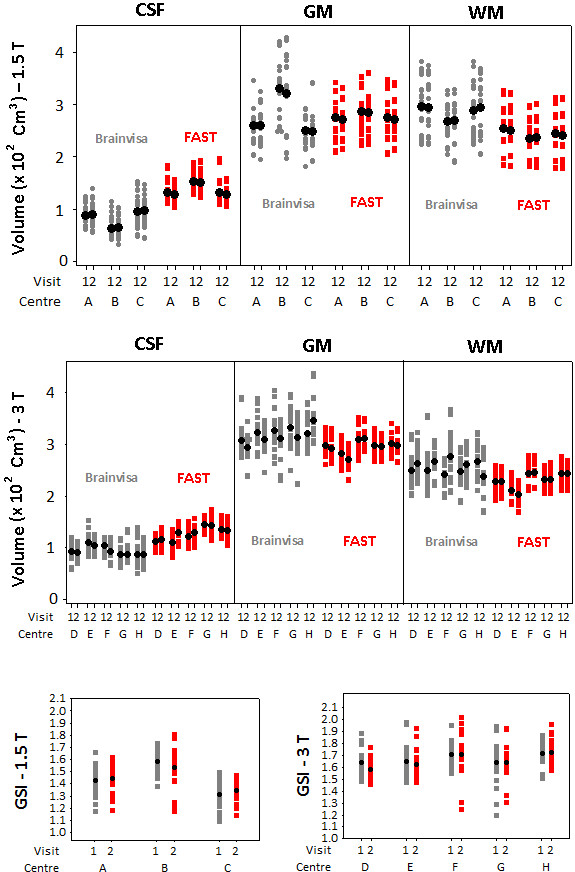
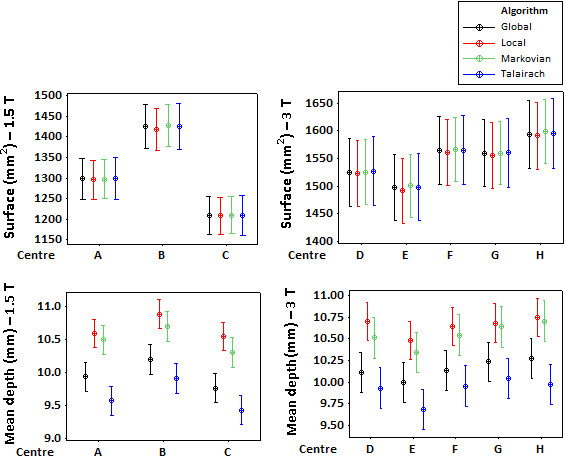
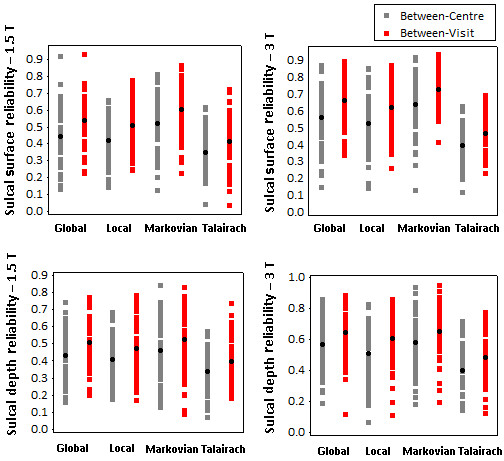
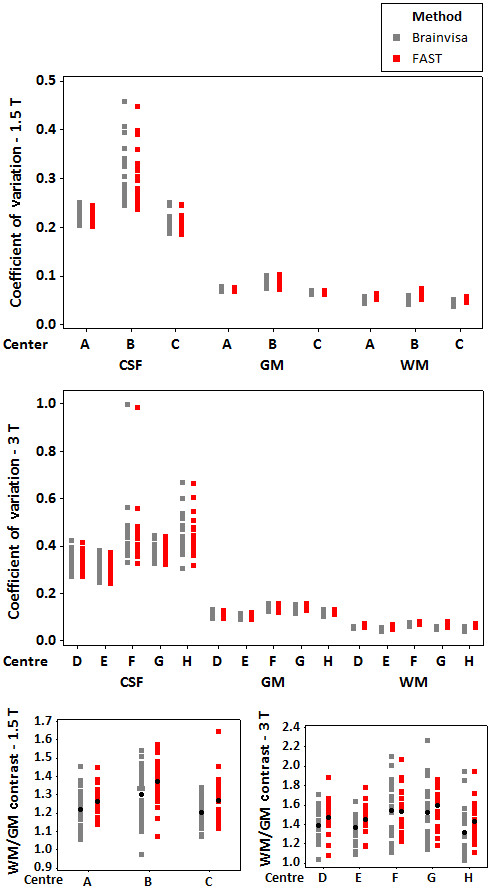
We assessed the variability and reliability for the grey matter, white matter, cerebrospinal fluid and cerebral hemisphere volumes as well as the global sulcal index, sulcal surface and mean geodesic depth using Brainvisa. We used datasets obtained across multiple MR scanners at 1.5 T and 3 T from the same groups of 13 and 11 healthy volunteers, respectively. For each morphometric measure, we conducted ANOVA analysis and verified whether the estimated values were significantly different across different scanners or different sessions of the same scanner. The between-centre and between-visit reliabilities were estimated from their contribution to the total variance, using a random-effects ANOVA model. To estimate the main processes responsible for low reliability, the results of brain segmentation were compared to those obtained using FAST within FSL.
In a considerable number of cases, the main effects of both centre and visit factors were found to be significant. Moreover, both between-centre and between-visit reliabilities ranged from poor to excellent for most morphometric measures. A comparison between segmentation using Brainvisa and FAST revealed that FAST improved the reliabilities for most cases, suggesting that morphometry could benefit from improving the bias correction. However, the results were still significantly different across different scanners or different visits.
Our results confirm that for morphometry analysis with the current version of Brainvisa using data from multicentre or longitudinal studies, the scanner-related variability must be taken into account and where possible should be corrected for. We also suggest providing some flexibility to Brainvisa for a step-by-step analysis of the robustness of this package in terms of reproducibility of the results by allowing the bias corrected images to be imported from other packages and bias correction step be skipped, for example.
脑形态计量学在横断面研究中得到了广泛应用。然而,患者和健康受试者之间形态计量测量值的差异可能很小,因此容易被扫描仪相关的变异性所掩盖,尤其是在多中心和纵向研究中。因此,研究不同扫描仪之间以及同一扫描仪不同扫描之间形态计量测量的变异性和可靠性非常重要。
我们使用 Brainvisa 评估了灰质、白质、脑脊液和大脑半球体积以及全局脑沟指数、脑沟表面积和平均测地线深度的变异性和可靠性。我们分别使用来自相同的 13 名和 11 名健康志愿者的在 1.5T 和 3T 磁共振扫描仪上获得的数据集。对于每个形态计量测量,我们进行了方差分析,并验证了不同扫描仪或同一扫描仪的不同扫描之间估计值是否存在显著差异。使用随机效应方差分析模型,从其对总方差的贡献来估计中心间和访问间的可靠性。为了估计导致低可靠性的主要过程,将脑分割的结果与使用 FSL 中的 FAST 获得的结果进行了比较。
在相当多的情况下,中心和访问因素的主要效应都被发现是显著的。此外,对于大多数形态计量测量,中心间和访问间的可靠性范围从差到优。使用 Brainvisa 和 FAST 进行分割的比较表明,FAST 提高了大多数情况下的可靠性,这表明形态计量学可以从改善偏差校正中受益。然而,不同扫描仪或不同访问之间的结果仍然存在显著差异。
我们的结果证实,对于使用多中心或纵向研究数据的当前版本的 Brainvisa 进行形态计量分析,必须考虑与扫描仪相关的变异性,并在可能的情况下进行校正。我们还建议为 Brainvisa 提供一些灵活性,例如允许从其他软件包导入经过偏差校正的图像,并跳过偏差校正步骤,以便逐步分析该软件包在结果重现性方面的稳健性。