Universidade de São Paulo, Cancer Institute, Department of Anesthesiology and Critical Care, Intensive Care Unit, São Paulo/SP, Brazil.
Clinics (Sao Paulo). 2011;66(12):2037-42. doi: 10.1590/s1807-59322011001200007.
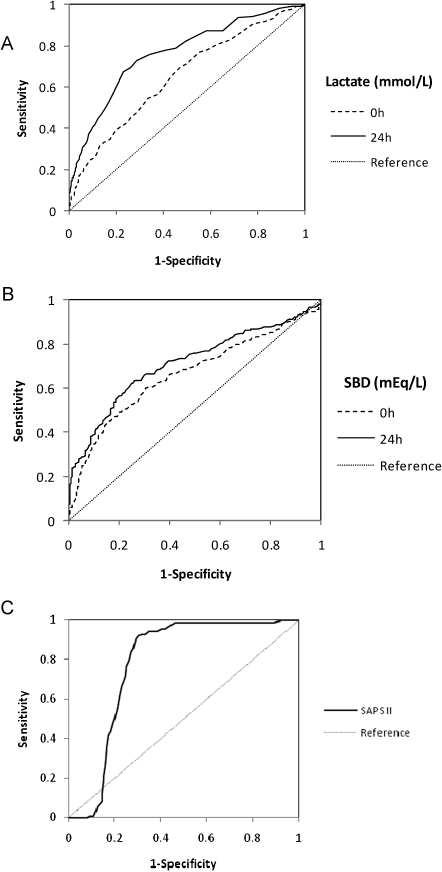
Cancer patients frequently require admission to intensive care unit. However, there are a few data regarding predictive factors for mortality in this group of patients. The aim of this study was to evaluate whether arterial lactate or standard base deficit on admission and after 24 hours can predict mortality for patients with cancer.
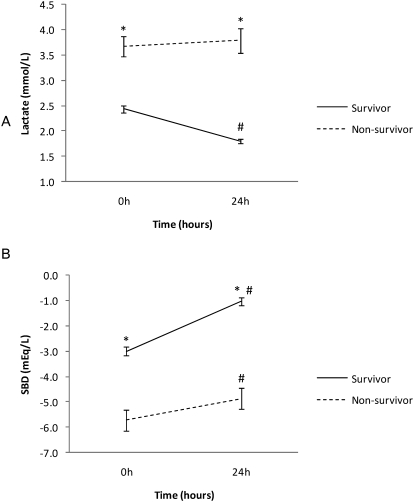
We evaluated 1,129 patients with severe sepsis, septic shock, or postoperative after high-risk surgery. Lactate and standard base deficit collected at admission and after 24 hours were compared between survivors and non-survivors. We evaluated whether these perfusion markers are independent predictors of mortality.
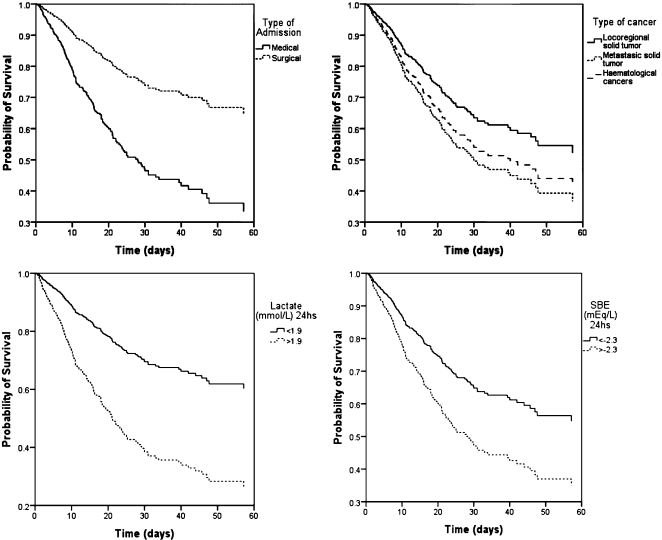
There were 854 hospital survivors (76.5%). 24 h lactate > 1.9 mmol/L and standard base deficit < -2.3 were independent predictors of intensive care unit mortality. 24 h lactate >1.9 mmol/L and 24 h standard base deficit < -2.3 mmol/Lwere independent predictors of hospital death.
Our findings suggest that lactate and standard base deficit measurement should be included in the routine assessment of patients with cancer admitted to the intensive care unit with sepsis, septic shock or after high-risk surgery. These markers may be useful in the adequate allocation of resources in this population.
癌症患者经常需要入住重症监护病房。然而,关于这组患者的死亡率预测因素的数据较少。本研究旨在评估入院时和 24 小时后动脉血乳酸或标准基础不足是否可以预测癌症患者的死亡率。
我们评估了 1129 例严重脓毒症、败血症性休克或高危手术后的患者。比较了存活者和非存活者入院时和 24 小时后的乳酸和标准基础不足。我们评估了这些灌注标志物是否是死亡率的独立预测因素。
有 854 例医院幸存者(76.5%)。24 小时乳酸>1.9mmol/L 和标准基础不足<-2.3 是重症监护病房死亡率的独立预测因素。24 小时乳酸>1.9mmol/L 和 24 小时标准基础不足<-2.3mmol/L 是医院死亡的独立预测因素。
我们的研究结果表明,对于因败血症、败血症性休克或高危手术后入住重症监护病房的癌症患者,应将乳酸和标准基础不足的测量纳入常规评估。这些标志物可能有助于在该人群中合理分配资源。