Schork Anja, Moll Kathrin, Haap Michael, Riessen Reimer, Wagner Robert
Division of Endocrinology, Diabetology, and Nephrology, Department of Internal Medicine IV, University Hospital Tübingen, Tübingen, Germany.
Institute of Diabetes Research and Metabolic Diseases (IDM) of the Helmholtz Center Munich at the University of Tübingen, Tübingen, Germany.
PLoS One. 2021 Dec 20;16(12):e0261564. doi: 10.1371/journal.pone.0261564. eCollection 2021.
As base excess had shown superiority over lactate as a prognostic parameter in intensive care unit (ICU) surgical patients we aimed to evaluate course of lactate, base excess and pH for prediction of mortality of medical ICU patients.
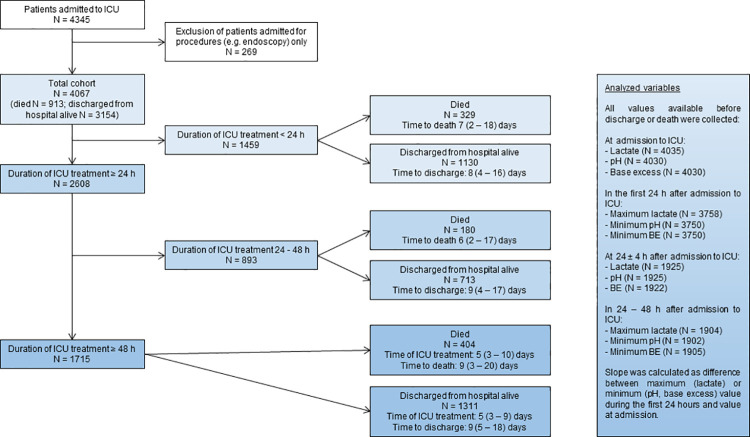
For lactate, pH and base excess, values at the admission to ICU, at 24 ± 4 hours, maximum or minimum in the first 24 hours and in 24-48 hours after admission were collected from all patients admitted to the Medical ICU of the University Hospital Tübingen between January 2016 until December 2018 (N = 4067 at admission, N = 1715 with ICU treatment > 48 h) and investigated for prediction of in-hospital-mortality.
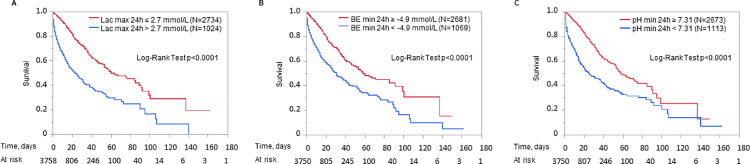
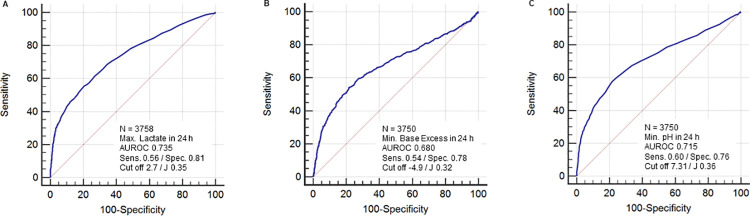
Mortality was 22% and significantly correlated with all evaluated parameters. Strongest predictors of mortality determined by ROC were maximum lactate in 24 h (AUROC 0.74, cut off 2.7 mmol/L, hazard ratio of risk group with value > cut off 3.20) and minimum pH in 24 h (AUROC 0.71, cut off 7.31, hazard ratio for risk group 2.94). Kaplan Meier Curves stratified across these cut offs showed early and clear separation. Hazard ratios per standard deviation increase were highest for maximum lactate in 24 h (HR 1.65), minimum base excess in 24 h (HR 1.56) and minimum pH in 24 h (HR 0.75).
Lactate, pH and base excess were all suitable predictors of mortality in internal ICU patients, with maximum / minimum values in 24 and 24-48 h after admission altogether stronger predictors than values at admission. Base excess and pH were not superior to lactate for prediction of mortality.
由于在重症监护病房(ICU)外科患者中,碱剩余作为预后参数已显示出优于乳酸的特性,我们旨在评估乳酸、碱剩余和pH值的变化过程,以预测内科ICU患者的死亡率。
收集了2016年1月至2018年12月期间图宾根大学医院内科ICU收治的所有患者的乳酸、pH值和碱剩余数据,包括入ICU时、24±4小时、入院后24小时内的最大值或最小值以及入院后24 - 48小时的值(入院时N = 4067,接受ICU治疗> 48小时的N = 1715),并对这些数据进行分析以预测院内死亡率。
死亡率为22%,且与所有评估参数显著相关。通过ROC曲线确定的最强死亡率预测指标为24小时内的最大乳酸值(AUROC 0.74,临界值2.7 mmol/L,值>临界值的风险组的风险比为3.20)和24小时内的最低pH值(AUROC 0.71,临界值7.31,风险组的风险比为2.94)。根据这些临界值分层的Kaplan Meier曲线显示出早期且明显的分离。每标准差增加的风险比在24小时内的最大乳酸值(HR 1.65)、24小时内的最低碱剩余值(HR 1.56)和24小时内的最低pH值(HR 0.75)中最高。
乳酸、pH值和碱剩余均是内科ICU患者死亡率的合适预测指标,入院后24小时和24 - 48小时内的最大值/最小值作为预测指标总体上比入院时的值更强。在预测死亡率方面,碱剩余和pH值并不优于乳酸。