National Yang-Ming University Hospital, Department of Medicine, Division of Hematology and Oncology, Yilan, Taiwan, Republic of China.
Clinics (Sao Paulo). 2011;66(12):2055-61. doi: 10.1590/s1807-59322011001200010.
Cytotoxic agents and steroids are used to treat lymphoid malignancies, but these compounds may exacerbate chronic viral hepatitis. For patients with multiple myeloma, the impact of preexisting hepatitis virus infection is unclear. The aim of this study is to explore the characteristics and outcomes of myeloma patients with chronic hepatitis virus infection.
From 2003 to 2008, 155 myeloma patients were examined to determine their chronic hepatitis virus infection statuses using serologic tests for the hepatitis B (HBV) and C viruses (HCV). Clinical parameters and outcome variables were retrieved via a medical chart review.
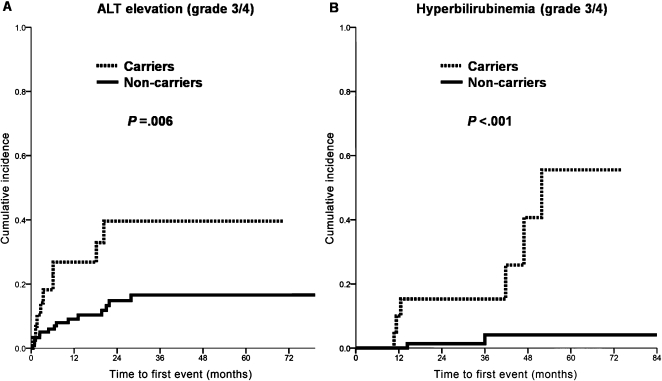
The estimated prevalences of chronic HBV and HCV infections were 11.0% (n = 17) and 9.0% (n = 14), respectively. The characteristics of patients who were hepatitis virus carriers and those who were not were similar. However, carrier patients had a higher prevalence of conventional cytogenetic abnormalities (64.3% vs. 25.0%). The cumulative incidences of grade 3-4 elevation of the level of alanine transaminase, 30.0% vs. 12.0%, and hyperbilirubinemia, 20.0% vs. 1.6%, were higher in carriers as well. In a Kaplan-Meier analysis, carrier patients had worse overall survival (median: 16.0 vs. 42.4 months). The prognostic value of carrier status was not statistically significant in the multivariate analysis, but an age of more than 65 years old, the presence of cytogenetic abnormalities, a beta-2-microglobulin level of more than 3.5 mg/L, and a serum creatinine level of more than 2 mg/ dL were independent factors associated with poor prognosis.
Myeloma patients with chronic hepatitis virus infections might be a distinct subgroup, and close monitoring of hepatic adverse events should be mandatory.
细胞毒性药物和类固醇用于治疗淋巴恶性肿瘤,但这些化合物可能会加重慢性病毒性肝炎。对于多发性骨髓瘤患者,先前存在的肝炎病毒感染的影响尚不清楚。本研究旨在探讨伴有慢性肝炎病毒感染的骨髓瘤患者的特征和结局。
2003 年至 2008 年,对 155 例骨髓瘤患者进行了检查,通过乙型肝炎(HBV)和丙型肝炎病毒(HCV)的血清学检测来确定他们的慢性肝炎病毒感染状态。通过病历回顾获取临床参数和结局变量。
慢性 HBV 和 HCV 感染的估计患病率分别为 11.0%(n=17)和 9.0%(n=14)。病毒携带者和非携带者的特征相似,但携带者的常规细胞遗传学异常发生率更高(64.3% vs. 25.0%)。丙氨酸转氨酶水平 3-4 级升高的累积发生率(30.0% vs. 12.0%)和高胆红素血症的发生率(20.0% vs. 1.6%)也更高。在 Kaplan-Meier 分析中,携带者的总生存情况较差(中位数:16.0 个月 vs. 42.4 个月)。在多变量分析中,携带者状态的预后价值不显著,但年龄大于 65 岁、存在细胞遗传学异常、β2-微球蛋白水平大于 3.5mg/L 和血清肌酐水平大于 2mg/dL 是与预后不良相关的独立因素。
伴有慢性肝炎病毒感染的骨髓瘤患者可能是一个独特的亚组,应强制性密切监测肝脏不良事件。