Department of Psychiatry, Weill Cornell Medical College, New York, USA.
Am J Psychiatry. 2012 Mar;169(3):285-91. doi: 10.1176/appi.ajp.2011.11060948.
In 2009 the U.S. Food and Drug Administration issued a warning regarding suicidality and antiepileptic drugs based on meta-analyses of 199 randomized trials (over 43,000 subjects with different illnesses) of 11 antiepileptics. The present study examines the hypothesis that the three antiepileptics approved for bipolar disorder (carbamazepine, lamotrigine, and valproate) are associated with an elevated risk of suicide attempts and suicides.
A prospective observational study was conducted at five U.S. academic medical centers from 1978 to 2009. Analyses included 199 participants with bipolar disorder for whom 1,077 time intervals were classified as either exposed to an antiepileptic (carbamazepine, lamotrigine, or valproate) or not exposed to an antiepileptic, an antidepressant, or lithium during 30 years of follow-up.
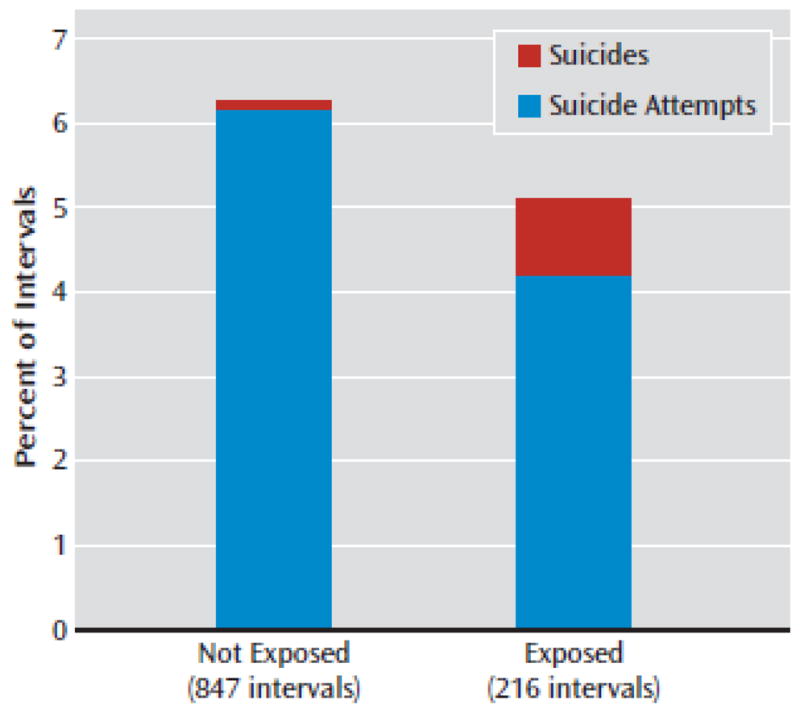
Participants who had more severe manic symptoms were more likely to receive antiepileptic drugs. Mixed-effects grouped-time survival models revealed no elevation in risk of suicide attempt or suicide during periods when participants were receiving antiepileptics relative to periods when they were not (hazard ratio=0.93, 95% CI=0.45-1.92), controlling for demographic and clinical variables through propensity score matching.
In this longitudinal observational study, the risk of suicide attempts or suicides was not associated with the antiepileptics approved for bipolar disorder.
2009 年,美国食品和药物管理局根据对 199 项随机试验(涉及 43000 名患有不同疾病的患者)的荟萃分析,就自杀倾向和抗癫痫药物发布了一项警告。本研究检验了这样一个假设,即三种批准用于治疗双相情感障碍的抗癫痫药物(卡马西平、拉莫三嗪和丙戊酸)与自杀企图和自杀的风险增加有关。
这项前瞻性观察性研究在美国 5 家学术医疗中心进行,从 1978 年至 2009 年,共纳入 199 名患有双相情感障碍的参与者,对他们进行了分析,共涉及 1077 个时间间隔,这些时间间隔被分为暴露于抗癫痫药物(卡马西平、拉莫三嗪或丙戊酸)或未暴露于抗癫痫药物、抗抑郁药或锂期间,随访时间长达 30 年。
具有更严重躁狂症状的参与者更有可能接受抗癫痫药物治疗。混合效应分组时间生存模型显示,与未接受抗癫痫药物治疗的时间相比,参与者接受抗癫痫药物治疗期间,自杀企图或自杀的风险没有增加(风险比=0.93,95%置信区间=0.45-1.92),这是通过倾向评分匹配控制了人口统计学和临床变量的结果。
在这项纵向观察性研究中,自杀企图或自杀的风险与批准用于治疗双相情感障碍的抗癫痫药物无关。