
IGF-1 和 PDGF-bb 通过下调 NF-κB 信号通路抑制 IL-1β 诱导的软骨降解:涉及 Src/PI-3K/AKT 途径。
IGF-1 and PDGF-bb suppress IL-1β-induced cartilage degradation through down-regulation of NF-κB signaling: involvement of Src/PI-3K/AKT pathway.
机构信息
Department of Anatomical Sciences, Tabriz University of Medical Sciences, Tabriz, Iran.
出版信息
PLoS One. 2011;6(12):e28663. doi: 10.1371/journal.pone.0028663. Epub 2011 Dec 14.
OBJECTIVE
Interleukin-1β (IL-1β) is a pro-inflammatory cytokine that plays a key role in the pathogenesis of osteoarthritis (OA). Growth factors (GFs) capable of antagonizing the catabolic actions of cytokines may have therapeutic potential in the treatment of OA. Herein, we investigated the potential synergistic effects of insulin-like growth factor (IGF-1) and platelet-derived growth factor (PDGF-bb) on different mechanisms participating in IL-1β-induced activation of nuclear transcription factor-κB (NF-κB) and apoptosis in chondrocytes.
METHODS
Primary chondrocytes were treated with IL-1β to induce dedifferentiation and co-treated with either IGF-1 or/and PDGF-bb and evaluated by immunoblotting and electron microscopy.
RESULTS
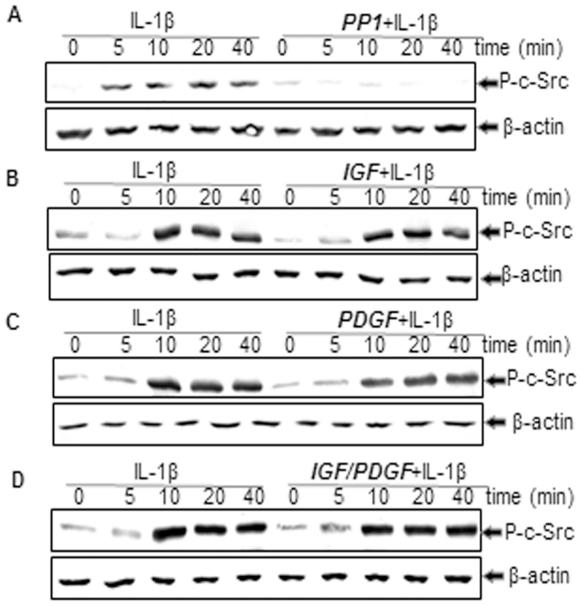
Pretreatment of chondrocytes with IGF-1 or/and PDGF-bb suppressed IL-1β-induced NF-κB activation via inhibition of IκB-α kinase. Inhibition of IκB-α kinase by GFs led to the suppression of IκB-α phosphorylation and degradation, p65 nuclear translocation and NF-κB-regulated gene products involved in inflammation and cartilage degradation (COX-2, MMPs) and apoptosis (caspase-3). GFs or BMS-345541 (specific inhibitor of the IKK) reversed the IL-1β-induced down-regulation of collagen type II, cartilage specific proteoglycans, β1-integrin, Shc, activated MAPKinase, Sox-9 and up-regulation of active caspase-3. Furthermore, the inhibitory effects of IGF-1 or/and PDGF-bb on IL-1β-induced NF-κB activation were sensitive to inhibitors of Src (PP1), PI-3K (wortmannin) and Akt (SH-5), suggesting that the pathway consisting of non-receptor tyrosine kinase (Src), phosphatidylinositol 3-kinase and protein kinase B must be involved in IL-1β signaling.
CONCLUSION
The results presented suggest that IGF-1 and PDGF-bb are potent inhibitors of IL-1β-mediated activation of NF-κB and apoptosis in chondrocytes, may be mediated in part through suppression of Src/PI-3K/AKT pathway, which may contribute to their anti-inflammatory effects.
目的
白细胞介素-1β(IL-1β)是一种促炎细胞因子,在骨关节炎(OA)的发病机制中起关键作用。能够拮抗细胞因子分解代谢作用的生长因子(GFs)可能具有治疗 OA 的潜力。在此,我们研究了胰岛素样生长因子(IGF-1)和血小板衍生生长因子(PDGF-bb)对不同机制的协同作用,这些机制参与了 IL-1β诱导的核转录因子-κB(NF-κB)激活和软骨细胞凋亡。
方法
用 IL-1β处理原代软骨细胞以诱导去分化,并与 IGF-1 或/和 PDGF-bb 共同处理,并用免疫印迹和电子显微镜进行评估。
结果
软骨细胞先用 IGF-1 或/和 PDGF-bb 预处理可通过抑制 IκB-α 激酶抑制 IL-1β诱导的 NF-κB 激活。GFs 抑制 IκB-α 激酶导致 IκB-α 磷酸化和降解、p65 核易位以及 NF-κB 调节的炎症和软骨降解(COX-2、MMPs)和凋亡(caspase-3)基因产物受到抑制。GFs 或 BMS-345541(IKK 的特异性抑制剂)逆转了 IL-1β诱导的胶原 II 型、软骨特异性蛋白聚糖、β1-整合素、Shc、激活的 MAPKinase、Sox-9 的下调和活性 caspase-3 的上调。此外,IGF-1 或/和 PDGF-bb 对 IL-1β诱导的 NF-κB 激活的抑制作用对 Src(PP1)、PI-3K(wortmannin)和 Akt(SH-5)的抑制剂敏感,表明该途径由非受体酪氨酸激酶(Src)、磷脂酰肌醇 3-激酶和蛋白激酶 B 组成必须参与 IL-1β 信号转导。
结论
研究结果表明,IGF-1 和 PDGF-bb 是软骨细胞中 IL-1β 介导的 NF-κB 激活和凋亡的有效抑制剂,部分可能通过抑制 Src/PI-3K/Akt 途径介导,这可能有助于其抗炎作用。


 Zotero 插件