School of Psychology, University of New South Wales, Sydney, Australia.
PLoS One. 2011;6(12):e29221. doi: 10.1371/journal.pone.0029221. Epub 2011 Dec 14.
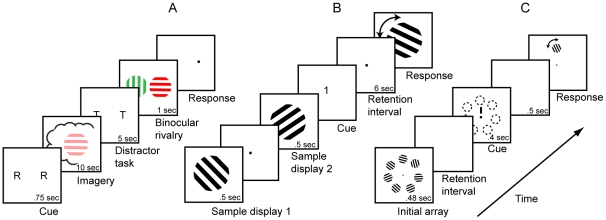
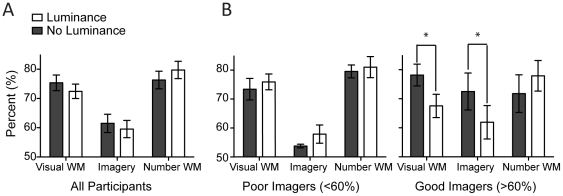
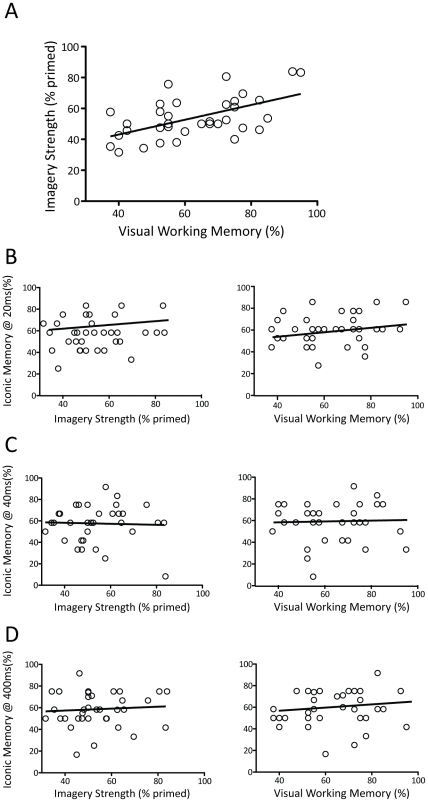
Visual working memory provides an essential link between past and future events. Despite recent efforts, capacity limits, their genesis and the underlying neural structures of visual working memory remain unclear. Here we show that performance in visual working memory--but not iconic visual memory--can be predicted by the strength of mental imagery as assessed with binocular rivalry in a given individual. In addition, for individuals with strong imagery, modulating the background luminance diminished performance on visual working memory and imagery tasks, but not working memory for number strings. This suggests that luminance signals were disrupting sensory-based imagery mechanisms and not a general working memory system. Individuals with poor imagery still performed above chance in the visual working memory task, but their performance was not affected by the background luminance, suggesting a dichotomy in strategies for visual working memory: individuals with strong mental imagery rely on sensory-based imagery to support mnemonic performance, while those with poor imagery rely on different strategies. These findings could help reconcile current controversy regarding the mechanism and location of visual mnemonic storage.
视觉工作记忆为过去和未来事件提供了重要的联系。尽管最近有研究努力,但视觉工作记忆的容量限制、其起源以及潜在的神经结构仍不清楚。在这里,我们表明,在给定个体中用双眼竞争评估的心理意象强度可以预测视觉工作记忆的表现,但不能预测表象视觉记忆。此外,对于具有强烈意象的个体,调节背景亮度会降低视觉工作记忆和意象任务的表现,但不会降低数字字符串的工作记忆。这表明亮度信号干扰了基于感觉的意象机制,而不是一般的工作记忆系统。在视觉工作记忆任务中表现不佳的个体仍然表现出高于机会的表现,但他们的表现不受背景亮度的影响,这表明视觉工作记忆策略存在二分法:具有强烈心理意象的个体依赖基于感觉的意象来支持记忆表现,而那些表现不佳的个体则依赖不同的策略。这些发现可以帮助调和当前关于视觉记忆存储机制和位置的争议。