Division of Research, Kaiser Permanente Northern California, 2000 Broadway, Oakland, CA 94612-2304, USA.
BMC Public Health. 2011 Dec 23;11:952. doi: 10.1186/1471-2458-11-952.
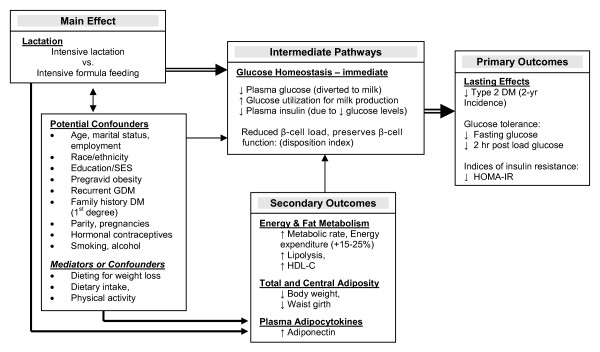
Women with history of gestational diabetes mellitus (GDM) are at higher risk of developing type 2 diabetes within 5 years after delivery. Evidence that lactation duration influences incident type 2 diabetes after GDM pregnancy is based on one retrospective study reporting a null association. The Study of Women, Infant Feeding and Type 2 Diabetes after GDM pregnancy (SWIFT) is a prospective cohort study of postpartum women with recent GDM within the Kaiser Permanente Northern California (KPNC) integrated health care system. The primary goal of SWIFT is to assess whether prolonged, intensive lactation as compared to formula feeding reduces the 2-year incidence of type 2 diabetes mellitus among women with GDM. The study also examines whether lactation intensity and duration have persistent favorable effects on blood glucose, insulin resistance, and adiposity during the 2-year postpartum period. This report describes the design and methods implemented for this study to obtain the clinical, biochemical, anthropometric, and behavioral measurements during the recruitment and follow-up phases.
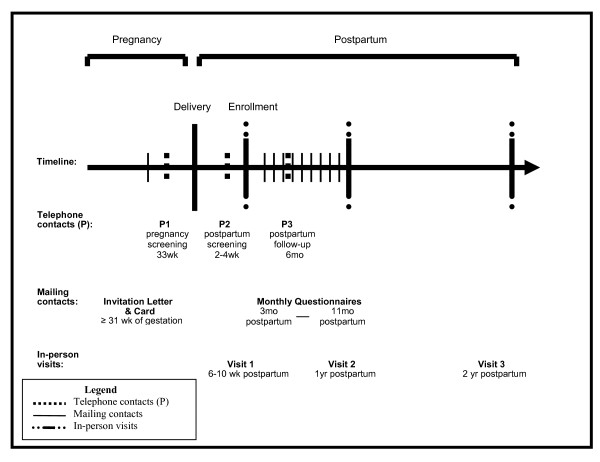
SWIFT is a prospective, observational cohort study enrolling and following over 1, 000 postpartum women diagnosed with GDM during pregnancy within KPNC. The study enrolled women at 6-9 weeks postpartum (baseline) who had been diagnosed by standard GDM criteria, aged 20-45 years, delivered a singleton, term (greater than or equal to 35 weeks gestation) live birth, were not using medications affecting glucose tolerance, and not planning another pregnancy or moving out of the area within the next 2 years. Participants who are free of type 2 diabetes and other serious medical conditions at baseline are screened for type 2 diabetes annually within the first 2 years after delivery. Recruitment began in September 2008 and ends in December 2011. Data are being collected through pregnancy and early postpartum telephone interviews, self-administered monthly mailed questionnaires (3-11 months postpartum), a telephone interview at 6 months, and annual in-person examinations at which a 75 g 2-hour OGTT is conducted, anthropometric measurements are obtained, and self- and interviewer-administered questionnaires are completed.
This is the first, large prospective, community-based study involving a racially and ethnically diverse cohort of women with recent GDM that rigorously assesses lactation intensity and duration and examines their relationship to incident type 2 diabetes while accounting for numerous potential confounders not assessed previously.
有妊娠糖尿病史的女性在产后 5 年内患 2 型糖尿病的风险更高。关于母乳喂养持续时间会影响妊娠糖尿病后 2 型糖尿病发病的证据,仅有一项回顾性研究报告称两者无关联。“妊娠糖尿病后妇女、婴儿喂养和 2 型糖尿病研究(SWIFT)”是一项针对 Kaiser Permanente 北加州(KPNC)综合医疗保健系统内近期妊娠糖尿病产后妇女的前瞻性队列研究。SWIFT 的主要目标是评估与配方喂养相比,延长、强化母乳喂养是否能降低妊娠糖尿病女性 2 年内患 2 型糖尿病的发病率。该研究还检查了母乳喂养的强度和持续时间在产后 2 年内是否对血糖、胰岛素抵抗和肥胖有持续的有利影响。本报告介绍了为进行这项研究而实施的设计和方法,以在招募和随访阶段获得临床、生化、人体测量和行为测量。
SWIFT 是一项前瞻性、观察性队列研究,纳入并随访了 1000 多名在 KPNC 妊娠期间被诊断为妊娠糖尿病的产后妇女。该研究于产后 6-9 周(基线)招募了符合标准妊娠糖尿病诊断标准、年龄在 20-45 岁之间、分娩单胎、足月(大于或等于 35 周妊娠)活产、未服用影响葡萄糖耐量的药物且在未来 2 年内无生育计划或搬离该地区的妇女。在基线时无 2 型糖尿病和其他严重疾病的参与者在产后 2 年内每年接受 2 型糖尿病筛查。招募工作于 2008 年 9 月开始,2011 年 12 月结束。通过妊娠和产后早期的电话访谈、自我管理的每月邮寄问卷(产后 3-11 个月)、6 个月时的电话访谈以及每年的面对面检查收集数据,在面对面检查中进行 75g 2 小时口服葡萄糖耐量试验、人体测量学测量和自我及访谈者管理的问卷调查。
这是第一项涉及最近有妊娠糖尿病的、种族和民族多样化的社区队列的大型前瞻性、基于社区的研究,该研究严格评估了母乳喂养的强度和持续时间,并在考虑到以前未评估的许多潜在混杂因素的情况下,检查了它们与新发 2 型糖尿病的关系。