Ferrara Assiamira, Peng Tiffany, Kim Catherine
Division of Research, Kaiser Permanente Northern California, Oakland, California, USA.
Diabetes Care. 2009 Feb;32(2):269-74. doi: 10.2337/dc08-1184. Epub 2008 Nov 4.
The purpose of this study was to examine trends in postpartum glucose screening for women with gestational diabetes mellitus (GDM), predictors of screening, trends in postpartum impaired fasting glucose (IFG) and diabetes, and diabetes and pre-diabetes detected by postpartum fasting plasma glucose (FPG) versus a 75-g oral glucose tolerance test (OGTT).
This was a cohort study of 14,448 GDM pregnancies delivered between 1995 and 2006. Postpartum screening was defined as performance of either an FPG or OGTT at least 6 weeks after delivery and within 1 year of delivery.
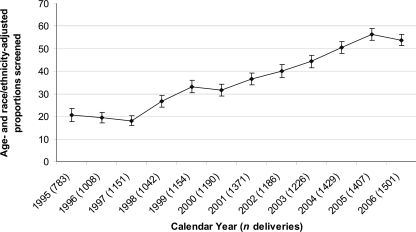
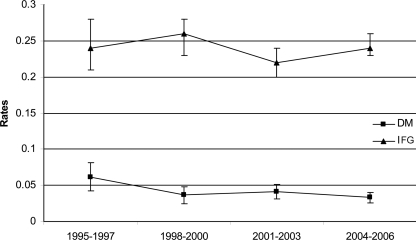
Between 1995 and 2006, the age- and race/ethnicity-adjusted proportion of women who were screened postpartum rose from 20.7% (95% CI 17.8-23.5) to 53.8% (51.3-56.3). Older age, Asian or Hispanic race/ethnicity, higher education, earlier GDM diagnosis, use of diabetes medications during pregnancy, and more provider contacts after delivery were independent predictors of postpartum screening. Obesity and higher parity were independently associated with lower screening performance. Among women who had postpartum screening, the age- and race/ethnicity-adjusted proportion of IFG did not change over time (24.2 [95% CI 20.0-27.8] in 1995-1997 to 24.3 [22.6-26.0] in 2004-2006), but the proportion of women with diabetes decreased from 6.1 (95% CI 4.2-8.1) in 1995-1997 to 3.3 (2.6-4.0) in 2004-2006. Among women who received an OGTT in 2006, 38% of the 204 women with either diabetes or pre-diabetes were identified only by the 2-h glucose measurements.
Postpartum screening has increased over the last decade, but it is still suboptimal. Compared with FPGs alone, the 2-h values identify a higher proportion of women with diabetes or pre-diabetes amenable to intervention.
本研究旨在探讨妊娠糖尿病(GDM)女性产后血糖筛查的趋势、筛查的预测因素、产后空腹血糖受损(IFG)和糖尿病的趋势,以及产后空腹血糖(FPG)与75克口服葡萄糖耐量试验(OGTT)检测出的糖尿病和糖尿病前期情况。
这是一项对1995年至2006年间分娩的14448例GDM妊娠进行的队列研究。产后筛查定义为在分娩后至少6周且在分娩后1年内进行FPG或OGTT检查。
1995年至2006年间,经年龄和种族/民族调整后的产后接受筛查的女性比例从20.7%(95%CI 17.8 - 23.5)升至53.8%(51.3 - 56.3)。年龄较大、亚洲或西班牙裔种族/民族、高等教育程度、GDM诊断较早、孕期使用糖尿病药物以及产后更多次与医疗服务提供者接触是产后筛查的独立预测因素。肥胖和较高的产次与较低的筛查率独立相关。在进行产后筛查的女性中,经年龄和种族/民族调整后的IFG比例随时间未发生变化(1995 - 1997年为24.2 [95%CI 20.0 - 27.8],2004 - 2006年为24.3 [22.6 - 26.0]),但糖尿病女性比例从1995 - 1997年的6.1(95%CI 4.2 - 8.1)降至2004 - 2006年的3.3(2.6 - 4.0)。在2006年接受OGTT检查的女性中,204例患有糖尿病或糖尿病前期的女性中有38%仅通过2小时血糖测量被确诊。
在过去十年中,产后筛查有所增加,但仍未达到最佳水平。与单独的FPG相比,2小时血糖值能识别出更高比例的适合干预的糖尿病或糖尿病前期女性。