Division of Allergic Diseases, Department of Internal Medicine, Mayo Clinic, Rochester, MN 55905, USA.
J Immunol. 2012 Feb 1;188(3):1503-13. doi: 10.4049/jimmunol.1102832. Epub 2011 Dec 23.
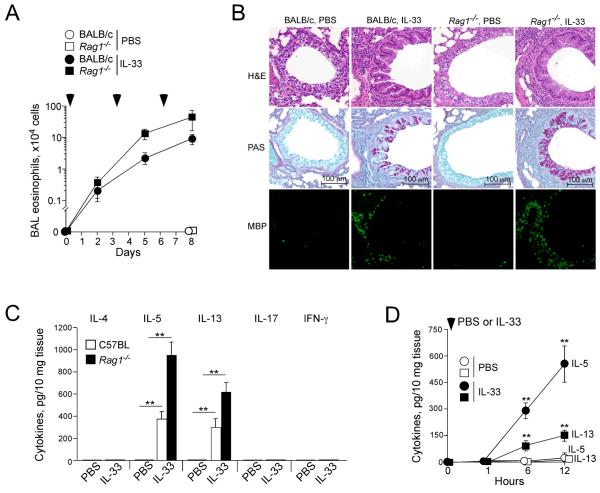
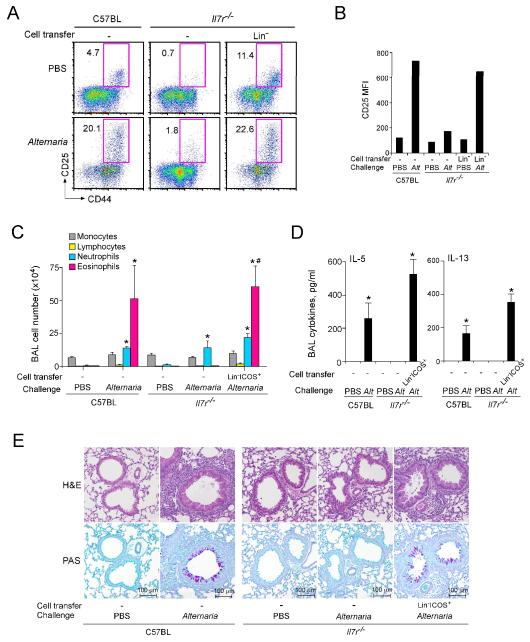
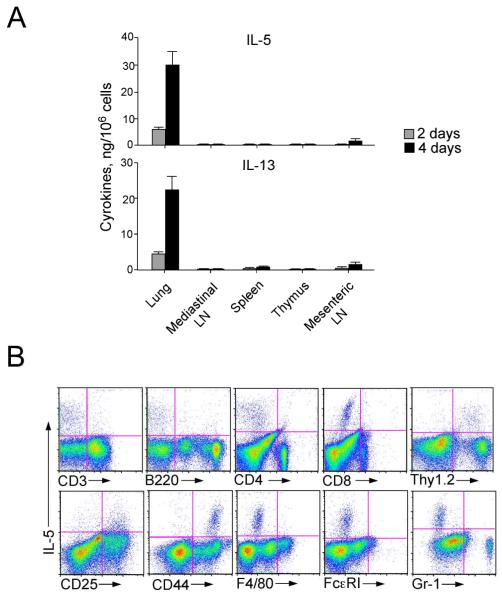
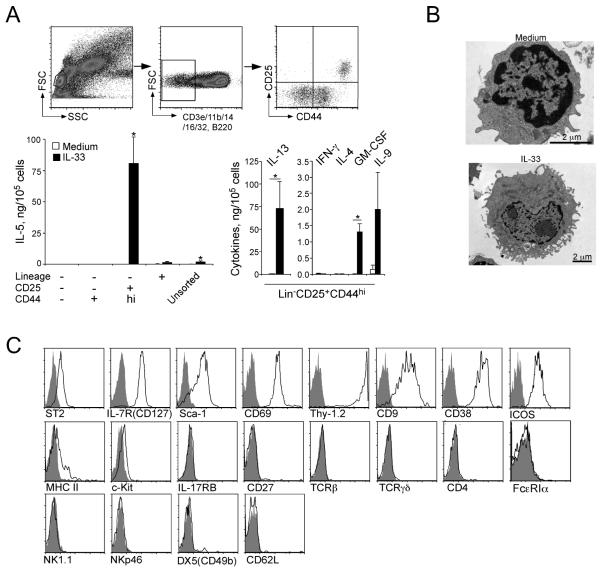
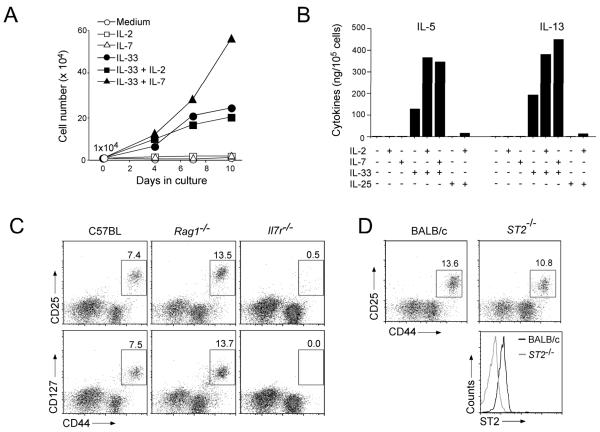
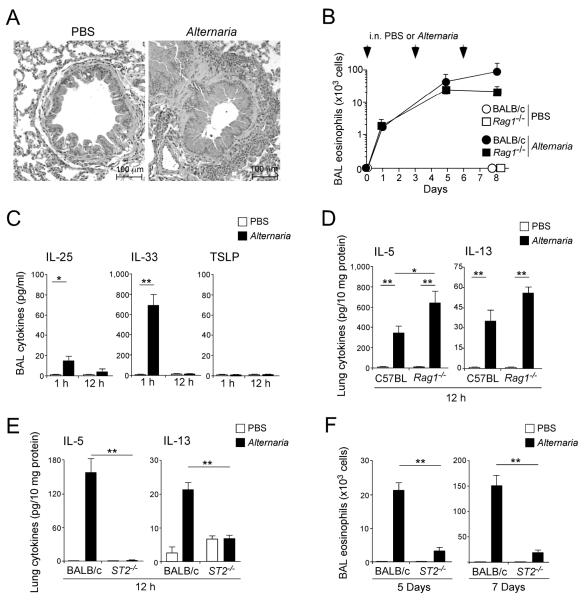
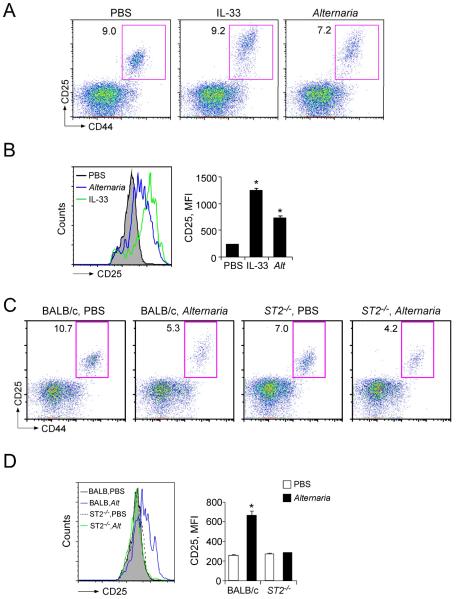
Innate immunity provides the first line of response to invading pathogens and a variety of environmental insults. Recent studies identified novel subsets of innate lymphoid cells that are capable of mediating immune responses in mucosal organs. In this paper, we describe a subset of lymphoid cells that is involved in innate type 2 immunity in the lungs. Airway exposure of naive BALB/c or C57BL/6J mice to IL-33 results in a rapid (<12 h) production of IL-5 and IL-13 and marked airway eosinophilia independently of adaptive immunity. In the lungs of nonsensitized naive mice, IL-33-responsive cells were identified that have a lymphoid morphology, lack lineage markers, highly express CD25, CD44, Thy1.2, ICOS, Sca-1, and IL-7Rα (i.e., Lin(-)CD25(+)CD44(hi) lymphoid cells), and require IL-7Rα for their development. Airway exposure of naive mice to a clinically relevant ubiquitous fungal allergen, Alternaria alternata, increases bronchoalveolar lavage levels of IL-33, followed by IL-5 and IL-13 production and airway eosinophilia without T or B cells. This innate type 2 response to the allergen is nearly abolished in mice deficient in IL-33R (i.e., ST2), and the Lin(-)CD25(+)CD44(hi) lymphoid cells in the lungs are required and sufficient to mediate the response. Thus, a subset of innate immune cells that responds to IL-33 and vigorously produces Th2-type cytokines is present in mouse lungs. These cells may provide a novel mechanism for type 2 immunity in the airways and induction of allergic airway diseases such as asthma.
先天免疫为抵御入侵病原体和各种环境侵袭提供了第一道防线。最近的研究发现了能够在黏膜器官中介导免疫反应的新型先天淋巴样细胞亚群。在本文中,我们描述了一种参与肺部先天 2 型免疫的淋巴样细胞亚群。气道暴露于 naive BALB/c 或 C57BL/6J 小鼠的 IL-33 会导致 IL-5 和 IL-13 的快速(<12 h)产生,并独立于适应性免疫而导致明显的气道嗜酸性粒细胞增多。在未致敏的 naive 小鼠的肺部中,鉴定出对 IL-33 有反应的细胞,这些细胞具有淋巴样形态,缺乏谱系标记物,高表达 CD25、CD44、Thy1.2、ICOS、Sca-1 和 IL-7Rα(即 Lin(-)CD25(+)CD44(hi) 淋巴样细胞),并且其发育需要 IL-7Rα。气道暴露于一种临床上相关的无处不在的真菌过敏原,Alternaria alternata,会增加支气管肺泡灌洗液中的 IL-33,随后产生 IL-5 和 IL-13,并导致气道嗜酸性粒细胞增多,而不需要 T 或 B 细胞。对该过敏原的这种先天 2 型反应在缺乏 IL-33R(即 ST2)的小鼠中几乎被消除,并且肺部中的 Lin(-)CD25(+)CD44(hi) 淋巴样细胞是介导该反应所必需和充分的。因此,存在于小鼠肺部中的对 IL-33 作出反应并大量产生 Th2 型细胞因子的一组先天免疫细胞。这些细胞可能为气道中的 2 型免疫和诱导哮喘等过敏性气道疾病提供了一种新的机制。