Department of Otorhinolaryngology-Head and Neck Surgery, Samsung Medical Center, Sungkyunkwan University School of Medicine, Seoul, Korea.
Allergy Asthma Immunol Res. 2012 Jan;4(1):37-45. doi: 10.4168/aair.2012.4.1.37. Epub 2011 Nov 1.
There is growing evidence that nasal airway remodeling occurs in allergic rhinitis (AR). Although angiogenesis is an important component of airway remodeling in asthma, its involvement in AR has been little studied. Furthermore, information regarding the role of potent angiogenic factors, such as vascular endothelial growth factor (VEGF) and platelet-derived growth factor (PDGF), in the nasal airway remodeling process is limited. This study was conducted to investigate the role of VEGF and PDGF in nasal airway remodeling, and to assess the preventive effects of anti-angiogenic drugs on this process in a murine AR model.
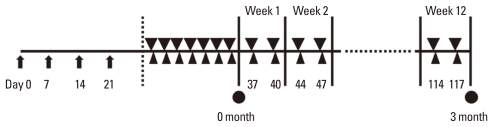
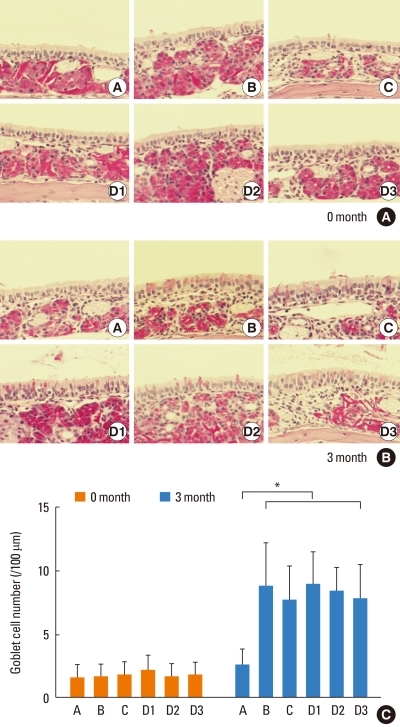
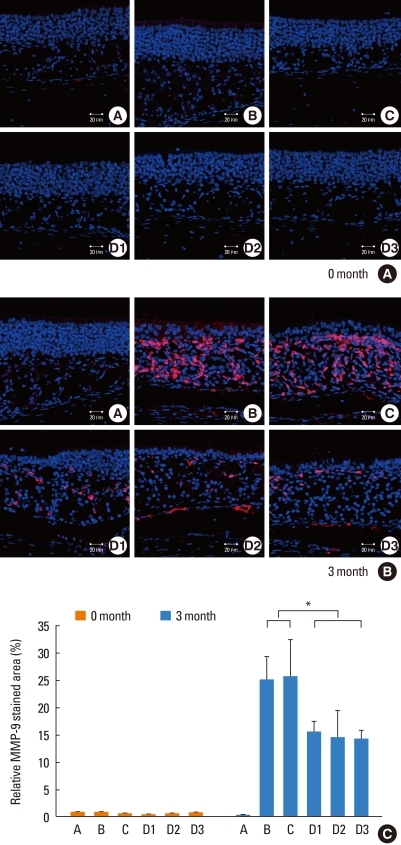
Mice were systemically sensitized and subjected to inhalation of ovalbumin (OVA) twice a week for 3 months. Control mice were challenged with phosphate buffered saline, while the treatment group received SU1498, a VEGF receptor inhibitor, and/or AG1296, a PDGF receptor inhibitor, via intraperitoneal injection 4 hours prior to each OVA inhalation. Staining using hematoxylin and eosin, Masson's trichrome, and periodic acid-Schiff were separately performed to assess eosinophil infiltration, subepithelial fibrosis, and goblet cell hyperplasia, respectively, in the nasal airway. Immunohistochemical staining for matrix metalloproteinase-9 (MMP-9) and tissue inhibitor of metalloproteinase-1 (TIMP-1) was also conducted.
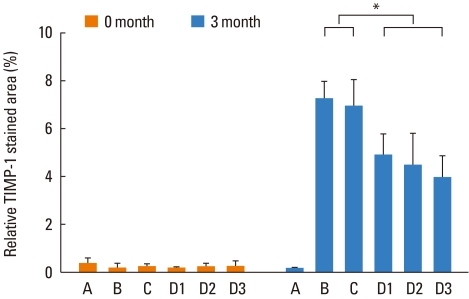
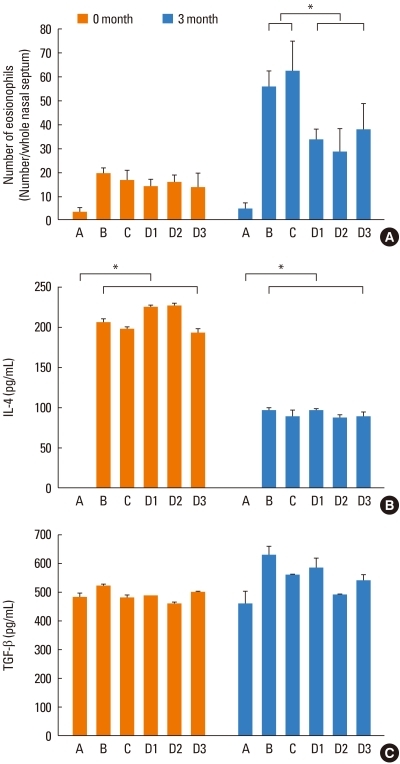
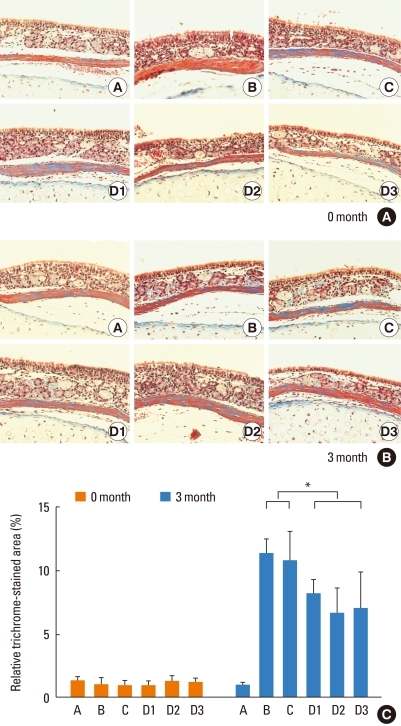
Repetitive intranasal inhalation of OVA resulted in significant increases in eosinophil infiltration, subepithelial fibrosis, goblet cell count, and MMP-9/TIMP-1 expression. Administration of SU1498 or AG1296 prevented these abnormal responses.
The results of this study suggest that a causal relationship may exist between angiogenic factors and nasal airway remodeling in AR. Inhibition of VEGF or PDGF receptors may, in turn, suppress the remodeling process through the regulation of MMP-9/TIMP-1 expression.
越来越多的证据表明变应性鼻炎(AR)中存在鼻气道重塑。尽管血管生成是哮喘气道重塑的重要组成部分,但对其在 AR 中的作用研究甚少。此外,关于血管内皮生长因子(VEGF)和血小板衍生生长因子(PDGF)等强效血管生成因子在鼻气道重塑过程中的作用的信息也很有限。本研究旨在探讨 VEGF 和 PDGF 在鼻气道重塑中的作用,并评估抗血管生成药物在 AR 小鼠模型中对该过程的预防作用。
小鼠系统致敏,每周两次接受卵清蛋白(OVA)吸入治疗,共 3 个月。对照组小鼠用磷酸盐缓冲液(PBS)进行挑战,而治疗组在每次 OVA 吸入前 4 小时通过腹腔注射给予 VEGF 受体抑制剂 SU1498 和/或 PDGF 受体抑制剂 AG1296。分别使用苏木精和伊红、Masson 三色和过碘酸-Schiff 染色分别评估鼻气道中的嗜酸性粒细胞浸润、上皮下纤维化和杯状细胞增生。还进行了基质金属蛋白酶-9(MMP-9)和组织抑制剂金属蛋白酶-1(TIMP-1)的免疫组织化学染色。
重复鼻内吸入 OVA 导致嗜酸性粒细胞浸润、上皮下纤维化、杯状细胞计数和 MMP-9/TIMP-1 表达显著增加。给予 SU1498 或 AG1296 可预防这些异常反应。
本研究结果表明,血管生成因子与 AR 中的鼻气道重塑之间可能存在因果关系。抑制 VEGF 或 PDGF 受体可能通过调节 MMP-9/TIMP-1 表达来抑制重塑过程。