Department of Primary and Community Care, Radboud University Nijmegen Medical Centre, P.O. Box 9101, 117 ELG, 6500 HB Nijmegen, The Netherlands.
BMC Geriatr. 2012 Jan 3;12:1. doi: 10.1186/1471-2318-12-1.
The effectiveness and efficiency of nursing-home dementia care are suboptimal: there are high rates of neuropsychiatric symptoms among the residents and work-related stress among the staff. Dementia-care mapping is a person-centred care method that may alleviate both the resident and the staff problems. The main objective of this study is to evaluate the effectiveness and cost-effectiveness of dementia-care mapping in nursing-home dementia care.
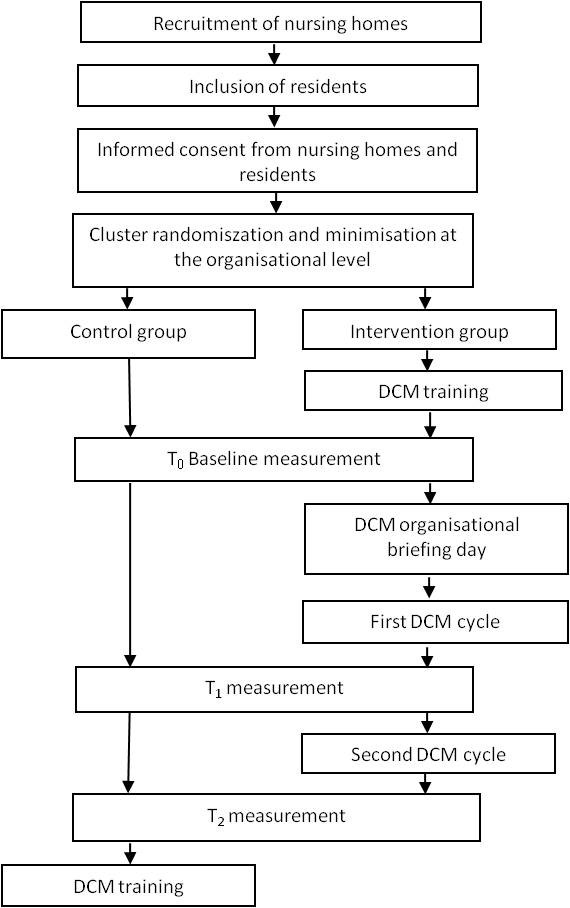
METHODS/DESIGN: The study is a cluster-randomised controlled trial, with nursing homes grouped in clusters. Studywise minimisation is the allocation method. Nursing homes in the intervention group will receive a dementia-care-mapping intervention, while the control group will receive usual care. The primary outcome measure is resident agitation, to be assessed with the Cohen-Mansfield Agitation Inventory. The secondary outcomes are resident neuropsychiatric symptoms, assessed with the Neuropsychiatric Inventory--Nursing Homes and quality of life, assessed with Qualidem and the EQ-5D. The staff outcomes are stress reactions, job satisfaction and job-stress-related absenteeism, and staff turnover rate, assessed with the Questionnaire about Experience and Assessment of Work, the General Health Questionnaire-12, and the Maastricht Job Satisfaction Scale for Health Care, respectively. We will collect the data from the questionnaires and electronic registration systems. We will employ linear mixed-effect models and cost-effectiveness analyses to evaluate the outcomes. We will use structural equation modelling in the secondary analysis to evaluate the plausibility of a theoretical model regarding the effectiveness of the dementia-care mapping intervention. We will set up process analyses, including focus groups with staff, to determine the relevant facilitators of and barriers to implementing dementia-care mapping broadly.
A novelty of dementia-care mapping is that it offers an integral person-centred approach to dementia care in nursing homes. The major strengths of the study design are the large sample size, the cluster-randomisation, and the one-year follow-up. The generalisability of the implementation strategies may be questionable because the motivation for person-centred care in both the intervention and control nursing homes is above average. The results of this study may be useful in improving the quality of care and are relevant for policymakers.
The trial is registered in the Netherlands National Trial Register: NTR2314.
养老院的痴呆症护理效果和效率并不理想:居民中有很高的神经精神症状发生率,而工作人员则有很高的工作相关压力。痴呆症护理映射是一种以人为本的护理方法,可能会缓解居民和工作人员的问题。本研究的主要目的是评估痴呆症护理映射在养老院痴呆症护理中的效果和成本效益。
方法/设计:这是一项集群随机对照试验,将养老院分组为集群。研究明智的最小化是分配方法。干预组的养老院将接受痴呆症护理映射干预,而对照组将接受常规护理。主要结局指标是居民的激越,用 Cohen-Mansfield 激越量表评估。次要结局是居民的神经精神症状,用神经精神疾病-养老院量表评估;生活质量,用 Qualidem 和 EQ-5D 评估。工作人员的结局是应激反应、工作满意度和与工作压力相关的缺勤率,以及员工离职率,分别用工作经验和评估问卷、一般健康问卷-12 和马斯特里赫特医疗保健工作满意度量表评估。我们将从问卷和电子登记系统中收集数据。我们将采用线性混合效应模型和成本效益分析来评估结果。我们将在二次分析中使用结构方程模型来评估痴呆症护理映射干预效果的理论模型的合理性。我们将进行过程分析,包括与工作人员的焦点小组,以确定实施痴呆症护理映射的相关促进因素和障碍。
痴呆症护理映射的新颖之处在于它为养老院的痴呆症护理提供了一种整体的以人为本的方法。研究设计的主要优势是样本量大、集群随机化和一年的随访。由于干预和对照组养老院的以人为本护理的动机都高于平均水平,因此实施策略的普遍性可能值得怀疑。这项研究的结果可能有助于提高护理质量,对政策制定者具有重要意义。
该试验在荷兰国家试验注册处注册:NTR2314。